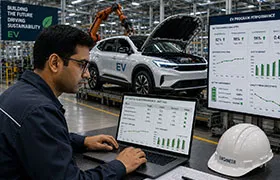
Net Zero refers to a state where greenhouse gas emissions produced = emissions removed from the atmosphere. It is the world’s most urgent climate priority, driven by the Paris Agreement’s mandate to limit warming to 1.5°C.
Unlike sustainability, Net Zero is a science-backed, data-driven, time-bound strategy, requiring:
Governments and corporations are rapidly aligning with Net Zero pathways:
Today, Net Zero is not optional-it is a requirement for:

Global momentum toward Net Zero is accelerating, with leading companies such as Microsoft, Google, Apple, Unilever, Tata Steel, Mahindra Group, and IKEA committing to science-aligned decarbonisation targets. Cities and communities are also adopting clean mobility, renewable energy, and climate-resilient development plans. Platforms like ZeroTracker track these commitments and provide real-time data on which organisations are making measurable progress toward Net Zero.
Exploring the 6 Pillars of Net Zero Transformation
Net Zero is a systems transition, spanning energy, finance, technology, policy, and nature-positive solutions. Below are the foundational pillars shaping the world’s Net Zero future.
Renewables | Electrification | Hydrogen | Storage
Industries are shifting from fossil-fuel dependency toward clean grids, low-emission processes, electrified transport, and hydrogen ecosystems.
Key drivers include:
.jpg)
GHG Protocol | Life Cycle Emissions | Digital MRV
Accurate emissions measurement is core to every Net Zero roadmap. Leaders must quantify direct (Scope 1), energy-related (Scope 2), and value-chain emissions (Scope 3), which can represent 70–90% of total emissions.
Key skills:
.jpg)
Material efficiency | EPR | Circular manufacturing
Circularity accelerates Net Zero by reducing waste, improving material use, and decarbonising supply chains.
Impact areas:
.jpg)
ETS | Voluntary carbon markets | Green bonds
Financial systems are aligning with climate goals, creating new markets and investment opportunities:
Leaders require skills in carbon pricing, trading, risk modelling, and green financial instruments.
.jpg)
Direct Air Capture | Biochar | Mineralisation
Net Zero cannot be achieved through emission reduction alone. Removal technologies, engineered and nature-based, play a crucial role.
Global trends:
.jpg)
Afforestation | Mangroves | Regenerative agriculture
NbS contribute up to 30% of climate mitigation potential, supporting:
.jpg)
Professionals need interdisciplinary climate, technology, and strategy skills:


.webp)
Net Zero is now a core strategic capability across industries.


Categories and roles include:
Ideal Audience for Advanced Climate & Decarbonisation Related Programs


Ideal for anyone asking:
“How do I build a measurable, science-led, investor-ready Net Zero pathway?”
.jpg)
Focus On


As Net Zero commitments accelerate across governments, corporations, and financial markets, the demand for strategic climate leadership is rising globally. Programs focused on Net Zero strategy, sustainability management, climate finance, and energy transition are now essential for professionals who need to navigate complex regulatory landscapes, drive decarbonisation initiatives, and lead organisational transformation. These programs blend climate science, policy, technology, and business strategy, equipping leaders with the expertise to design measurable Net Zero pathways, manage climate risks, and unlock new opportunities in clean technologies, carbon markets, and circular economy systems. For mid-senior professionals, such programs offer a future-proof skillset and a competitive edge in a rapidly evolving climate economy.
IIM Kashipur PG Executive Program in Net Zero Strategy & Sustainability Leadership
This program is India’s most advanced Net Zero and sustainability leadership track, preparing professionals for roles in:
Designed for mid-senior professionals across industries.
.webp)
.webp)
.webp)
.webp)


.webp)
.jpg)
.jpg)

%20(1).webp)