
People think of green jobs growth as something they’re waiting for in the future. That’s not the case. The reality is that the green jobs growth is happening now, and the hiring demand is exceeding the pool of talent to fill the roles. For anyone who has been asking whether it’s worthwhile to study for an EV technology course in India, this growing need for skills will be their answer.
Net-zero targets are more than a goal anymore. They’ve moved from just being policy goals to becoming tangible infrastructure projects, vehicle fleets, and logistics changes. Each one of these efforts will require people who know how to apply electric mobility knowledge.
This blog explains why skills in EV technology for net-zero careers are now essential, what specific skills companies seek, and how India fits into the trend.
The figures speak for themselves. As per the study carried out by Taggd in 2025, green hiring increased by 7.7%, from 2024 to 2025, whereas green skills supply increased by only 4.3%. The disparity will not resolve itself. With each additional net-zero pledge, it increases.
However, this boom in greener job creation has touched upon all the expected industries, such as energy and automotive and even those that seem to be far away from green jobs, such as finance, logistics, and real estate. After all, any sector with plans for decarbonization needs staff members who are well acquainted with the meaning of decarbonization at work.
This trend requires immediate action, as there are more and more pledges signed by companies in their commitment to net zero, while there are fewer graduates skilled enough to put them into action.
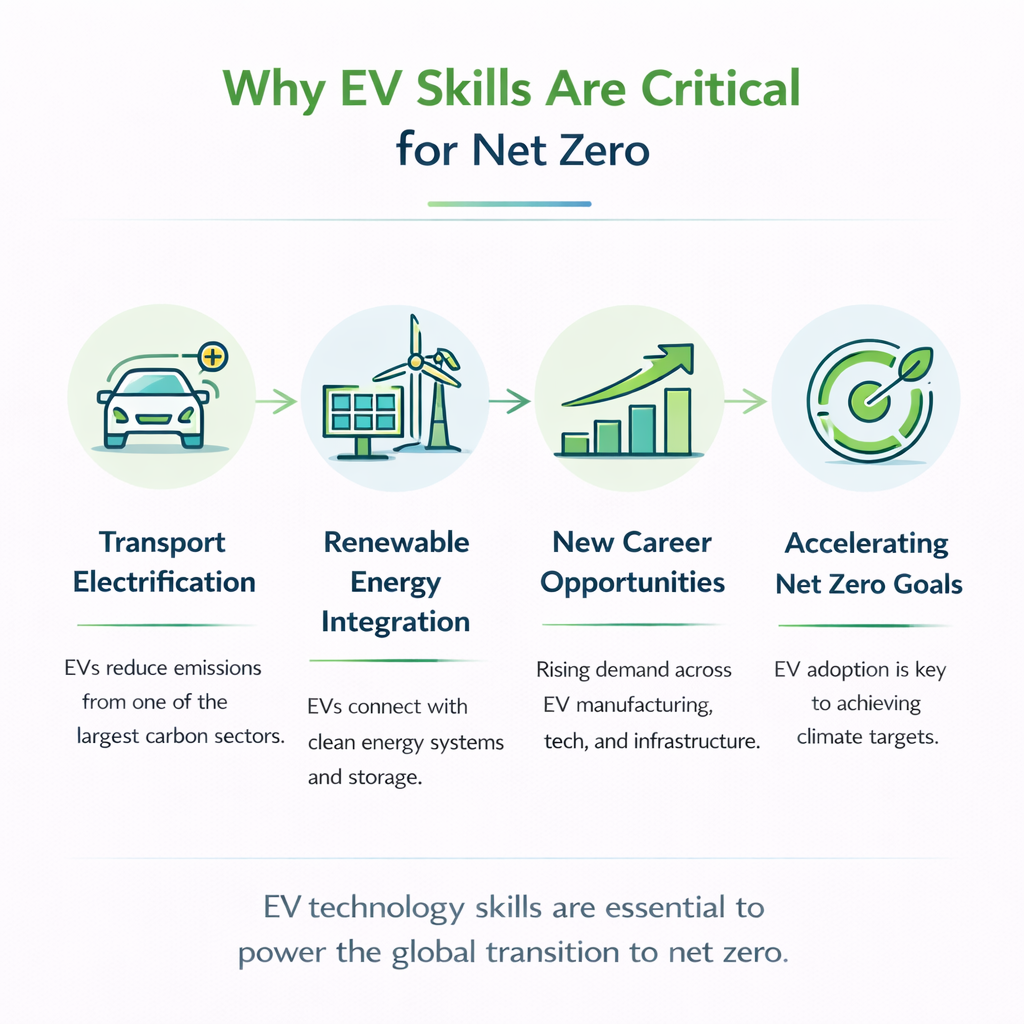
Greenhouse gas emissions related to transport make up a substantial portion of the total emissions, making electrification one of the most evident solutions to reduce them. That is why joining a net-zero EV career in 2026 might be a very specific opportunity to join the climate workforce.
In terms of road transport, greenhouse gas emissions make up 16% of the global CO2 emissions. It is absolutely vital to switch from traditional fuels to electric cars if the goal of reaching net-zero emissions is relevant. That is why the huge shift of road transport to the use of electric technologies becomes a huge challenge and leads to the demand for skilled people.
An electric car requires specific knowledge about the car itself and related infrastructure. Thus, those who understand how to charge and manage car batteries become a part of the climate professionals' community.
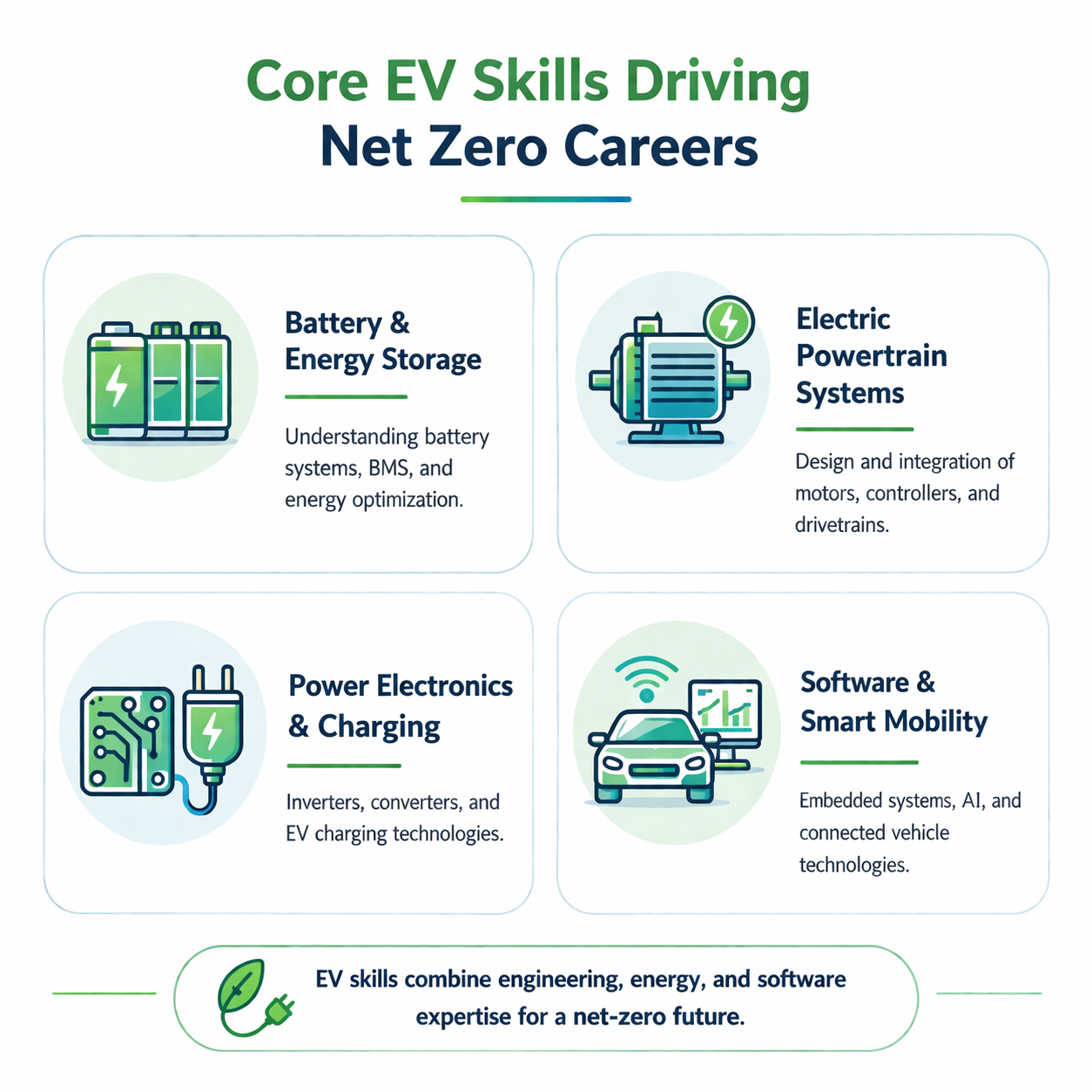
The skillset employers are looking for is broader than most candidates expect. It spans three main areas:
These are the fundamentals. Working knowledge must be acquired of:
Technical skills alone won't do the trick. Employers seek employees who work at the interface of engineering and public policy:
The current EV industry is all about data. Engineers and analysts capable of working between different software programs are much more likely to get hired:
The Indian electric vehicle market is developing much faster than any of us would have imagined even a decade ago. Government policies, incentive plans linked to production, and escalating fuel prices are some of the factors that have driven its adoption.
The uniqueness of India as a source for talent lies not just in its own market but in the sheer size of the engineering graduate workforce, lower training costs, and increasing opportunities for exporting the skills of producing EV components and software. Many multinational EV companies have begun to recruit engineering talent from India for positions other than domestic needs.
e-mobility jobs India 2026 is definitely not an empty hope. There's a lot of development going on in terms of the OEM presence, startups, and skill initiatives by the government to create a talent pipeline in the coming years.
Up to 35 million jobs can be created in the green sector by 2047, according to an analysis by Mongabay India in 2025. However, as per the report, skill and awareness augmentation alone remain the most critical factor determining success in realising this possibility.
The current educational system needs interdisciplinary training because it requires this approach to create competent professionals. The job candidates for these positions will receive training in both mechanical engineering and environmental sciences.
The candidates will have expertise in multiple fields, including expertise in data science, economics and policy studies. The industry demands specific skills that interdisciplinary programs in EV studies develop through their educational approach.
The industrial sector needs engineers who possess hybrid skills and sustainability experts with technological knowledge and data scientists who specialise in energy studies. This particular situation is typical. The fundamental purpose of the Net Zero careers upskilling program exists in this particular practice.
The need for EV technology skills for net-zero careers is not just a hypothesis but a proven fact. The statistics on hiring trends speak volumes, the regulatory framework is in place, and the infrastructure development is well underway. It's the lack of qualified personnel that creates the gap, which is why this is exactly the time when upskilling can make all the difference.
If you're a technician interested in transitioning into electric vehicle technology or a sustainability specialist aiming to get into more practical aspects of the business, or even a recent graduate still searching for a career path to follow, electric vehicles are one of the most obvious solutions.
The evACAD training course focuses specifically on the field of electric vehicle technology and e-mobility, offering training modules for people who are ready to build their careers in the areas relevant to the future.


.webp)
.jpg)
.jpg)