Three years of experience, an engineering degree, and a hunger to venture into the EV industry, but every time you look out for an M.Tech course, this acronym GATE pops up everywhere. But guess what? This roadblock is already cleared!
The EV sector in India is witnessing rapid growth. In FY2026, there were sales of 24.52 lakh EVs, showing a growth of 24.6% annually [1]. Given this huge growth rate, there is a requirement for engineers who have specialisation in batteries and the powertrain system, along with policies for them. This is understood by all Indian IITs.
Various colleges such as IIT Bhubaneswar, IIT Madras, and IIT Bhilai offer M.Tech EV technology programs without any GATE program, and these programs are designed for those who want to upgrade themselves. Such programs will enable you to earn a complete M.Tech degree while continuing with your job in the organisation. This blog will take you through various aspects of such a program.
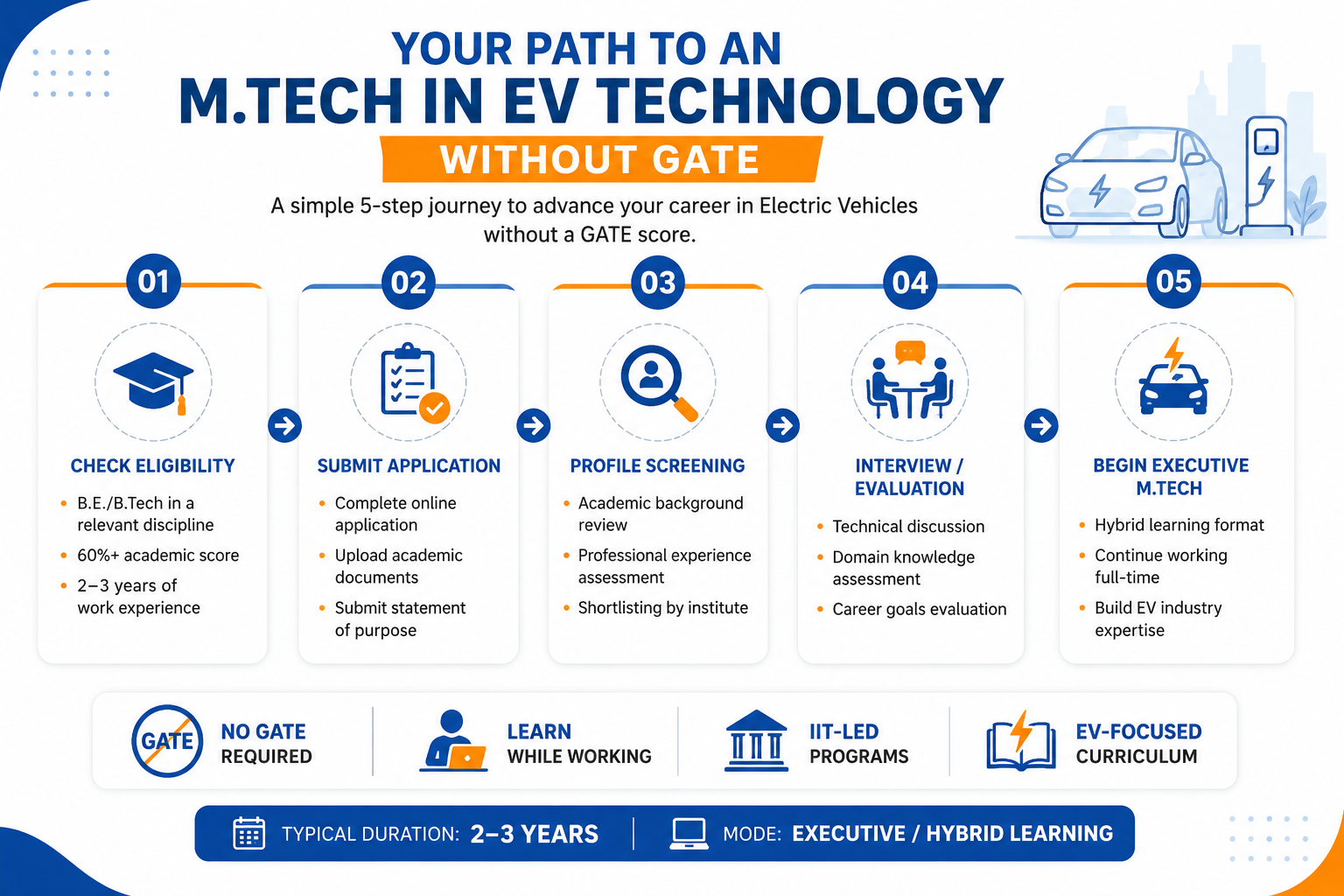
And yes, it is not a loophole either. There have been multiple IITs that have introduced the executive and hybrid M.Tech programmes where GATE is not a prerequisite at all. As an example, one can refer to the 2026 admission process of the IIT Bhubaneswar, which states that no GATE score is required for their new programme called EV Technology [News 1].
Such courses are aimed at people who already have industrial experience in this field. The explanation is quite obvious here since, after years of problem-solving in engineering, standardised scores will not reflect your true ability to do things.
In the format of Executive M.Tech in EV Technology, the courses usually take two to three years. They involve online study coupled with brief periods of visits to the campus. You won't have to leave your job or change your location.
The M.Tech in EV Technology eligibility criteria are straightforward, but they vary slightly between institutions. Here's what most programmes ask for:
In the case of the IITs, such as IIT-Bhilai and IIT-Madras, applications can be made even without having the necessary background, because the job industry itself may have significance in your career path irrespective of whether the degree is related to the field of employment.
This condition of work experience must not be ignored. Apart from being an administrative process, this factor may prove to be significant enough for the selection committees to take into account.
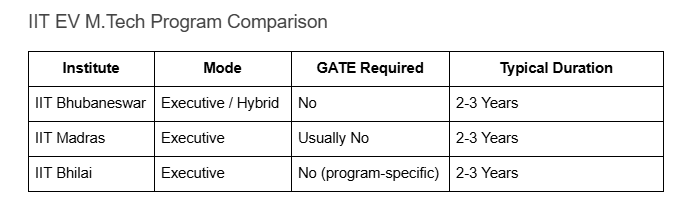
Applicants should always verify the latest admission notification, as eligibility requirements may change between admission cycles.
The process is simpler than you'd expect. Most programmes follow a four-step flow:
Deadline dates change every year, so you should start checking the portal from March/April onwards. For IIT Bhubaneswar’s session 2026, the application process began in June [News 1].
Money matters. The cost of M.Tech in EV Technology is always an important point, especially among self-sponsored candidates. Comparison is as follows:
The above figures may vary depending on each admission year. Always check the official notice of the institution. Moreover, some courses also give the option for instalment payment, which is useful if your employer is not sponsoring your education.
Compare this with the full-time M.Tech, in which you have lost two years of salary. In the end, you will find that the executive path is much more financially viable.
Besides educational expenses, there is the ROI consideration. With an Executive M.Tech in EV Technology, engineers are able to continue working and pursuing their education at the same time; hence, no loss of income due to the break from work which one faces in full-time postgraduate courses. It is beneficial for professionals looking to work in the field of EV research, design, and development.
The Executive M.Tech in EV Technology program employs a hybrid mode of learning. This implies that live sessions, recordings of lectures, and limited campus visits are combined.
The program typically covers four to five courses related to Battery Management Systems, Drivetrain Engineering in Electric Vehicles, Power Electronics, Charging Infrastructures, and Policy Frameworks for Electric Vehicles. There is also a dissertation project on a topic relevant to your work or a particular situation in the industry.
Campus visits take about one to two weeks during each semester and enable you to visit labs, meet faculty members in person, and discuss your research project.
The main benefit here is the application of knowledge right from the start of the course. If you are an employee at an auto components manufacturing plant, then the dissertation would likely bring positive changes to your organisation.
Companies that operate in various facets of EV development are seeking individuals who have knowledge in BMS systems, power electronics, electric powertrains, chargers, embedded systems, and energy storage technologies. Having an engineering background combined with the skills listed above positions one for success in such a role.
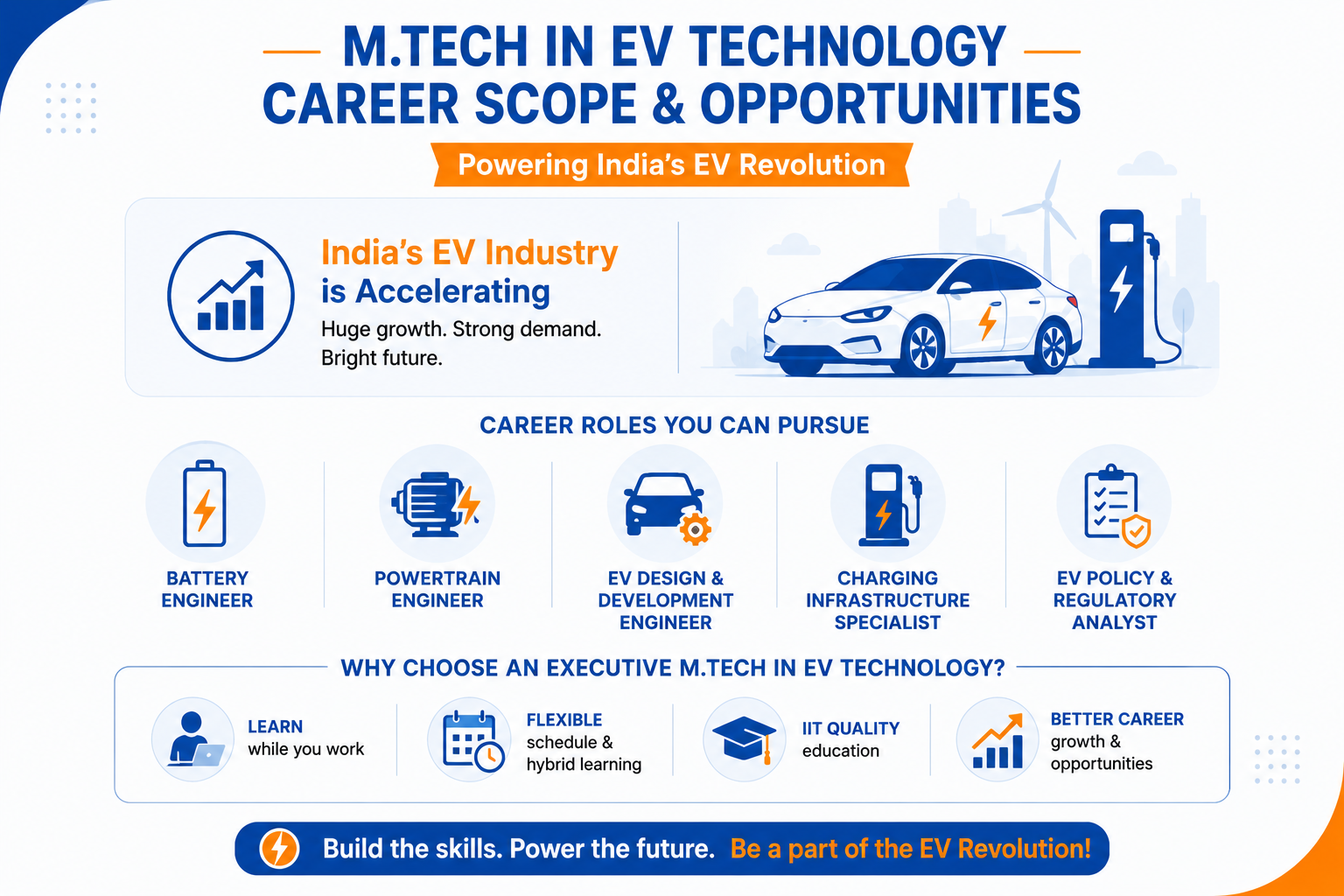
The development in the electric vehicle supply chain in India has been taking place at quite an accelerated rate. The investments totalling INR 25,000-30,000 crore would be made solely by the auto component sector in FY26 to cater to capacity building and manufacture of EV components [3]. As many as 28 lakh units of EVs have been delivered through the PM E-DRIVE scheme till February 2026 [2].
As a result of having obtained the degree of M.Tech, there is scope for taking up different career options, including:
The value of the degree provided by IIT cannot be underestimated. Thanks to your prior experience, you will be able to prove that you not only mastered the theory but also encountered difficulties in practice.
The course would prove especially fitting for individuals working in automotive engineering, manufacturing, power systems, electronics, renewable energy, and other relevant fields and who wish to develop their skills in the domain of electric vehicle technology without having to quit their job.
Industry Viewpoint
The rise of Executive M.Tech in Electric Vehicle technology is indicative of a wider shift in workforce dynamics within both the automotive and energy industries.
As the use of EVs continues to become mainstream, companies are finding that they require professionals who are able to make links between traditional engineering principles and new technology areas, including batteries, power electronics, charging systems, and energy management.
For professional engineers, postgraduate education is not only a means of attaining qualifications but also keeping abreast of trends.
Getting an M.Tech EV Technology without GATE is not a half-measure but a well-thought-out route for those looking to develop without leaving work behind. The admission requirements are generally more focused on academic background and professional experience than GATE performance. The tuition fees are fair considering what you receive in return.
The development of electric vehicles is currently gaining traction in India, and the possibility to get ahead in the field remains. Be it about changing your professional specialisation, climbing higher corporate ladders or heading R&D teams in the future - all that starts here.
If you are interested in researching particular courses and comparing the options available, evACAD’s materials on Executive M.Tech in EV Technology can be helpful.
[1] Over 28 lakh electric vehicles have been sold under the PM E-DRIVE scheme as of February 2026, including over 20 lakh electric two-wheelers and nearly 3 lakh electric three-wheelers. (Source: Union Minister HD Kumaraswamy via All India Radio, February 2026)
[2] India's auto component industry will see INR 25,000-30,000 crore investment in FY26 for capacity expansion and EV parts. (Source: IBEF, 2025)