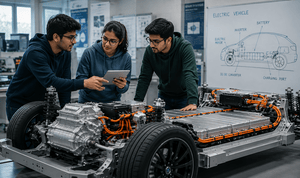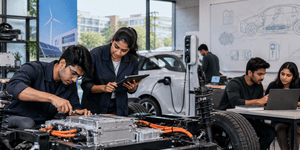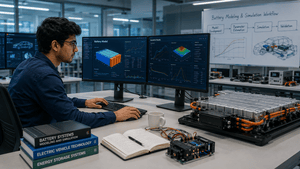
In general, the majority of people tend to perceive an electric car as just a car which operates on the basis of a battery pack. However, it is similar to considering a smartphone as nothing else but a display screen with a telephone. In reality, any electric vehicle works on the basis of a precisely coordinated system of EV components.
According to projections, the market for India's electric vehicle components will have eight times growth rate over the period from 2025 up to 2032, going up from Rs 41,000 crore in 2025 to Rs 3.55 lakh crore by 2032 [1]. Such growth cannot be connected with a regular type of product, but rather with a sophisticated, dynamic and career-oriented technology behind it.
This guide is going to reveal all the secrets of the major electric vehicle parts. Irrelevant of your status being a student of engineering, a working professional willing to explore the world of EV careers or just a curious individual, you are going to receive a clear understanding of how EV components function.
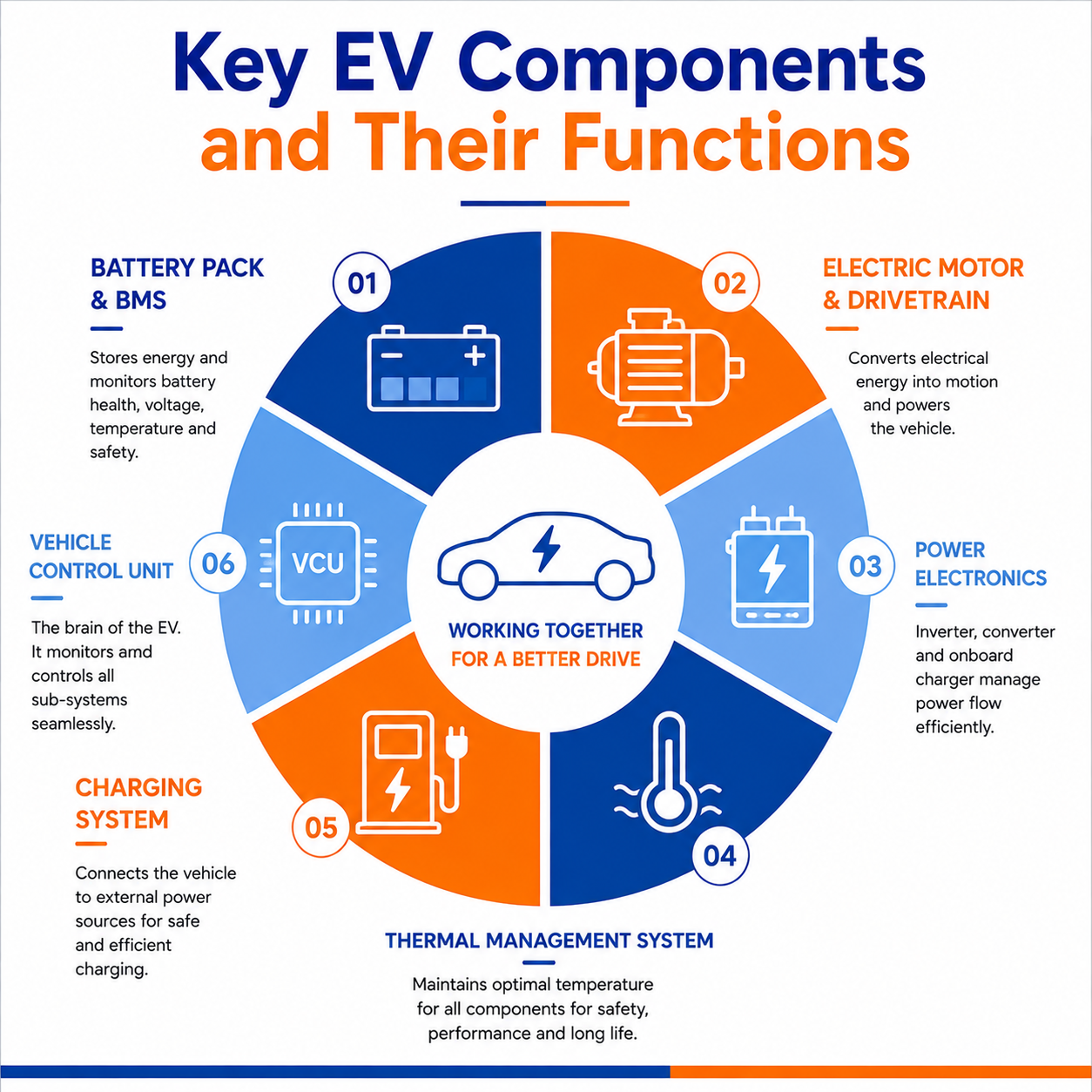
All electric vehicles are made up of various basic subsystems. This group of components that form an EV subsystem helps to provide energy storage, conversion, and safe operation of the vehicle. The following are the main ones:
The sales of EVs in India were at 24.52 lakh units in FY2026, marking an increase of 24.6% from the previous year [2]. All these vehicles require all these components to work in harmony. To give an analogy, consider a cricket team. If one batsman is not up to mark, the entire game is affected.
The battery pack happens to be the costliest of all EV parts within any electric vehicle. It contains the power source for all other parts. In modern EVs, the battery comprises lithium-ion cells placed together in modules.
However, a battery without a control mechanism is a hazard. The BMS regulates cell voltage, temperature, and state of charge in real-time. It avoids overcharging, regulates thermal management, and increases the battery's lifespan. If you have ever seen your mobile phone battery swell up due to excessive usage over many years, then that is precisely what the BMS avoids.
The India EV components market is estimated to be worth USD 7.80 billion in 2025 and expected to touch USD 28.50 billion in 2030 [3]. Battery systems comprise the biggest portion of this number.
An electric motor converts electrical energy into movement. The most common types of EV motors include permanent magnet synchronous motors and induction motors.
EV motors are fascinating due to their unique ability to use regenerative braking. Once the driver stops pressing the accelerator pedal, the motor switches its functions and becomes a generator of the energy that is converted from the vehicle's kinetic energy and stored in the battery. The use of regenerative braking extends an EV’s driving range by about 10 to 15%.
The Indian market for EV motors was estimated at USD 0.54 billion in 2025. By 2032, it is expected to grow to USD 1.43 billion with 14.8% CAGR [4].
Power electronics are the nervous system of the electric vehicle. The inverter is the device that transforms DC energy stored in the battery into AC energy consumed by the motor. The DC-DC converter is responsible for reducing the voltage from the battery to 12V to operate the vehicle accessories. The onboard charger controls AC charging from the mains or public facilities.
It is not very exciting information, but it decides on the efficiency of your energy utilisation. A bad inverter will drain your energy regardless of how good your battery is.
All of these components produce heat. The thermal management system ensures that each part is working within its safe operating limits. Thermal energy management includes the use of liquid loops and heat exchangers. In some cases, heat pumps may be used to manage the flow of thermal energy.
The fact of the matter is that thermal management is absolutely essential in India, where temperatures regularly exceed 45°C. Without it, a battery could degrade in three years instead of eight.
The charging system is the connection between the electricity grid and the electric car. The system consists of the charging port, onboard charger, and communications protocol that communicates with outside stations. DC fast charging systems do not need an onboard charger at all but rather charge the battery directly.
The PM E-DRIVE system has helped sell more than 26.54 lakh EVs by July 2026 [5]. The government support in this form helps promote the development of charging stations and subsequently makes all other EV components more practical in their daily lives.
The vehicle control unit (VCU) acts like the brain. The VCU will take information from the BMS, motor controller, thermal system, and driver input and make decisions on how much torque is required, when regenerative braking should be used, and energy allocation.
Today’s VCUs have highly complex software algorithms based on learned driving behaviours. This is where mechanical engineering meets embedded systems and data science. This is where things get really interesting for engineers looking at entering the electric vehicle industry.
Knowledge of electric vehicle components is not just a piece of theoretical knowledge anymore. As the market for EV components in India is experiencing a growth rate of almost 30% CAGR [3], all the subsystems that we have discussed become a source of professional or business opportunity, or both.
The amount of engineering that goes into the design of one electric car is amazing. The people who know how EV components work together will drive the next ten years in the Indian transportation sector.
If you are serious about acquiring knowledge about electric vehicle components, then structured learning becomes essential. evACAD presents special courses on battery systems, EV design, thermal management, and control systems for engineers.
1. India's EV components market projected to grow eight-fold from Rs 41,000 crore (2025) to Rs 3.55 lakh crore by 2032 - Source: IESA and Customised Energy Solutions, IESW 2026 - https://www.autoguideindia.com/reports/india-ev-components-market-growth-report-iesa-ces-iesw-2026/
2. India's EV sales reached 24.52 lakh units in FY2026, a 24.6% YoY increase - Source: FADA, April 2026 - https://evreporter.com/indias-electric-vehicle-sales-trend-june-2026/
3. India EV components market valued at USD 7.80 billion in 2025, projected to reach USD 28.50 billion by 2030 at 29.58% CAGR - Source: Marqstats Intelligence, April 2026 - https://marqstats.com/reports/india-ev-component-market/
4. India EV motor market valued at USD 0.54 billion in 2025, projected to reach USD 1.43 billion by 2032 at 14.8% CAGR - Source: MarkNtel Advisors - https://www.marknteladvisors.com/research-library/india-electric-vehicle-motor-market.html
5. PM E-DRIVE scheme supported sale of 26.54 lakh EVs as of July 22, 2026 - Source: Ministry of Heavy Industries, August 2026 - https://www.aninews.in/news/business/government-says-pm-e-drive-supported-sales-of-over-265-lakh-evs-pushes-indigenous-manufacturing-charging-infrastructure20260804153448/