Five years ago, if you were to suggest mechanical engineering graduates specialising in electric vehicles, you could expect an amused response from them. Fast forward to today, and you will see that they are competing to get into an EV course.
Now, the numbers that make sense: By 2030, India's electric vehicle industry is set to create a demand of around 30-40 million jobs, whereas there is already a shortage of 20-25% skilled manpower [1]. There is no way out of this unless trained professionals are on board. And that too soon.
In this guide, we will discuss the top EV courses in India for 2026. From certification courses to M.Tech degree and PG diploma courses, this guide covers everything that you need to know before joining one of these courses.
In FY2026, the sales of electric vehicles in India were 24.52 lakh, which is 24.6% more compared to the previous year [2]. The growth is still continuing, and it’s increasing the need for engineers, designers, and technicians along the whole value chain.
The issue? Around 35 percent of India’s ICE engineers will not be able to do anything in the EV industry until they undergo further training [3]. Though there may be some commonality between ICE technology and electric drive train technology, both fundamentally belong to entirely different technologies altogether.
An electric vehicle course with a certificate is exactly what you need.
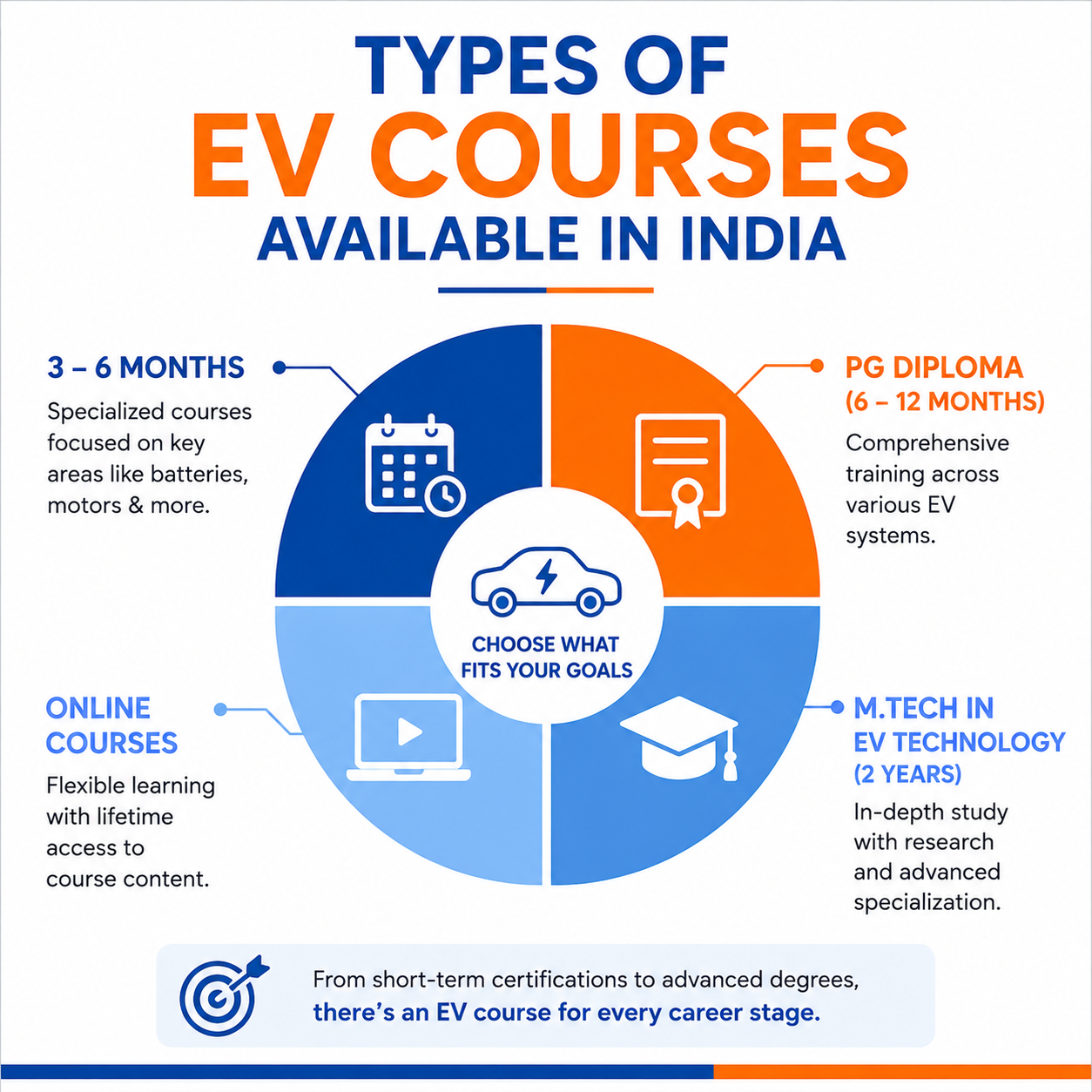
The EV course market in India has matured significantly. You're no longer stuck choosing between a vague online tutorial and a four-year degree. Here's what's available today:
For the person handling a job and pursuing education, flexible learning programs carry a lot of weight. For students interested in specialising in something, a Post-Graduation diploma or an M.Tech would help to achieve their purpose.
All electric vehicle certifications are not made equal. Before applying, make sure that your curriculum includes practical tools used in the industry. For example, MATLAB, Simulink, and battery simulation software should be covered in your classes, rather than being theoretical PDFs.
Try finding a program that involves practical work or case studies. Knowing something about regenerative braking from books is one thing. But building a model for it is completely another matter. Don’t forget to research the credentials of your instructors. Someone who has designed algorithms for BMS at an OEM will approach classes very differently.
According to the prediction, India’s EV market will be worth USD 61.15 billion in 2026, with USD 277.51 billion by 2035 [4].
Completing the EV course is just the beginning, not the end. How your career unfolds will depend on which subsystem you choose to specialise in.
If you have an interest in battery engineering, you can work on cell designs, integration, and thermals. If you prefer motor control engineering, then you will be working to increase the efficiency of the drivetrain. For power electronics engineers, their primary responsibility is to work on inverters and converters. If you're into embedded systems engineering, your work will involve writing software. In each of these streams, your career will take you places at OEMs, T1s, and EV companies.
A certification program will be your easiest route to enter the industry if you are a final-year engineering student. This will give you a specialisation right away on your resume before even attending any interviews. Choose a focused specialisation like battery technology or design integration of EVs
Those professionals who have worked in the automotive industry for 2 to 5 years can opt for PG diplomas. These provide enough knowledge to shift careers without having to go through an entire master’s degree program. The M.Tech degree in electric vehicle technology will help professionals to pursue a career in leadership or research roles.
The EV course you enrol in today plays a vital role in determining your future job prospects. The EV industry in India is not waiting around for its talent pool to develop; instead, it is expanding at an impressive 24.6% annually [2]. Professionals who enrol in systematic courses today will take precedence in these jobs.
It doesn’t even matter how long you stay in the course or how many certifications you get in those few months or weeks. The bottom line is that you learn skills that will be appreciated by your future employer. This is what simulation, projects, and practical knowledge in the industry can give you.
Are you interested in getting them? evACAD offers you certification, PG and M.Tech courses focused on the EV industry. All kinds of courses on anything related to the battery system and EV vehicles are offered there.
1. India's EV industry projected to create 30 to 40 million jobs by 2030, talent lags demand by 20 to 25% - Source: pv magazine India, August 2026 - https://www.pv-magazine-india.com/2026/08/05/indias-ev-industry-to-create-30-40-million-jobs-by-2030/
2. India's EV sales reached 24.52 lakh units in FY2026, 24.6% YoY growth - Source: FADA, April 2026 - https://evreporter.com/indias-electric-vehicle-sales-trend-june-2026/
3. 35% of India's ICE-trained workforce not directly transferable to EV roles without reskilling - Source: pv magazine India, August 2026 - https://www.pv-magazine-india.com/2026/08/05/indias-ev-industry-to-create-30-40-million-jobs-by-2030/
4. India's EV market projected to reach USD 61.15 billion in 2026, growing to USD 277.51 billion by 2035 - Source: Market Research Future - https://www.marketresearchfuture.com/reports/india-electric-vehicle-market-12671