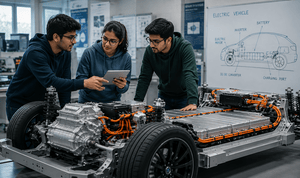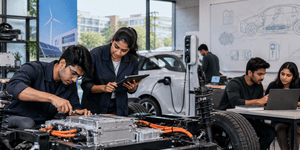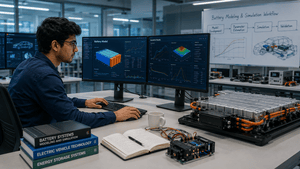
Just imagine having spent two years designing a battery pack and then having realised that it overheats when charging it fast after physical tests. It is not a hypothetical scenario but one that is likely to occur if you don't do the simulation but jump directly to the prototyping stage. Battery modelling comes exactly for that purpose to avoid costly mistakes.
The global battery modelling and simulation software market was valued at USD 41.22 million in 2025. The market is expected to hit USD 67.14 million by 2032 with 7.21% CAGR [1]. These figures may look small compared to the size of the EV market itself, but it is the software layer behind all other processes.
This guide will tell you about battery simulation as the actual process, what software engineers use to perform it, what industries apply it and how to start a career in this field.
Battery modelling is the creation of models through mathematics that help understand the working behavior of batteries under various conditions and predict their voltages, currents, temperatures, and degradations in charging and discharging modes.
So why does it matter? This is because physical testing of battery packs is costly and time-consuming; one can end up spending lakhs on building one pack for a prototype. Simulation is helpful for engineers because it allows testing of several designs virtually instead of physically spending months or even years iterating.
A paper published by SAE in 2026 proves that simplified forms of battery modelling can actually provide an accurate result for vehicle simulation, helping reduce calculation time and overall costs of production [3].
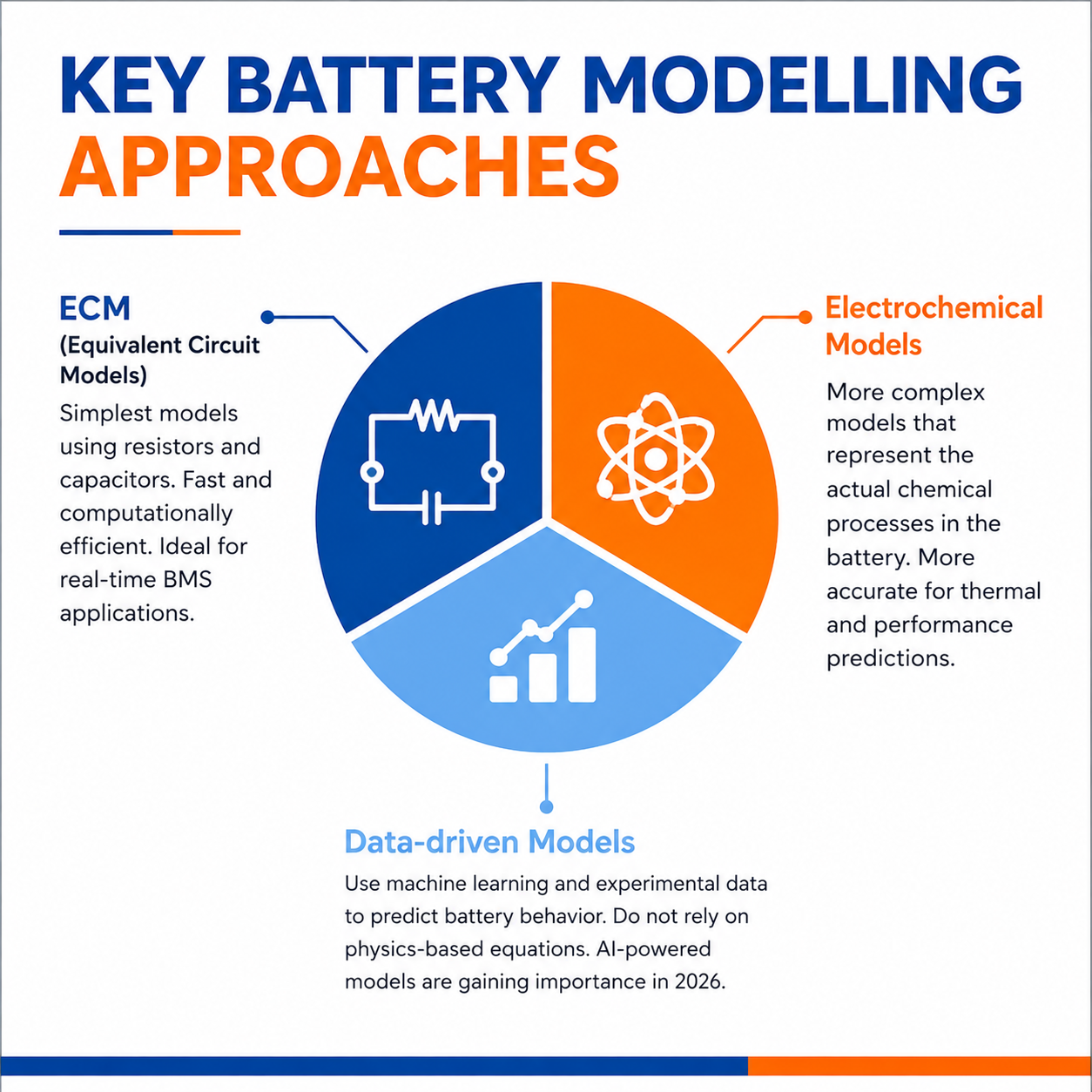
ECMs are the simplest models. Batteries are modeled througmodelledbination of resistors and capacitors. They are computationally efficient, very fast, and most suitable for real-time BMS applications.
Electrochemical models are somewhat more complex in nature. Electrochemical models are the real representation of the process taking place in the battery cell through lithium ion flow, electrode kinetics, and electrolyte behavior. They are more complex than ECMs but at the same time, more precise in their predictions for thermal behavior.
Data-driven models are based on machine learning and need data gathered through experiments. They do not demand any knowledge of the physics behind it, but lots of high-quality data. AI-powered battery models will become one of the most important techniques in 2026.
Engineers who work on battery simulation utilise various proprietary and open-source software packages. The choice of software varies according to the level of modelling and applications. Below is the list of the top ones being used in 2026:
• MATLAB and Simulink: industry standard for BMS algorithms and pack-level models [2].
• COMSOL Multiphysics: detailed electrochemical and thermal simulations.
• AVL CRUISE M: vehicle-level energy and powertrain simulations.
• PyBaMM (Python): open-source, flexible, gaining traction in research.
• GT-SUITE: system-level modelling for thermal and fluid interactions.
For engineers starting MATLAB battery modelling is the safest bet for industry readiness. PyBaMM is excellent for building conceptual understanding without licensing costs.
Battery Simulation is the practice used by OEMs to optimize the design of battery packs before the start of manufacturing. The cells can be tested for various combinations, cooling techniques, and even safety margins using simulations. It cuts down the number of prototypes and saves months in the development process.
Manufacturers of battery cells use simulations to understand the chemistry of electrodes and manufacturing aspects to improve energy density and cycle life. Companies that manufacture charging stations simulate how batteries behave when subjected to fast charging patterns. Fleet operators even use simulations to know when batteries need replacement.
In India, where the EV industry is expected to provide 30 to 40 million jobs by 2030 [5], battery modelling is becoming a crucial aspect of the industry.
Availability of special EV talent remains behind industry requirements in the field of battery science and electrochemistry by 20 to 25 percent [4]. This shortage is especially evident in the case of battery modelling, which implies the intersection of electrochemistry, mathematics, and software skills.
The career choices are wide and include but are not limited to battery simulation engineer, BMS algorithm developer, thermal simulation engineer, and cell design engineer. There are job opportunities in organizations such as Tata Motors and Mahindra, which include manufacturing organizations, battery organizations, and research and development centers throughout the globe, especially in India.
The salary for battery simulation engineer jobs with 3 to 5 years of experience ranges from 12 to 25 LPA.
Get the basics covered first: electrochemistry, circuitry, and heat transfer. Otherwise, there would be no point to the simulation software. After that, select an environment and get to work.
Learn from existing datasets in batteries. Construct your own equivalent circuit model for it. Verify it against actual experimental data. It will look a lot more impressive in your CV than just a certification course.
Battery modelling goes beyond mere technicality. It is the bedrock of safe, efficient, and economical design of electric vehicles. All the battery packs driving around in today's world have been simulated even before they were manufactured.
The career opportunity that comes from this is clear and burgeoning. In the face of the rapid expansion of the electric vehicle industry in India and shortage of specialised talent [4], engineers with the ability to model batteries will be in high demand in the coming years.
For those interested in acquiring such skills systematically, evACAD provides courses on topics like battery systems, EV modelling and simulation, and others.
1. Global battery modelling and simulation software market estimated at USD 41.22 million in 2025, projected to reach USD 67.14 million by 2032 at 7.21% CAGR - Source: 360iResearch, June 2026 - https://www.360iresearch.com/library/intelligence/battery-modeling-simulation-software
2. MATLAB remains the go-to platform for battery models and BMS control algorithms in 2026 - Source: Intercalation Station, February 2026 - https://intercalationstation.substack.com/p/a-whos-who-guide-to-battery-modeling
3. SAE paper demonstrating simplified battery models for full vehicle simulations - Source: SAE International, April 2026 - https://saemobilus.sae.org/papers/optimizing-ev-battery-models-full-vehicle-simulations-2026-01-0389
4. Specialised EV talent availability lags industry demand by 20 to 25% across battery sciences and electrochemistry - Source: pv magazine India, August 2026 - https://www.pv-magazine-india.com/2026/08/05/indias-ev-industry-to-create-30-40-million-jobs-by-2030/
5. India's EV industry projected to create 30 to 40 million jobs by 2030 - Source: pv magazine India, August 2026 - https://www.pv-magazine-india.com/2026/08/05/indias-ev-industry-to-create-30-40-million-jobs-by-2030/