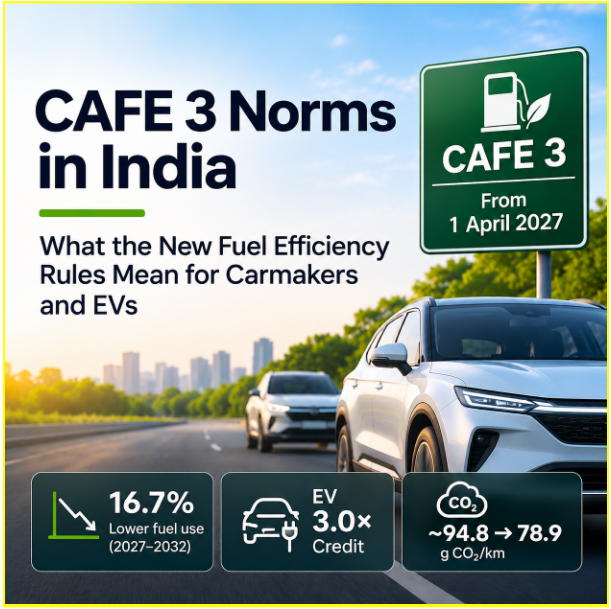
What changes for car companies, and for the engineers who work in them, when the third round of CAFE 3 norms starts on 1 April 2027?
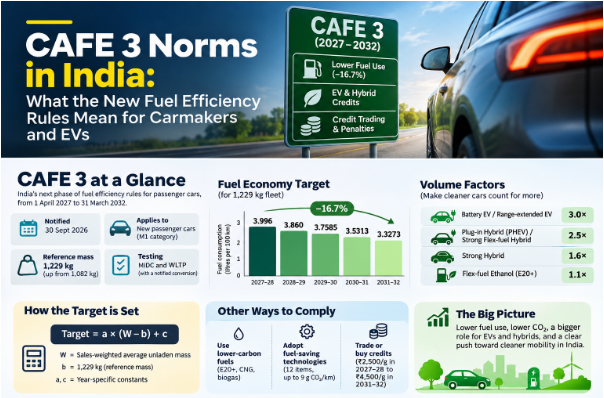
The CAFE 3 rules in India will lower gasoline consumption for an average new car by over 16.7% over five years, from 3.996 litres per 100 km in 2027-28 to 3.3273 litres per 100 km in 2031-32. Here, CAFE stands for Corporate Average Fuel Economy. The rule judges a carmaker's whole year of sales, not single models. The Ministry of Power notified CAFE 3 on 30 September 2026, and it covers new passenger cars made or imported for sale from 1 April 2027 to 31 March 2032, according to the Press Information Bureau (PIB). A maker that misses its target must earn or buy credits. Engine fixes alone will struggle to deliver the cut, so the sales mix has to move toward electric vehicles (EVs), hybrids and ethanol-ready cars.
CAFE 3 replaces the current fuel economy rules from 1 April 2027. It sets one target for fuel consumption for each carmaker, depending on the average weight and sales of the cars it sells.
The two test methods are the Modified Indian Driving Cycle (MIDC) and the Worldwide Harmonised Light Vehicles Test Procedure (WLTP). The Ministry of Power will notify a conversion factor between them separately, Autocar Professional reported.
Four reasons sit behind every fuel economy rule. Tailpipe pollutants such as carbon monoxide and nitrogen oxides harm health, but the Bharat Stage VI emission standards already cap them. Carbon dioxide is different. It is not toxic, but it traps heat, so the damage builds over decades. Petrol, diesel and compressed natural gas (CNG) come from fossil fuels, which are finite. And India is a net importer of oil, so its fuel bill and its foreign policy depend on supply routes it does not control.
Every fuel that contains carbon makes CO₂ when it burns, so a rule can reduce it but not remove it. Therefore, lower-carbon fuels help. Petrol is mostly octane, which has eight carbon atoms per molecule, while natural gas is mostly methane, which has one. Ethanol blended into petrol also cuts the fossil carbon that is burnt. Only a fuel with no carbon, such as hydrogen, removes tailpipe CO₂.
One trade-off makes the job hard. Cleaning the exhaust of other pollutants tends to raise fuel use, because particulate filters and similar devices add back-pressure that the engine works against. So the engine burns more for the same power. CAFE therefore works on the sales mix as well as on the engine.
The target is a straight-line formula. The Ministry of Power's July 2026 draft notification writes it as a × (W − b) + c. W is the sales-weighted average unladen mass of the maker's new cars. The constant b is 1,229 kg. The numbers a and c change every year:
A fleet that averages exactly 1,229 kg gets the c value as its target. Heavier fleets get a looser target because weight raises fuel use. Lighter fleets get a tighter one. The weight allowance shrinks each year as it falls.
Here is an illustrative maker with three models. These figures are ours, not from any company.
The sales-weighted mass is (950 × 400,000 + 1,250 × 450,000 + 1,500 × 150,000) ÷ 1,000,000, which equals 1,167.5 kg. For 2027-28 the target is 0.00158 × (1,167.5 − 1,229) + 3.996 = 3.899 litres per 100 km, or about 92.5 g CO₂/km. By 2031-32 the same fleet faces 3.247 litres, about 77.0 g CO₂/km. The maker gets no say in what buyers choose, so the target depends on the sales mix it manages to build.
What changes from the current rules?
Engines have little room left. Squeezing out the last bit of efficiency costs a great deal, so the rules give makers other routes.
The first route is a different sales mix. The draft gives "volume factors" that make cleaner cars count for more than one car in the average. Battery electric and range-extended electric cars count 3.0 times. Plug-in hybrids and strong flex-fuel hybrids count 2.5 times. Strong hybrids count 1.6 times, and flex-fuel ethanol cars 1.1 times. One battery EV, in other words, pulls the average down as much as three cars would. The draft does not treat EVs as zero. It converts their electricity use in kilowatt-hours per 100 km into a petrol-equivalent figure.
The second route is fuel. A carbon neutrality factor lets part of the tailpipe CO₂ go uncounted when the fuel is partly renewable. The draft sets it at 8% for cars running E20 or higher blends (petrol with at least 20% ethanol), including strong and plug-in hybrids, and 22.3% for flex-fuel ethanol cars. For CNG it is 5%, or the notified share of compressed biogas, whichever is higher.
The third route is technology: start-stop systems, regenerative braking, efficient air-conditioning, solar-reflective paint and others from the twelve-item list.
The fourth route is credits. A maker that beats its target earns credits, which it can trade with other makers on agreed terms. A maker that does not meet its target can buy credits from the Bureau of Energy Efficiency (BEE). The draft prices them at ₹2,500 per g CO₂/km in 2027-28, rising to ₹4,500 in 2031-32, and trade press reports the same prices in the final rules. A maker that still falls short is liable to a penalty under Sections 26 to 28 of the Energy Conservation Act, 2001 (draft).
A maker with many EVs and hybrids already has room. A maker whose range is mostly petrol and diesel has less room to change the mix quickly. It can slow sales of its highest-emitting models, which is a blunt tool.
For buyers, the likely effect is on prices and choice. Makers have a reason to price petrol and diesel cars higher and EVs and hybrids lower to shift the mix. This is our reasoning, not a published plan. No maker has announced it.
For engineers, the work moves toward hybrid and electric powertrains, calibration for ethanol blends, testing under two cycles, and compliance reporting. Professionals who can read a fleet target and work backwards to a product plan will be useful to both carmakers and suppliers.
Four things need checking before anyone plans around CAFE 3. The PIB release gives only the first and last year's targets, and the yearly 'a' and 'c' values here come from the July draft, with the trade press reporting the same targets in the final rules. The conversion between MIDC and WLTP results is still to be notified. The exact way EVs are counted in the final text needs reading against the draft. And the sources do not state the penalty amount or whether the buyout price applies per vehicle sold.
If you work in EV engineering, compliance or product planning and want the technical basis behind decisions like these, evACAD's EV technology programmes with IIT Bhubaneswar cover powertrains, standards and vehicle systems for the Indian market.