
In a Mumbai boardroom in mid-2025, the CFO is trying to explain why third-party assurance for the company’s BRSR Core disclosures is not just a compliance step but something that needs serious attention before the next fiscal year. Across the table, the supply chain manager is talking about Scope 3 emissions as a practical business issue, not just a sustainability metric. The CEO, meanwhile, is caught between dealing with these rising demands and staying focused on quarterly earnings. The larger issue is that many individuals in the room lack the necessary skills to engage in that conversation effectively.
SEBI requires India’s top 1,000 listed companies to file standardised sustainability disclosures under the BRSR framework. Value chain ESG reporting for the top 250 listed entities operates on a comply-or-explain basis, as established in SEBI’s July 2023 circular. These requirements now influence how organisations are evaluated by investors, lenders, and procurement teams.
The urgent requirement for net-zero strategy executive education has never been more urgent. Organisations need programs built specifically to develop leaders who can manage sustainability transitions, not generic awareness training that stops with theory.
The risks span three dimensions: regulatory exposure, financial pressure, and reputational damage.
India’s BRSR framework mandates structured ESG disclosures across nine environmental, social, and governance dimensions, from greenhouse gas emissions to gender diversity metrics. A more stringent subset, BRSR Core, requires third-party assurance on 49 key performance indicators.
The assurance requirement follows a phased glide path: the top 150 listed companies from FY 2023-24, expanding to the top 250 from FY 2024-25, top 500 by FY 2025-26, and the top 1,000 by FY 2026-27.
Companies now treat sustainability as a financial asset because senior executives need to show their commitment to environmental responsibility. Business leaders require sustainability courses which teach them regulatory compliance, carbon tracking, and ESG governance practices at the same level as financial management training, which became essential for executives during the past generation.
Leaders who cannot interpret a carbon intensity metric operate with a significant blind spot.
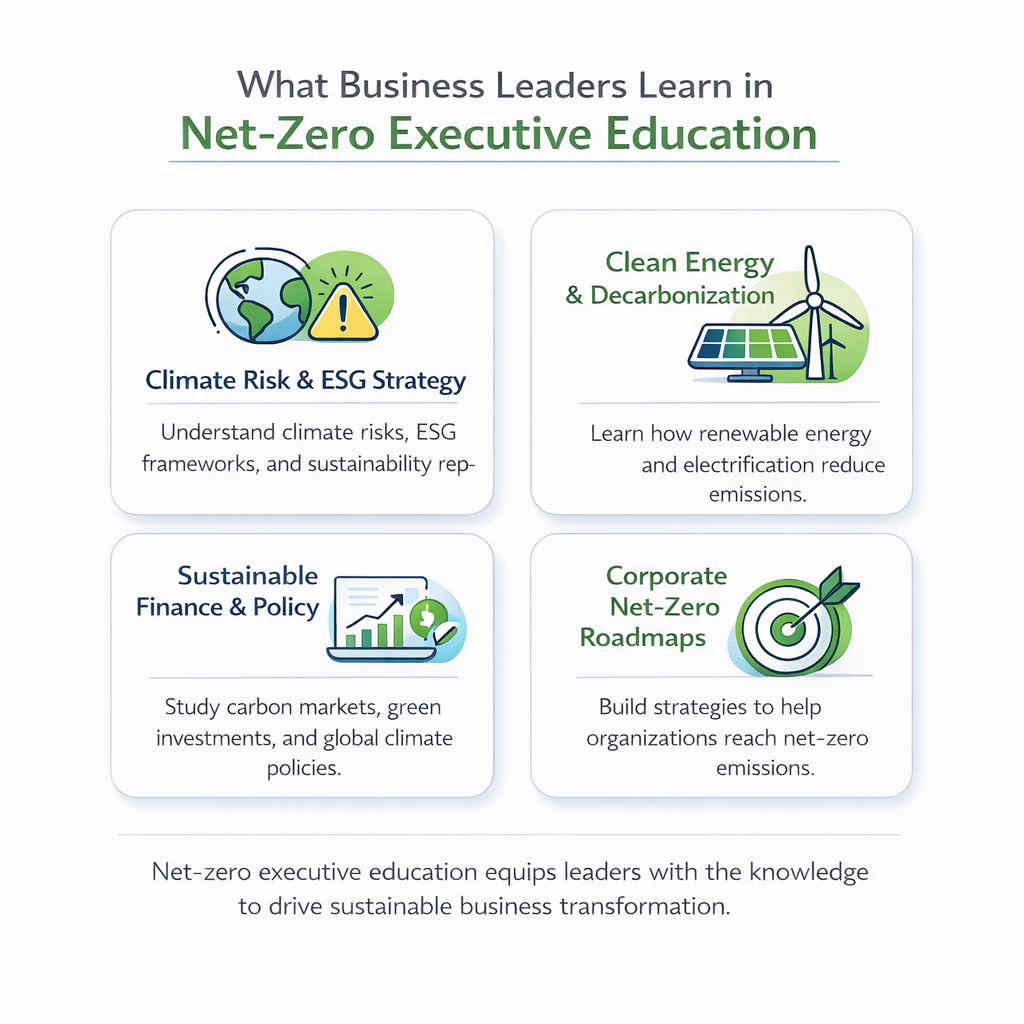
The credible Net Zero leadership program requires organisations to establish scientific targets that guide their decarbonisation efforts while using the TCFD framework to assess climate risks.
The participants learn how to evaluate their company's emissions, find effective ways to reduce them, and develop sustainable plans that balance high standards with cost-effectiveness.
The Indian context gets established through evACAD programmes, which work together with IIM Kashipur and other institutions. The curriculum addresses India's Carbon Credit Trading Scheme, the Green Credit Programme, and sector-specific decarbonisation pathways.
This is an applied strategy for the Indian corporate landscape, not imported Western theory.
The sharpest leaders are treating net-zero not as a compliance cost but as a strategic lever. Companies with verified sustainability credentials attract ESG-focused capital at lower cost. They win procurement contracts from multinational companies that mandate supply chain decarbonisation. They retain younger talent who choose employers based on climate alignment.
Executive education in Net Zero Strategy gives leaders a structured way to spot these business opportunities. Carbon market fluency, for instance, becomes a genuine competitive advantage once leaders understand how to act on it.
Understanding lifecycle assessment methodology enables businesses to identify design changes that will decrease emissions and decrease material expenses.
Completing a net-zero executive programme is not the end point. It is the start of a set of concrete actions leaders can take back to their organisations immediately:
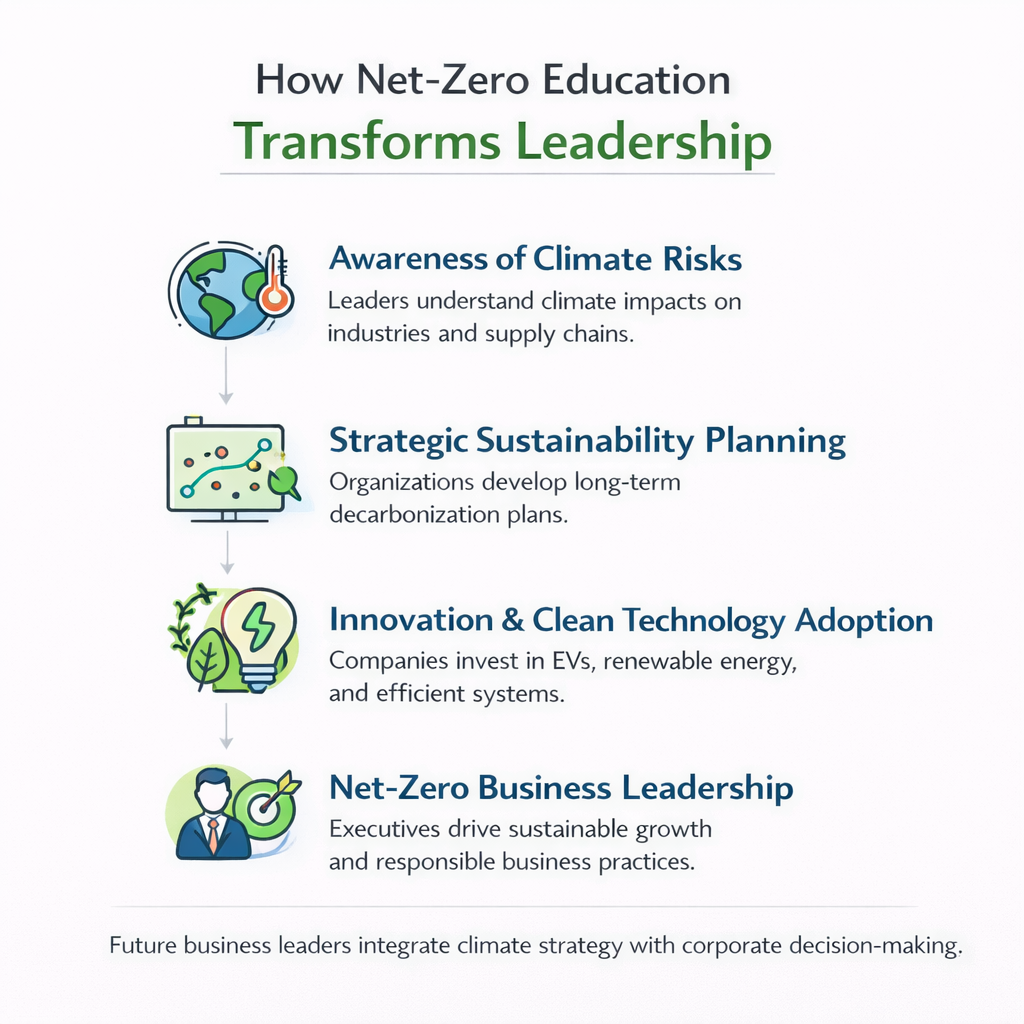
LinkedIn's 2025 Green Skills Report revealed that global demand for green talent is growing nearly twice as fast as the workforce is acquiring green skills, at 7.7 per cent annual growth and 4.3 per cent annual growth of green skills development. The executive level shows an extreme widening of this gap because existing leadership programs maintain their conventional structures.
This is precisely what sustainability courses for business leaders are designed to address. A mid-level manager with this knowledge can steer a team. A C-suite leader with the same fluency can redirect an entire organisation’s strategy.
Not all net-zero leadership programmes deliver equal value. The strongest ones combine faculty with direct industry experience, peer learning from executives facing the same challenges, and a curriculum built around real business decisions rather than theory. Organisations should look for evACAD programmes that address BRSR reporting requirements, India’s Carbon Credit Trading Scheme (CCTS), and the National Green Hydrogen Mission.
The future of Indian business belongs to leaders who understand this transition deeply enough to act on it. That means knowing the regulatory landscape, reading the numbers, and steering the organization toward positions that will hold value through 2030 and beyond. Executive education in net-zero strategy is not a luxury-to-have. It is the investment that keeps the business relevant.
Without it, every quarter carries more risk. Regulatory timelines do not pause for readiness. Investor expectations are not softening. The market is already separating the companies that have prepared from those that have not.


.webp)
.jpg)
.jpg)