Imagine you’re cruising along the highway, only 18% battery life left, and your EV’s software is frantically calculating whether it’ll make it to the next charging station in time. A conventional battery management system will provide an estimate. However, an AI-powered one will already know all this. It has already studied your driving pattern, environmental temperature, and road inclination for the past hour.
It’s not about mechanics anymore, they are more about data. As electric vehicles are moving closer to mass-market use, the difference between the most basic of BMS and intelligent ones is becoming too wide to overlook. Everyone from engineers to product managers at EV manufacturers is scrambling to narrow that gap, and AI-enabled EV battery management systems stand tall at the forefront of it.
In this article, we’re going to explain just how different this revolution is and why traditional BMS design is having trouble with it. We’ll also list everything you need to know to build future electric vehicles yourself.
The conventional BMS system is only required to execute orders. The function of monitoring the voltage levels, equalising the batteries, and controlling their temperature levels is carried out according to set equations. However, the problem lies in the fact that batteries are living things. They degrade, age, and react unpredictably.
This is where the practical problems arise:
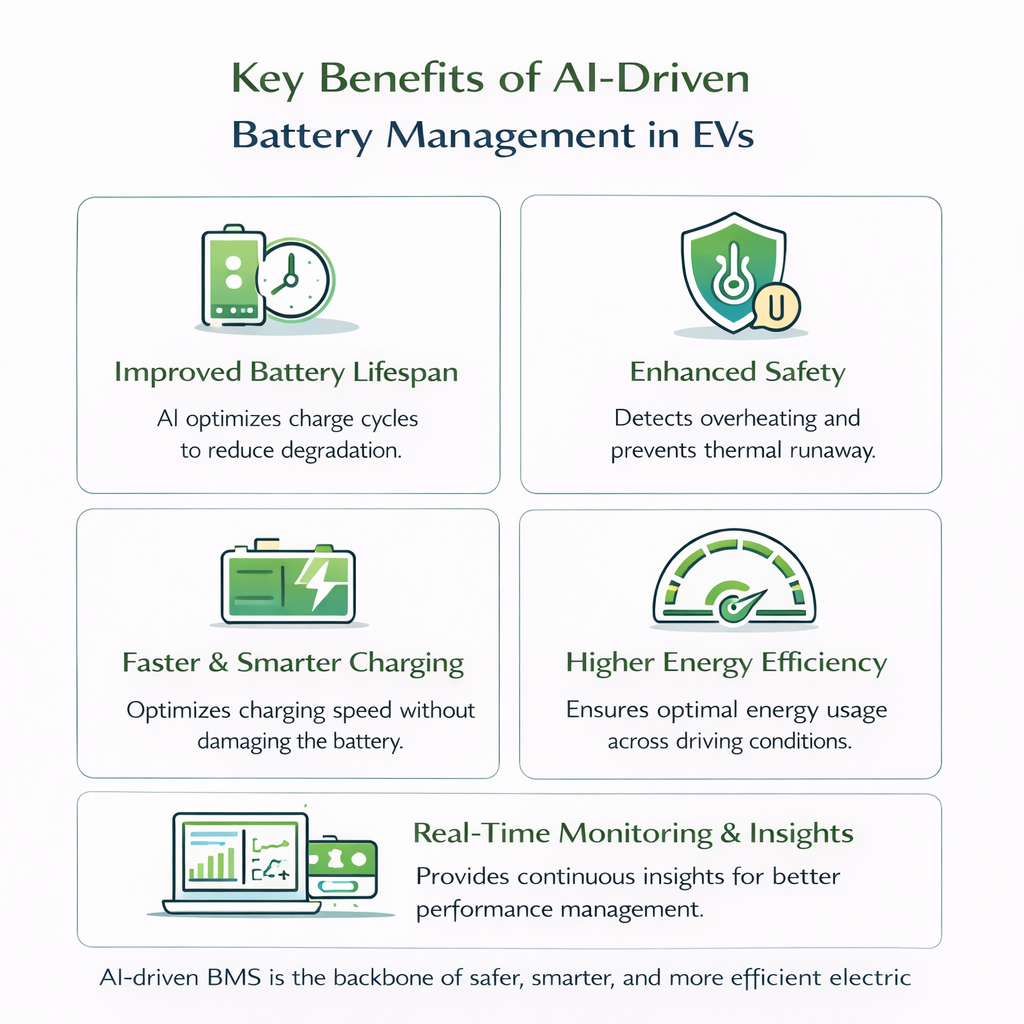
The effects of this situation demonstrate their actual existence. The Premier Science Journal reports that artificial intelligence-guided systems achieve 89.2% accuracy in predicting failures which occur in batteries and software, while they also reduce unexpected downtime by 26%, and they extend battery life by about 18%.
A standard BMS system lacks the ability to perform this function because it lacks the capability to learn.
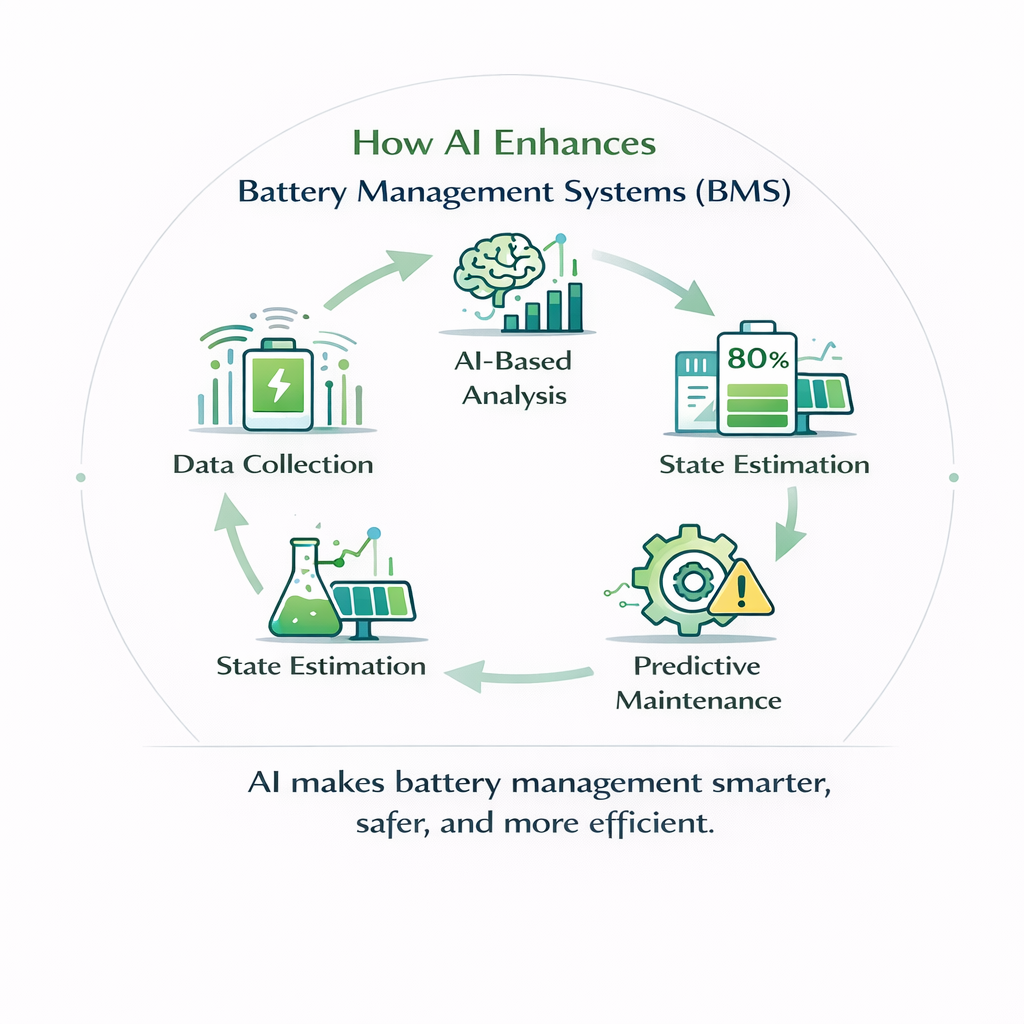
The AI-driven BMS does not simply observe. It anticipates, forecasts, and evolves. Instead of thinking of it as a thermostat, think of it as your co-pilot who knows everything there is to know about batteries through countless readings and simulations.
As evidenced by scientific research published in the International Journal of Low-Carbon Technologies, an AI-based BMS system significantly outperforms traditional systems in terms of battery efficiency and longevity.
SOC estimation marks the point at which conventional systems tend to falter. With an AI-enabled BMS system, it is possible to monitor SOC via RNNs and hybrid Kalman filtering, making it much easier to determine SOCs regardless of ageing effects or changes in internal resistance. SOH is estimated simultaneously, creating a constant profile of the battery pack’s status.
Thermal runaway is among the biggest dangers that EV batteries face, and the problem often gives no early warning signs. AI solutions based on millions of anomaly data points can detect the problem when the battery heats up, even before things get dangerous. No threshold needs to be crossed. The system learns, takes countermeasures, and shields the battery without alerting the driver.
The ability of operations to predict failure in the future is considered one of the greatest strengths that operations have, since with their ability to predict, they can act proactively rather than reactively once something occurs. These AI models are developed in such a way that they are able to predict using the data from charge cycling, temperature, and discharge levels.
The process of battery charging is not universal because different charging conditions will result in different charging results for the same battery. The advanced battery management system (BMS) uses machine learning to create a charging curve which adjusts according to battery stress levels and optimal operating conditions.
Machine learning EV charging systems allow operators to balance the grid load and schedule charging periods during non-peak hours, optimising the cost of electricity consumed per kilometre travelled. Not only does it benefit the battery, but also the power network and the operator’s budget.
Reinforcement learning is also used in charging agents that continually refine their approach by conducting millions of virtual charge episodes. Reinforcement learning applications aren’t a mere theoretical concept as of 2026. They are already implemented in production systems in several electric vehicle brands.
For those who are engineers who have spent decades learning the ins and outs of electrochemical reactions and circuits, it’s likely that the change is already happening. The positions being offered by electric vehicle companies and renewable energy firms require a blend of expertise, both in the physical workings of batteries and their data pipelines.
Here's where the demand is concentrating:
If you do an online search using EV battery and AI course India, then you will understand that there is still a shortage of engineers who can master all of these skills. However, this gap presents a unique opportunity for everyone ready to take advantage of it.
AI in e-mobility is no longer the buzzword it used to be. Rather, it's the engineering approach that has changed the game for what we expect from a BMS. In terms of SOC precision, thermal prediction, and charging, the difference between rules-based versus adaptive and intelligent systems can now be measured in terms of driving range, battery longevity, and operating costs.
The engineers who will shape the future are no longer specialists in only chemistry or software. They are those who understand the language of both sides and have been trained to think and operate across disciplines. The ability to bridge the two is already becoming a minimum standard of competence for any serious team involved in EV development.
At evACAD, we believe that such knowledge and skills are achievable and in high demand right now. We offer training programs for engineers in AI-based EV and e-drive systems.