Creating a prototype was the only means of determining whether the powertrain worked effectively before. You would design, build, test, identify issues and start all over again; a process that took up months and cost millions of dollars. The use of AI in EV powertrain simulations is going to make such processes seem painfully slow.
The transition doesn't just mean time-saving. It means getting insightful information without the need to even create a physical model first. Today's simulation environment, powered by machine learning algorithms, has been proven to be able to provide insights on performance, thermal management, and efficiency aspects earlier than prototype testing could.
For any engineer currently working within or transitioning into the EV sector, knowing how to work with AI in EV powertrain simulation is no longer optional. This post will give you a glimpse of how it works.
There have been three major issues in physical prototype testing. It is costly, it takes too long to perform, and it only checks the parameters one expects to check.
The cost of developing one powertrain prototype may be tens of thousands to hundreds of thousands of dollars, depending on the vehicle class. However, this does not even include all costs related to construction, instrumentation, running and interpreting the results. All these expenses and limitations may seem significant to the industry, which constantly tries to accelerate development times.
Yet there are more fundamental limitations of this approach. Physical prototype testing is necessarily done sequentially. The tester considers one operational parameter, then the next. However, AI-enabled simulation can test thousands of situations in parallel, including situations that no human tester could ever consider.

The difference between conventional simulation and AI-augmented simulation is roughly the difference between a calculator and a model that learns. Here's how that plays out in practice:
The result is a simulation environment that behaves less like a tool and more like a test track you can run inside a computer, one that doesn't require a physical vehicle to deliver meaningful results.
Three simulation applications are becoming standard across serious EV development programmes:
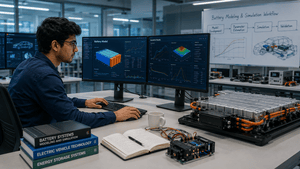
The three elements do not work individually. The charge level in the battery influences the transmission of torque to the motor. Switching frequency in the inverter impacts the efficiency of the motor and the heat generated in the battery. Co-simulation considers all three at once.
The thermal management problem is one of the toughest challenges in designing electric vehicles. Thermal characteristics of EVs under high-load driving, rapid charging, and regenerative braking are completely different from one another. Thanks to artificial intelligence technology, engineers can simulate the thermal flow inside the EV, thus detecting possible failures at an early stage.
The Digital Twin Electric Vehicle refers to an ever-evolving digital replica of the actual vehicle, which is continually monitored and analysed to detect any anomalies or deviations from the expected behaviour. During the design stage, it helps the designers to experiment with software and hardware changes before applying them to the actual vehicle.
This can be proven through data. Global Market Insights has projected that the global market for digital twins in the automotive industry would increase from $2.7 billion in 2025 to $28.7 billion by 2034 at a CAGR of 30.1%. Electric and hybrid cars have already dominated the passenger car digital twin market, representing 64.6% of it in 2025.
It is not an emerging technology trend, but rather a revolution of the process that validates, develops, and supports vehicle development. Model-Based EV Engineering 2026 is not a concept for the future; rather, it has become the reality at all major OEM and Tier 1 companies.
Engineers unfamiliar with these environments will only become further isolated from the true decision-making process.
You don't need to become a software engineer, but you do need to understand the environment you're working in. The core areas to build competence in:
The engineers getting hired into senior roles at EV companies in 2026 aren't just specialists in one of these areas. They're comfortable moving across all three.

EV simulation training has evolved from being a novelty to becoming a genuine career differentiator. Cycle times are tightening, team sizes are decreasing, and the ability of an engineer to operate on both hardware and software levels is the new norm.
An EV model-based engineering course covering the topics of simulation techniques, AI implementation, and digital twin technology provides you with the language and tools to engage in important discussions. Without this knowledge, you are merely looking at outputs that have been made by other people.
AI powertrain optimisation is now a legitimate job title. Organisations are actively recruiting in this area, but the pool of engineers capable of performing such work lags behind demand.
There is no gradual evolution from traditional testing approaches to those using EV powertrain simulation AI. The transformation is already happening, and those able to leverage co-simulation, thermodynamic modelling, and digital twins can add value that goes way beyond the abilities of those with physical testing experience only.
Fortunately, the skills are easily acquired. They do not require years of working experience in software engineering. What is needed is proper training that links the technical knowledge you have with the new ways of thinking in simulations and AI.
There are dedicated training programs by evACAD for engineers willing to master their skills in electric vehicles and modelling of systems.