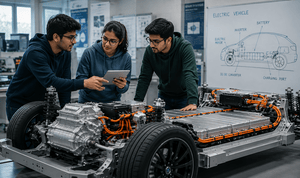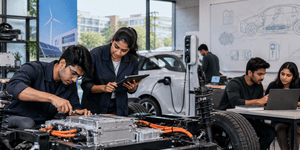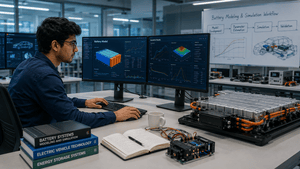
All automotive engineers in India know about electric vehicles. However, only a few discuss the battery value chain that is the backbone of all electric vehicles. And only an even lesser number knows how the sourcing, cell manufacturing, assembly of battery packs, recycling, and government policies fit together to form a single and coherent value chain. These information gaps create some of the most promising career paths in the field of clean mobility in India.
The electric vehicle market in India reached more than 24.5 lakh units in FY2025-26, with a year-on-year growth of 24.6%, and market penetration stood at 8.5%. However, battery production in India is still at the stage of development. Hence, there is a rising need for professionals having knowledge about the value chain of batteries.
No matter whether you are a mechanical, chemical, electrical, industrial, or manufacturing engineer, understanding the battery value chain can enable you to switch on to one of the fastest-growing segments of the EV market in India. This guide provides all the information on what battery supply chain skills include and how one can gain them.
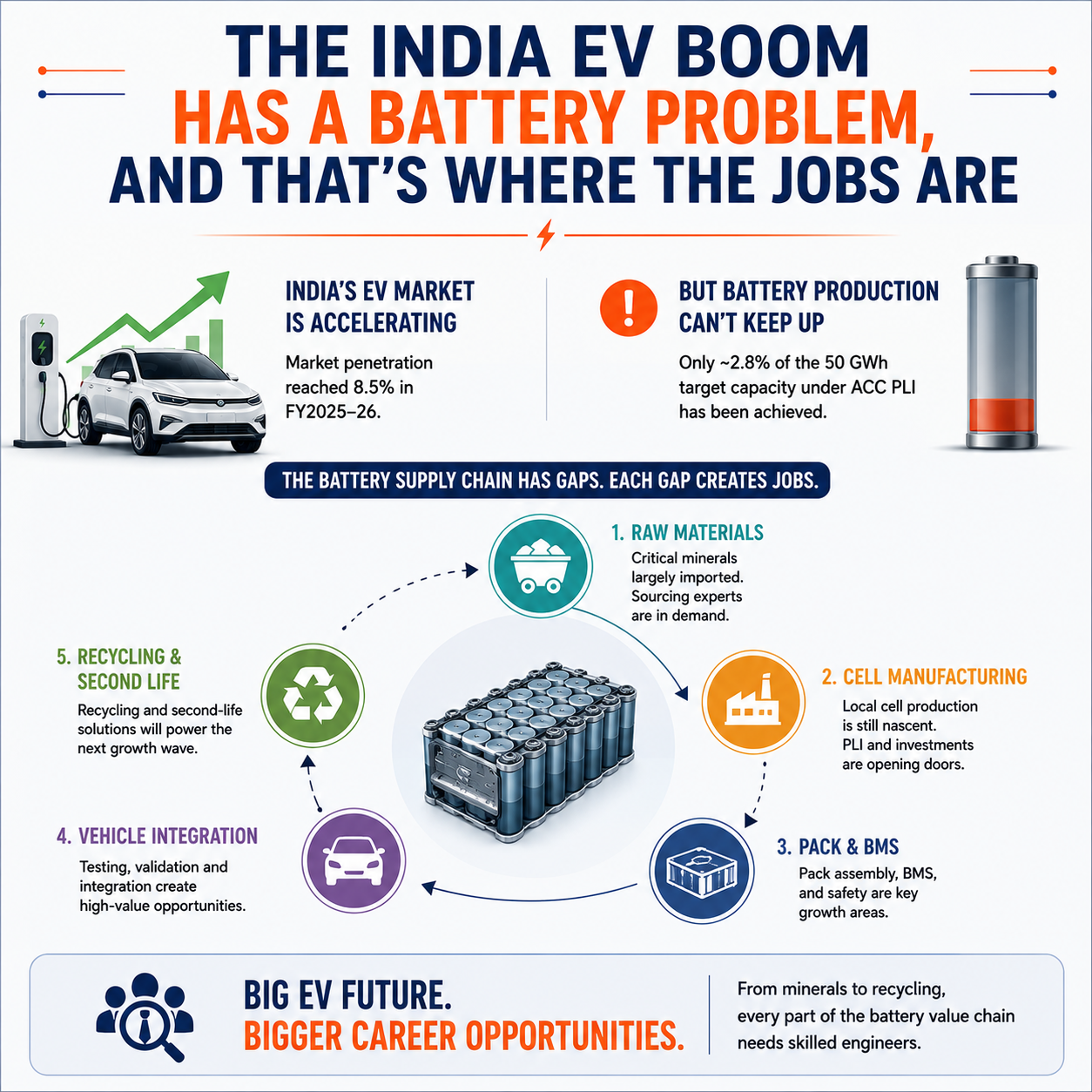
Conversations about electric cars tend to centre on the launch of vehicles, charging infrastructure, and consumer uptake. The truth is that there are many more layers in the battery supply chain. Battery production requires a reliable supply chain of minerals, production of cells, assembly, a battery management system, and a recycling process.
In India, the country is heavily reliant on the import of lithium-ion cells and some raw materials. Despite government initiatives such as Advanced Chemistry Cell Production Linked Incentive (ACC PLI), only 2.8% of the 50 GWh target capacity set through the ACC PLI scheme was achieved by October 2025 [2].
There are skill gaps in the battery value chain for all the missing links, and engineers will find opportunities in each gap.
The battery value chain is not a single process but a web of interrelated processes beginning from the extraction of raw materials to manufacturing, incorporation into vehicles, reuse, and recycling. The knowledge of how these processes relate allows engineers to explore specialised career pathways within the EV industry.
Lithium, cobalt, nickel, graphite, manganese. Exploration in India is underway, but production is just beginning. Raw material continues to come primarily from Australia, Chile, DR Congo, and Indonesia. It is hard to find engineers who understand sourcing risks.
Production of cells is the toughest one to localise. The Union Budget 2026-27 has taken measures in the form of exemptions from customs duties on the capital goods involved in the production of lithium-ion cells and also the PLI scheme EV battery expenditure amounting to INR 18,100 crore.
[4] [News 3]. Another Rs 12,000 crore scheme by the Government is also for battery components [News 2]. Hire follows the capital.
Pack design, BMS software, temperature calibration, safety testing. These are areas where Indian companies have expertise. Opportunities in these fields are highly competitive but growing rapidly among two and three-wheeler OEMs, and even four-wheelers.
By 2030, India will dispose of enough batteries that it will become a significant source of secondary raw materials. The term lithium-ion battery recycling in India will become a common one. Engineers who know how to handle chemical recovery and second-life logistics are already being sought after.
Understanding the complete battery lifecycle helps engineers appreciate where different skills fit within the industry.
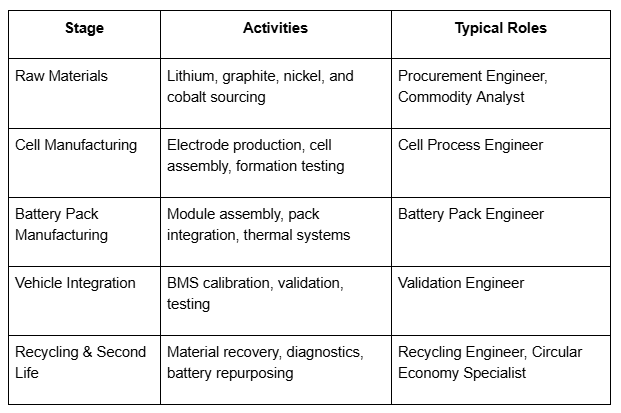
Job descriptions here rarely list one clean skill. They stack three layers, and engineers who move fastest bring visible strength in at least two of them.
Employers increasingly look for engineers who understand both battery science and manufacturing processes. High-demand technical competencies include:
A deep understanding of these areas enables engineers to communicate effectively across design, manufacturing, and quality teams.
The manufacture of batteries requires complex international logistics and supply chain management. People having experience in supplier certification, inventory control, logistics optimisation, cost modelling, localisation, and supplier auditing become highly valuable for battery manufacturing companies as well as automotive OEMs.
Knowledge and expertise regarding the BIS standard and AIS-156 safety standards are becoming equally important as that of engineering knowledge.
The Indian battery industry is regulated by a continuously changing regulatory structure, which consists of BIS standards, safety norms of AIS-156 Phase II, Extended Producer Responsibility (EPR) policies under Battery Waste Management Rules and sustainability disclosure guidelines for exporting globally.
With the increasing scope of manufacturing batteries, engineers who know compliance, along with engineering concepts, would be more likely to hold leadership positions.
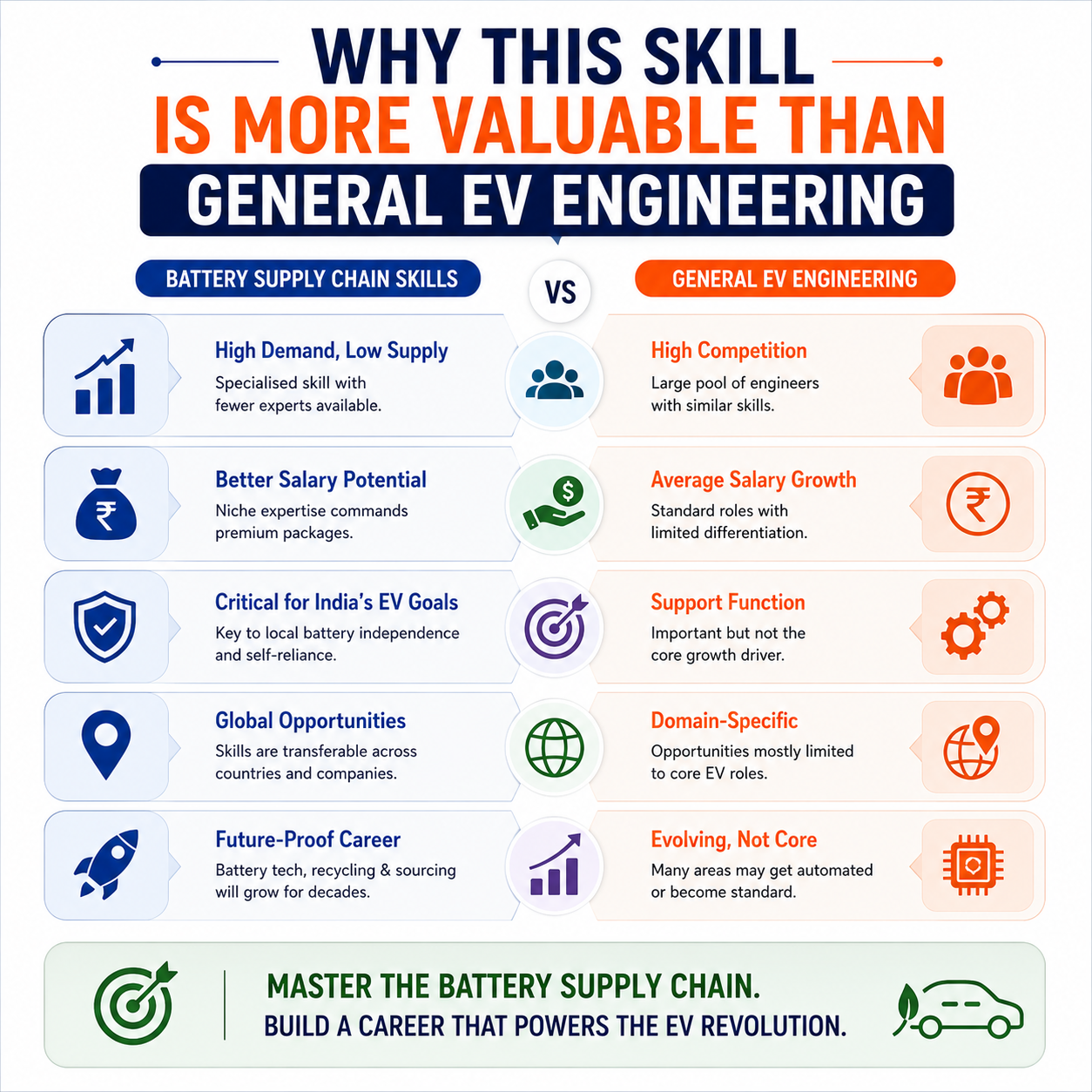
General electric vehicle engineering has reached saturation levels. Every academic institution is offering it. Battery value chain engineering finds its place at the crossroads of engineering, procurement, sustainability, and policy. And this crossroads has very few inhabitants.
The battery requirement in India is estimated to increase from 28 GWh in 2025 to 272 GWh in 2030 at a CAGR of 36.5% [3]. It is clearly a case of numbers on your side.
The field of battery technology is progressing very fast and, therefore, there is a need for engineers who can cope with innovations in production.
Main advancements in the field of battery technology include:
Professionals who understand these trends will remain competitive as India's battery manufacturing ecosystem matures.
There is no shortage of employment opportunities for positions like cell engineers to sourcing managers to compliance officers at companies like Ola Electric, Reliance New Energy, Exide, Amara Raja, Tata AutoComp, Attero, Lohum, and Mahindra.
The mid-level band ranges between INR 12 lakh and INR 35 lakh, and senior specialists make more than INR 50 lakh.
This is a learnable domain, not a decade-long academic path. Two things matter: what to study and where to study it from.
YouTube videos cannot show you the workings of PLI schemes or clauses in BIS 17855. A proper class offered by a reputable institution saves you from months of reading here and there and provides you with the technical jargon that employers look for.
Upstream-to-downstream, end-of-life, including real-life examples of Indian gigafactories, policy modules on the PLI plan, and circular economy coverage, whereby recycling is handled as a basic component of this module, not an afterthought.
Start growing your battery supply chain expertise today with our extensive online courses.
Recycling is a footnote in most EV courses. By the mid-2030s, it will be India's largest domestic feedstock stream. Engineers who master hydrometallurgy, black mass recovery, and battery passport frameworks are positioning themselves for a decade of relevance.
evACAD Perspective:
Another trend in battery supply chain recruitment is that firms do not look only for chemists for cells. They look for engineers who have experience in the manufacturing, sourcing, or quality control space that they can transfer to batteries.
This combination is even more scarce than having only one of the two skills, and it progresses faster towards senior positions than just freshers. Do not see your years working on ICE or manufacturing as liabilities. This is exactly what will differentiate you.
In contrast to many rapidly advancing technical skills, knowledge about battery supply chains is an integration of engineering knowledge, manufacturing practices, sustainability, procurement, and regulation.
With the growth of battery manufacturing and recycling in India, individuals with multifunctional skills will always remain in demand in several industries, such as automobiles, renewable energy, energy storage, and advanced manufacturing.
Therefore, knowledge about battery supply chains can serve as a career path.
And the narrative on Indian EVs is no longer about vehicles. The narrative is now about what makes those vehicles function. But India lacks the talent that can comprehend the entire stack of processes involved.
No matter if you are a mechanical engineer, chemical engineer or an industrial engineer, you can enter the world of battery supply chains through targeted education, not a complete career shift. The opportunity exists, but it won’t last long.
For those interested in making the transition into this field, the Battery Supply Chain & Circular Economy programme of evACAD provides a roadmap across the value chain. This programme is designed specifically for engineers who wish to remain relevant in the next decade of Indian mobility.
[1] India's EV market crossed approximately 24.5 lakh units in FY2025-26, marking 24.6% year-on-year growth with overall EV penetration reaching around 8.5%. (Source: Mover. delivery, 2026)
https://mover.delivery/blog/ev-sales-india-fy-2025-26
[2] Only 2.8% (1.4 GWh) of the ACC PLI scheme's 50 GWh target capacity was commissioned by October 2025, all by Ola Electric, against a scheme outlay of INR 181 billion (USD 2.08 billion). (Source: IEEFA and JMK Research, 2026)
[3] India's battery demand is projected to grow from 28 GWh in 2025 to 272 GWh in 2030 at 36.5% CAGR, with the country needing over 4,00,000 tonnes of cathode active materials and 2,00,000 tonnes of anode active materials annually by 2030. (Source: NIIR, 2026)
https://www.niir.org/blog/india-battery-component/
[4] Union Budget 2026-27 committed further capital toward domestic battery value addition, including customs duty exemption on lithium-ion cell manufacturing capital goods, complementing the existing INR 18,100 crore ACC PLI scheme. (Source: Mondaq, 2026)
1. Only 2.8% of Target Capacity Delivered Yet Under India's Battery Manufacturing Incentive Scheme - IEEFA, January 22, 2026
2. Government Finalises Rs 12,000 Crore Incentive Scheme for Battery Components - NIIR, late June 2026
https://www.niir.org/blog/india-battery-component/
3. EV Battery and Solar Panel Manufacturing: How Union Budget 2026-2027 Accelerates India's Supply Chain Shift - Mondaq, February 27, 2026