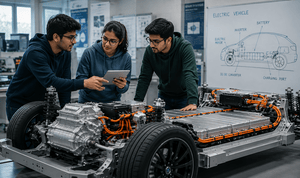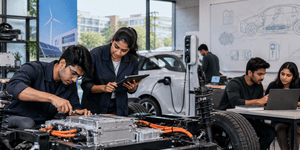
The region’s electric vehicle manufacturing industry is driven by state-owned firms and joint ventures with global carmakers, as governments in Saudi Arabia, the UAE, Egypt and Turkey look to increase local production capacity and reduce reliance on imported automobiles and oil revenues. This essay covers 10 firms leading that build-out and what they are manufacturing, where and at what scale.
The most typical regional setup is a joint venture between a state-owned corporation and a global carmaker. They are fighting each other and global giants like Tesla and Volkswagen for a slice of the region’s fast-growing EV pie.
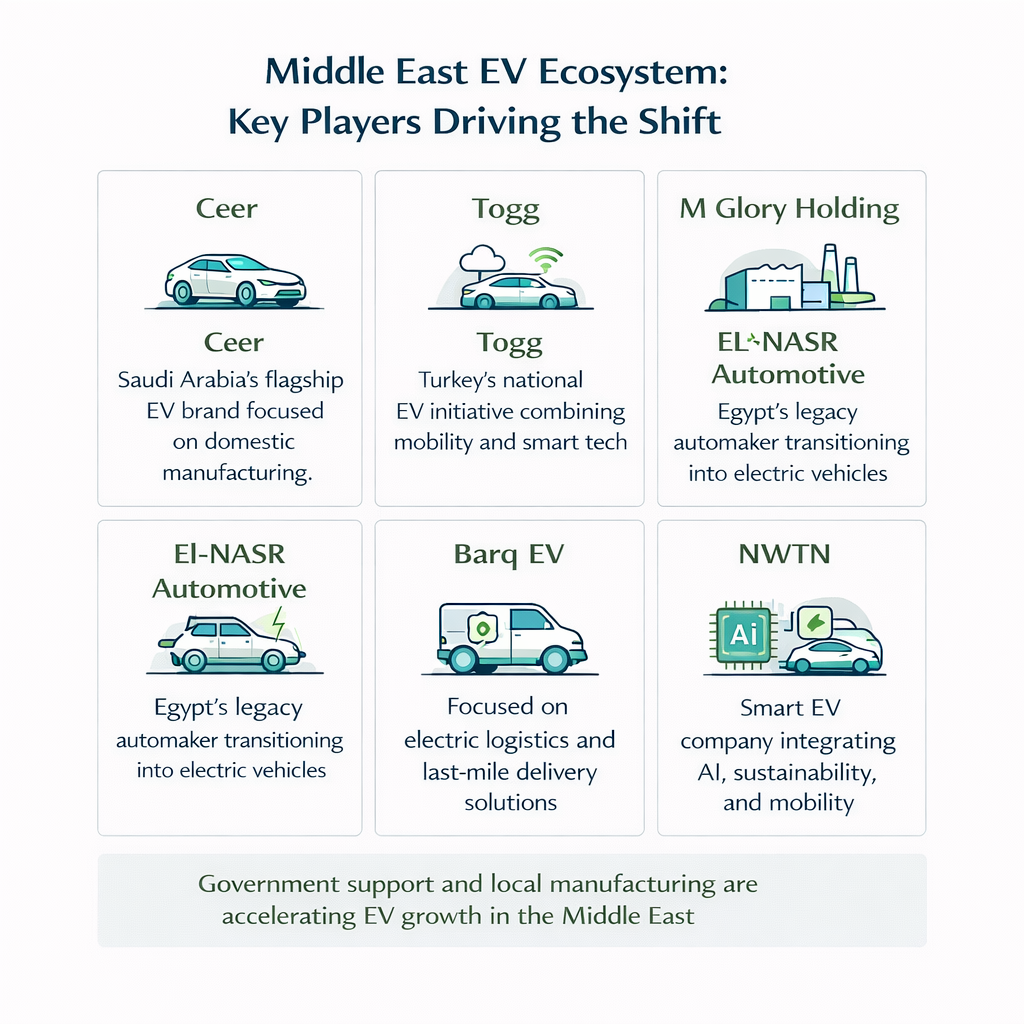
State-owned firms and collaborative ventures with multinational partners drive the region’s transition to zero-emission transport. Ceer, Togg and Lucid Motors have all promised to build large-scale local production facilities, a move regional governments say is crucial for economic diversification away from oil.
Saudi Arabia’s Public Investment Fund has teamed up with Taiwan’s Foxconn to develop Ceer, the kingdom’s first locally produced vehicle brand. The business is constructing a plant at King Abdullah Economic City (KAEC), near Jeddah, to manufacture electric sedans and SUVs for the Saudi market and the wider GCC.
Production capacity: 240,000 units yearly at full capacity, says Ceer CEO James DeLuca (source: Arab News, February 2025).
Manufacturing site: King Abdullah Economic City, near Jeddah
Investment and jobs: more than $150 million in foreign direct investment, estimated to sustain up to 30,000 direct and indirect jobs (source: AGBI).
Launch time frame: on schedule for commercial mass production in Q4 2026 (source: Arab News, Yallamotor).
Turkey supported Togg to create a domestic EV production base. The business boosted its manufacturing target after receiving more than 177,000 preorders following the release of prices for its first model, the T10X, in 2023 (source: Daily Sabah, CleanTechnica). Togg has more than 105,000 subscribers in its ecosystem as of mid-2026 and continues to lead Turkey’s EV market by sales share (source: Daily Sabah, June 2026).
Bursa, Gemlik Technology Campus, is a manufacturing base with an area of 1.2 million square metres.
The company aims to produce over 60,000 vehicles by 2026 (Daily Sabah, January 2026).
Long-term capacity: The Bursa factory is estimated to achieve 100,000 vehicles by the end of 2027, with 175,000 units as its ultimate full- capacity ceiling.
Long-term target: 1 million vehicles across 5 segments by 2030.
Export markets: Togg is already selling the T10F in Germany in a bid to expand into Europe, with France and Italy to follow.
M Glory Group has developed the UAE's first dedicated EV manufacturing facility at Dubai Industrial City. The AED 1.5 billion ($408 million) investment is estimated to create more than 1,000 jobs (Source: Arab News, Zawya, Dubai Industrial City).
Annual production: 55,000 electric cars.
Size of facility: 1 million square feet.
Export markets: broader GCC, plus Egypt, Kenya, and Tanzania.
El Nasr Automotive Manufacturing Company is Egypt’s oldest carmaker and the first Arab vehicle manufacturer in the country, owned by Egypt’s Metallurgical Industries Holding Company, formed in 1960. It has been relaunched for 2024-2026 with a focus on buses, including the CNG-powered Nasr Green line, and a newly inked collaboration with China’s FAW Group to build passenger vehicles under the Nasr name (source: Ecofin Agency; Egypt Today, June 2026). Egyptian officials said that the shift to electric car manufacture is part of the company’s longer-term strategy, though no date for dedicated EV production has been verified publicly as of this writing.
Founded by Ahmed Al Mazroui and Abdallah Abu Sheikh in the UAE, Barq EV creates electric delivery cars tailored to withstand Middle East conditions, such as heat-resistant parts and ergonomic design for drivers (The National).
Rena Max: An electric delivery scooter co-developed with Saudi Post (SPL) ranging up to 150 km on a single charge.
Rena Lite: a lighter scooter version for local delivery within 3km radius.
Yas 1: drone for delivery, range 15 km.
NWTN designs electric passenger vehicles and was originally created in China before moving its worldwide headquarters to the UAE. It has now teamed with Sultan Investments to set up an assembly centre in the Khalifa Industrial Zone Abu Dhabi (KIZAD).
Size of facilities: Second-phase expansion to more than 100,000 square metres.
The target is for 50,000 automobiles a year after phase two is complete (source: The National, Zawya).
King Abdullah Economic City, Saudi Arabia The manufacturer of the long-range premium Lucid Air vehicle, Lucid Motors, opens its first non-U.S. factory in King Abdullah Economic City. The Saudi government has agreed to pay Lucid up to $3.4 billion in financing and incentives over 15 years to build and manage the facility. (source: Arab News, Lucid Group)
Capacity: up to 150,000-155,000 automobiles per year as the plant ramps up to full production, with varying amounts quoted by sources depending on the phase and year.
The iE1 is a carbon-fibre, two-seater electric sports car from Mays Motors, Oman’s first indigenous EV manufacturer, that can go 500 km on a single charge and go from 0-100 km/h in less than five seconds (source: Times of Oman, Muscat Daily). The company is headquartered in Muscat and is supported by the Oman Technology Fund.
Dubai-based holding group META4 will invest about INR 250 crore in a 15-acre manufacturing unit at Telangana’s National Investment and Manufacturing Zone (NIMZ) in Zaheerabad, through its auto subsidiary Ellysium Automotives and its EVeium electric two-wheeler brand, in conjunction with its Voltly Energy unit (source: Business Standard, Entrepreneur, Daily Excelsior).