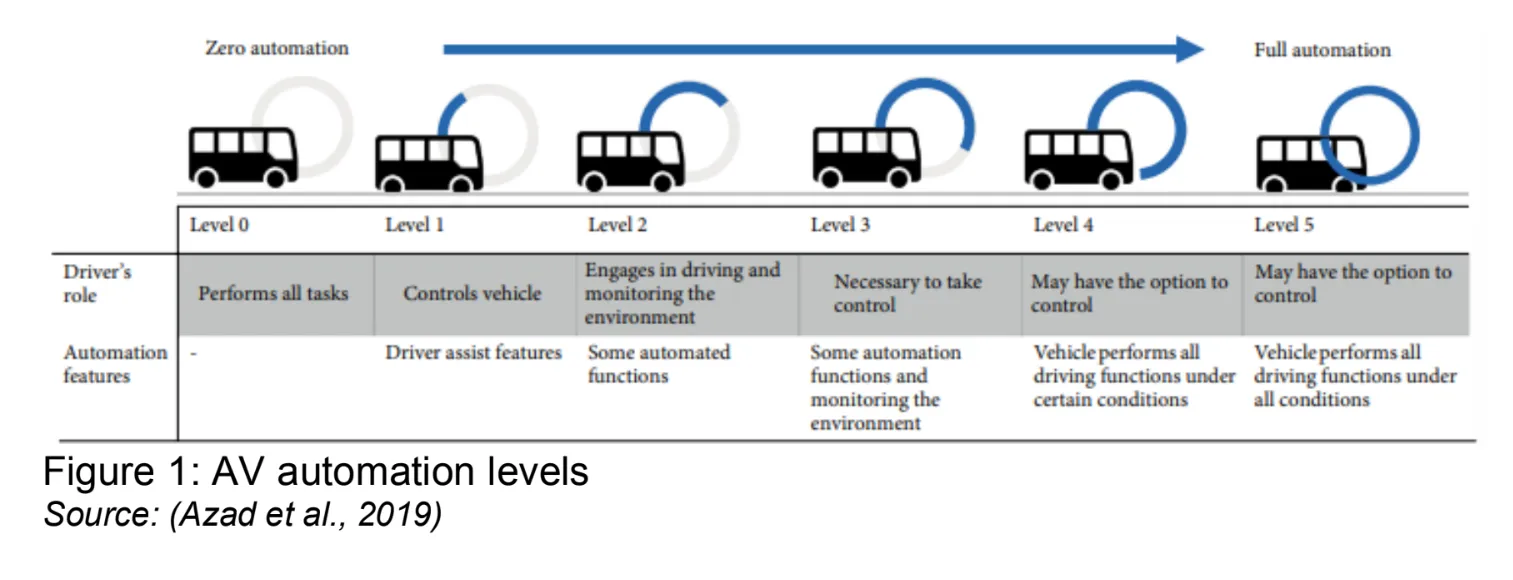
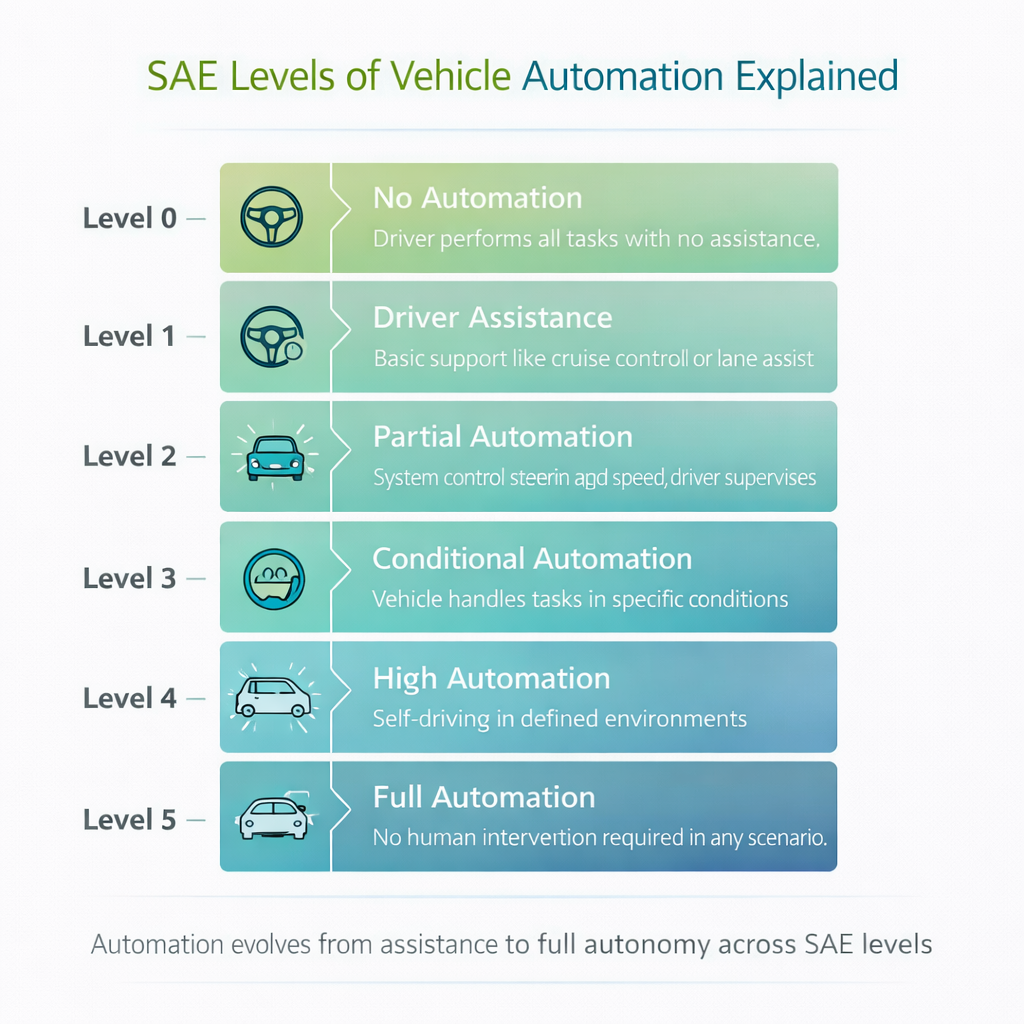
Advanced Driver Assistance Systems, or ADAS, are one of the most active innovation areas in e-Mobility. The Society of Automotive Engineers has defined six stages of driving automation, Level 0 through Level 5, in its J3016 standard, issued in 2014. Levels 0 through 2 are best defined as driver support features, as there is always a human in control of the vehicle. Levels 3 to 5 are functions of automated driving. The system takes over the driving task under certain conditions.
With all three levels, the human driver is driving the car, even when the support features are in operation. Features such as autonomous emergency braking, blind spot warning, and lane departure warning at Level 0 offer just temporary alerts or short-term support. Level 1 features such as adaptive cruise control or lane centreing provide either steering support or braking and acceleration support, but not both at the same time. Level 2 also combines the two sorts of help, but the driver still has to be ready to steer, halt or accelerate when necessary and do so at all times.
Level 3 means the vehicle can drive itself in some situations but may ask the human driver to take over again when it can’t identify a hazard like an animal in the road, for instance. Mercedes-Benz’s Drive Pilot was the first Level 3 system to be licensed for public road use in the US, in Nevada in January 2023 and California in June 2023. The picture has now changed: Mercedes-Benz has backed off releasing Level 3 in the U.S. market for the 2026 model-year S-Class, instead rolling out a Level 2++ driver assistance system while it works on a higher-speed Level 3 system and a separate Level 4 system for the future.
Level 4 vehicles can be autonomous without a human driver in limited and well-defined situations and, in some cases, without pedals or a steering wheel. Waymo has been running a Level 4 autonomous robotaxi service in more than 10 US cities, including Phoenix, the San Francisco Bay Area, Los Angeles, Austin, Atlanta and other newly added markets in Texas and Florida, as well as announced foreign debuts in London and Tokyo.
Level 5 is where the vehicle is able to handle all driving activities under all environmental situations, and there is no expectation that a human will ever have to take control. In India, Bhopal-based Swaayatt Robots has shown what it says is Level 5 capability on its self-driving test vehicles operating under unstructured Indian traffic conditions. This remains a company-reported milestone from closed demonstrations, not an independently certified deployment.
Modern ADAS uses sensors, cameras and radar to interpret the surroundings, while software processes that data to initiate safety actions. These are classified into three basic categories: alerts and warnings, driving-task support and visual and environmental monitoring.
Driver monitoring systems employ cameras inside the cabin to watch for attentiveness and tiredness. Forward collision warning watches the distance between you and the car in front of you and informs you if the distance is closing too quickly. The lane departure warning detects the lane markers and warns the driver if the vehicle wanders out of its lane without signalling. Blind spot monitors employ side-facing sensors to warn you of vehicles in the lanes next to you. Intelligent speed adaptation analyses posted speed restrictions and either warns you or automatically reduces your vehicle’s speed. The tyre pressure monitoring system alerts you when the pressure is outside the normal range.
Advanced emergency braking applies automatic braking if the driver does not react to an approaching collision. Electronic stability control employs individual wheel brakes to counteract oversteering and understeering. Adaptive cruise control maintains a defined speed and distance. Lane centreing makes minor adjustments to the steering angle to keep the car in its lane. Automatic parking handles steering, braking and accelerating during parking. Traction control reduces engine power to regain traction in slippery conditions.
Head-up displays display speed and navigation information on the windscreen. Omniview systems piece together a view that covers 360 degrees surrounding the car. Night vision systems use infrared to see pedestrians beyond the range of headlights. V2X (vehicle-to-everything) communication enables cars to communicate directly with other vehicles and the infrastructure of the road.
India’s dense, mixed-traffic environment, which includes two-wheelers, heavy trucks, and animals on the road, creates what engineers call a stochastic driving environment. Unlike closed, driver-free systems such as the Magenta and Pink lines of the Delhi Metro, which operate without operators as their tracks are completely segregated from other traffic,
The Ministry of Road Transport and Highways has mandated a suite of ADAS technologies for M2, M3, N2 and N3 bus and truck categories for road safety. The rule is phased in from April 1, 2026, for new models and October 1, 2026, for current vehicles. The package contains Advanced Emergency Braking Systems under AIS-162, Driver Drowsiness and Attention Warning Systems under AIS-184 and Lane Departure Warning Systems under AIS-188. Electronic Stability Control for trucks is individually regulated under IS 11852:2019 and will be obligatory from October 1, 2027.
ADAS and driverless vehicles continuously log information about the surroundings and the driver, creating cybersecurity and privacy concerns. Many jurisdictions remain an open subject when it comes to the legal liability of ADAS-related occurrences, particularly when a driver is supposed to be overseeing an operational system. Infrastructure also decides what can be done soon: closed systems, like the driverless lines of the Delhi Metro, function because the operating environment is completely regulated, while open-road autonomy at Levels 4 and 5 requires significantly greater computer power and regulatory groundwork. Adoption is likely to be gradual, with regulation and infrastructure and fleet technology maturing in tandem.