What can India's hydrogen mission learn from the $8.4 billion NEOM project, now in commissioning?
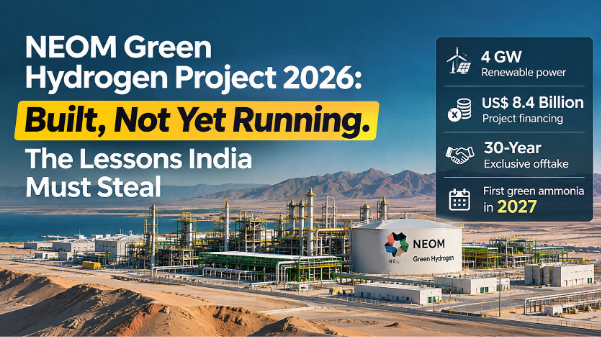
The NEOM green hydrogen project 2026 is a finished plant waiting for its first ammonia, and its main lesson for India is contract structure before concrete. NEOM Green Hydrogen Company (NGHC), an equal joint venture of ACWA Power, Air Products and NEOM, reported 90% overall construction completion on 26 March 2026. ACWA Power's chief executive told analysts on 6 August 2026 that the building is done and the plant is in commissioning, according to Energy Intelligence, with the first green ammonia planned for 2027. The project closed its $8.4 billion financing with a 30-year exclusive buyer in place; the green ammonia contracts India signed in March 2026 run for 10 years.
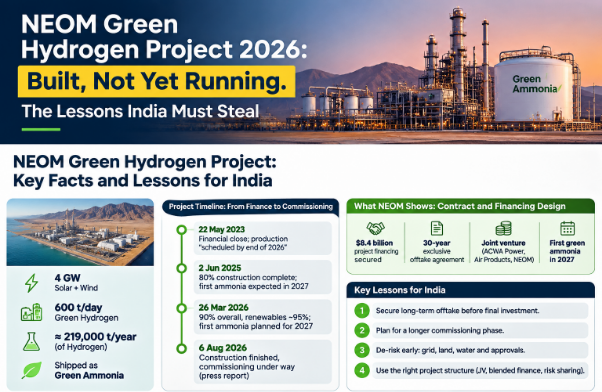
NGHC is building up to 4 gigawatts (GW) of solar and wind power, an electrolyser plant and an ammonia unit at Oxagon, Saudi Arabia. The design output is up to 600 tonnes of hydrogen a day, shipped as green ammonia. That is roughly 219,000 tonnes of hydrogen a year at full rate (600 tonnes times 365 days; our calculation).
NGHC's 26 March 2026 release put overall construction at 90% and the renewable assets at about 95%. It says commissioning of the electrolysers and the first ammonia is planned for 2027. A 10 August 2026 Energy Intelligence report quotes ACWA Power chief executive Samir Serhan as saying that building work is finished and that commercial operations will start next year. Treat that last claim as press-reported until NGHC confirms it. A construction percentage also measures what is built, not what produces: electrolyser commissioning and first ammonia are still ahead.
The schedule moved by about a year between the 2023 financing and today's plan. Air Products expects "a long commissioning process" before the plant reaches full production, World Fertilizer reported.
Spending is already tapering. Air Products reports that NGHC spending not funded by its own equity was $817.1 million in the nine months to 30 June 2026, against $1,981.2 million a year earlier (Air Products fiscal third-quarter 2026 results). That drop is what a project looks like when the heavy construction is behind it.
Commissioning timelines for India's emerging green hydrogen and ammonia industry show why reaching a final investment decision is only one milestone in a project's execution.
Consider AM Green's green ammonia complex in Kakinada, Andhra Pradesh. In a June 2026 interview with S&P Global Energy, the company's CEO, Gautam Reddy, said the first 500,000-tonne-per-year phase was targeting commissioning in July 2028. The second phase was planned six to nine months later. The same report noted that the project had initially targeted commissioning around mid-2026 following its final investment decision in 2024. The published schedule had therefore shifted by roughly two years. The interview did not establish one specific cause for the entire change.
The challenges become clearer in accounts from other Indian project developers. In April 2026, S&P Global Energy reported that renewable hydrogen and ammonia developers were facing delays related to grid connectivity, land allocation, regulatory approvals, water availability and transmission infrastructure. One awardee described a minimum one-year wait for grid connectivity through the central or state transmission utility. These dependencies can hold up commissioning even when the developer has identified the site and progressed with the plant itself.
Commissioning also does not necessarily mean immediate commercial production. In March 2024, Reuters reported that GAIL expected its 10 MW electrolyser at Vijaipur to begin producing hydrogen approximately one month after commissioning, once initial technical issues had been resolved. This highlights the distinction between completing equipment commissioning and achieving stable production.
The practical lesson for project developers is to track more than the headline commissioning date. Land and statutory approvals, grid connectivity, transmission readiness, water supply, equipment integration, initial technical issues and the ramp-up to stable production all need clear owners and realistic timelines.
Note: The dates and bottlenecks above come from published interviews and reporting. They illustrate specific project schedules and reported industry constraints. They should not be interpreted as a universal commissioning timeline for all Indian hydrogen, ammonia or renewable energy projects.
Further than the 2026 schedule suggests. A January 2022 commentary from the Center for Strategic and International Studies described NEOM as a US$5 billion green hydrogen project expected online in 2025. [dated: verify currency] The financing announced in May 2023 put total investment at $8.4 billion, and first ammonia is now planned for 2027.
Scope may have changed between those dates, so the comparison is not exact. [GAP: confirm whether the 2022 figure covered the same facilities as the 2023 financing.] The direction is still clear: cost rose, and start-up moved back by about two years. Indian developers pricing their first large project should include a contingency that reflects this history.
The NGHC announcement of 22 May 2023 puts total investment at $8.4 billion, with $6.1 billion of non-recourse debt from 23 banks and investment firms. Non-recourse means lenders can claim only the project's assets and cash flows, not the owners' other assets. The package includes what the filing calls an Euler Hermes tranche (Euler Hermes is a credit insurer). Air Products holds an exclusive 30-year offtake (a purchase contract) for all the green ammonia.
That ordering matters. The buyer was signed, the debt was raised against the buyer's contract, and then the plant was built. Debt of $6.1 billion is about 73% of the $8.4 billion total (our calculation).
The buyer's own plans changed. On 30 June 2026, Air Products said it would not proceed with its Louisiana clean energy complex, and its fiscal third-quarter results show project exit charges of about $2.9 billion before tax. Those charges cover Louisiana, the Casa Grande hydrogen facility in Arizona and smaller clean energy distribution projects. NEOM is not on the list.
Air Products then finalised a marketing and distribution agreement with Yara, as stated in its July 2026 results presentation. Yara markets the green ammonia that Air Products does not sell as renewable hydrogen and is paid on commission. Air Products says the deal reduces its need for downstream green hydrogen investment. Air Products still owns one-third of NGHC and remains the sole offtaker.
The lesson is narrow and useful, and it applies to Indian developers who rely on a handful of buyers. A 30-year contract protects the project, but the buyer's downstream market can still shrink. NEOM's answer was a second route to market.
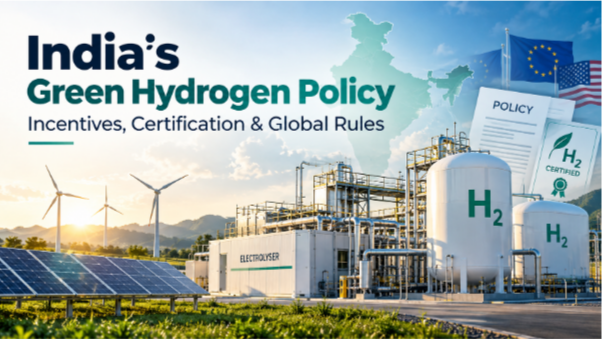
India signed its green ammonia purchase agreements on 30 March 2026. The Solar Energy Corporation of India (SECI) ran bids under the SIGHT programme (Strategic Interventions for Green Hydrogen Transition), and a Press Information Bureau (PIB) release lists 10-year purchase agreements with fertiliser units. Developers named in the release include ACME Cleantech, NTPC Renewable Energy, Jakson Green, SCC Infrastructure and Oriana Power. Discovered prices run from Rs 49.75 to Rs 64.74 per kg, against an international benchmark of about €1,000 per tonne (roughly Rs 110 per kg) in the release. The release estimates about $2.5 billion in foreign exchange savings over 10 years, and Minister Pralhad Joshi has named fertilisers, refineries, steel and transport as the next focus sectors.
The scale gap in India's green hydrogen capacity is evident in these numbers. A PIB release of 24 March 2026 lists 862,000 tonnes a year of green hydrogen capacity awarded to 18 companies. A 25 March 2026 release from the Ministry of New and Renewable Energy (MNRE) puts commissioned capacity at about 8,000 tonnes a year and green hydrogen for refineries at Rs 387 to Rs 397 per kg, including 18% goods and services tax. Against NEOM's design rate, India's commissioned capacity is about 3.7% of one Saudi plant (our calculation). The National Green Hydrogen Mission targets 5 million tonnes a year by 2030.
India's AM Green project in Kakinada offers a useful comparison with NEOM. The developer secured a long-term renewable ammonia off-take agreement with Germany's Uniper. In October 2026, the Asian Development Bank signed funding agreements with AM Green Ammonia (India), including a US$100 million loan sponsored by Japan’s JICA under the Leading Asia’s Private Infrastructure Fund 2.
The project shows why a credible purchaser and development finance matter. But it also reveals that lenders look beyond the headline production capacity.
ADB's public project documentation identifies detailed requirements around environmental management, water use, hazardous-material handling, ammonia process safety, emergency planning, transmission infrastructure and land access. A final quantitative risk assessment must be incorporated into plant design and emergency planning before commissioning. Phase 2 is also contingent on securing additional long-term offtake arrangements.
The lesson for India is clear: a production target is not the same as a bankable project. Developers need credible buyers, financing, safe plant designs, completed infrastructure arrangements and a realistic execution plan. NEOM and AM Green differ in scale and commercial structure, but both illustrate the importance of connecting demand, capital and project readiness.
NEOM is one plant with one anchor buyer, so not every part transfers. These six points do, and each rests on a fact from the sources above.
India has contracts and incentives in place, and awarded capacity is roughly four times NEOM's design output in tonnes of hydrogen (862,000 against about 219,000, our calculation). The gap sits between award and operation. A PIB release of 25 March 2026 counts about 8,000 tonnes a year commissioned, and the National Green Hydrogen Mission's 5 million-tonne target for 2030 is more than 20 times NEOM's design rate. Moving awards into operation decides whether the mission hits its numbers.
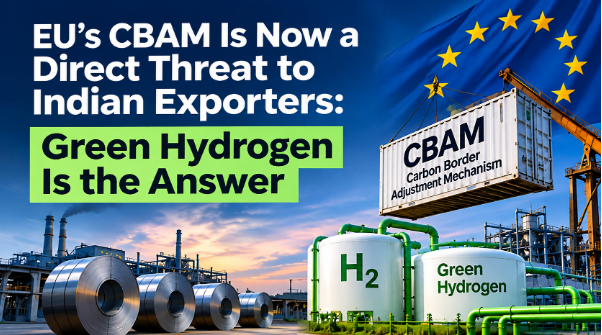
NEOM has not published a delivered price for its ammonia. [GAP: no public price for NEOM ammonia was found; check company disclosures.] India's anchor market is also different: domestic fertiliser and refinery demand, not a single export buyer. Whether Indian green ammonia can compete in export markets is untested, and developers with export plans will also face the EU's renewable fuel rules, as covered in our CBAM and green hydrogen guide [link: add URL of the CBAM blog once published]. And NEOM is not yet producing, so its operating performance is still unknown.
To build the project finance, policy and technical skills behind decisions like these, see evACAD's Advanced Green Hydrogen Course.