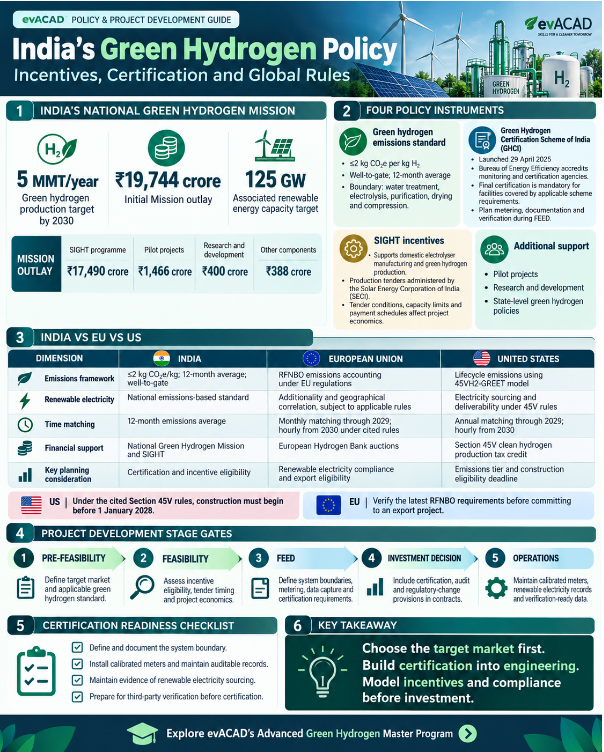
The Union Cabinet sanctioned the National Green Hydrogen Mission on January 4, 2023, with a preliminary budget of ₹19,744 crore. The objective is to achieve a minimum of 5 million metric tons (MMT) of green hydrogen production capacity annually by 2030, incorporating approximately 125 gigawatts (GW) of renewable energy capacity (PIB, 4 January 2023).
As of October 2026, the Ministry of New and Renewable Energy (MNRE) reports that incentives have been awarded for 862,000 tonnes a year of green hydrogen production capacity. It also reports incentives for 15 companies to build 3,000 megawatts (MW) a year of electrolyser manufacturing capacity (PIB, 17 June 2026). The outlay splits into four components:
Four instruments matter most to project developers.
In the standard notified by MNRE in August 2023, hydrogen is green if its emissions are no more than 2 kg of CO₂e per kg of hydrogen, measured from well to gate as a 12-month average. The boundary includes water treatment, electrolysis, gas purification, drying and compression, and it covers both electrolysis and biomass-based routes (PIB, 19 August 2023). Transport and distribution sit outside the boundary.
For scale, the IEA gives 10 to 12 kg of CO₂e per kg for hydrogen from unabated natural gas (International Energy Agency, Global Hydrogen Review 2024). The 12-month average allows renewable supply to vary throughout the year, so power choices during grid fallback periods still change the annual result.
The Union Minister launched GHCI on 29 April 2025 (PIB). The Bureau of Energy Efficiency (BEE) is the nodal authority that accredits the agencies that monitor and certify projects. A final certificate is mandatory for any green hydrogen facility in India that receives central or state subsidies or incentives or sells or uses its hydrogen domestically (PIB, 12 November 2025). On 17 June 2026, MNRE launched a Green Hydrogen Certification Portal (PIB).
The exact metering, documentation, and verification rules are detailed in the scheme document published by MNRE in April 2025. Read it before you fix your metering scope. As planning advice, treat certification as a design input: scope meters, data capture and records in front-end engineering design (FEED), and write them into the construction contract. Do not leave them to the operations team after commissioning.
The Strategic Interventions for Green Hydrogen Transition (SIGHT) programme has an outlay of ₹17,490 crore (PIB, 4 January 2023). It provides two kinds of incentive: one for domestic electrolyser manufacturing and one for green hydrogen production. The Solar Energy Corporation of India (SECI) runs the production tenders. Mode 1 Tranche II covers 450,000 tonnes a year, and bidders win by quoting the lowest average incentive (PIB, 3 July 2024).
Treat SIGHT as a planning variable, not a late adjustment in the model. Tender timing, capacity limits and payment schedules shape milestones, contracts and debt service, so read the guidelines of each tranche.
Beyond SIGHT, the Mission funds pilot projects, research and other components. By June 2026 MNRE reported 21 approved research projects, ₹84 crore for steel pilots and six states with dedicated green hydrogen policies (PIB, 17 June 2026). Rules change between tranches, so keep a live policy register for any project that takes more than a year to develop.
Policy changes engineering choices, contracts and financial models. The table below links policy questions to the project stages used in our roadmap article:
The four points below are the authors' planning advice. Confirm each against the GHCI scheme document before you fix the scope.
Map the plant layout against the boundary in the Green Hydrogen Standard: water treatment, electrolysis, gas purification, drying and compression. Confirm that each flow that crosses the boundary has a meter and a data record. Electricity in, water in and hydrogen out are the obvious flows. Gaps found after commissioning become retrofits or certificate problems.
Certification-grade metering is stricter than process-control metering. Expect to need calibrated meters, calibration records, and backup data capture and storage that allow an accredited agency to retrieve records for a past period. Write these into the construction contract scope.
If the plant uses grid power alongside a dedicated renewable supply, keep the documents that show where each unit came from. Check which instruments the scheme accepts, for example power purchase agreements or renewable energy certificates, before you sign any power contract.
BEE-accredited agencies monitor and certify projects (PIB). Gaps in calibration or procurement records are likely to delay verification, and a delayed certificate delays off-take revenue.
Indian developers who plan to export or advise projects that may supply EU or US buyers need to know where the rules differ. This article checks the main differences in how EU regulations and US law source electricity.
Delegated Regulation (EU) 2023/1184 sets the rules for counting electricity as renewable for renewable fuels of non-biological origin (RFNBO), which include renewable hydrogen. A separate regulation, (EU) 2023/1185, sets the emissions accounting method (EUR-Lex). A producer that uses power purchase agreements must meet three tests:
Two relief routes exist. Under the regulation, plants that start operating before 1 January 2028 are exempt from the additionality test until 1 January 2038 (Article 11). The regulation also treats grid electricity as fully renewable in a bidding zone where renewables exceeded 90% of the mix in the previous calendar year, within limits on production hours (Article 4).
These rules may change. In its AccelerateEU communication of 22 April 2026, the European Commission said it will propose a targeted review of the production criteria for renewable hydrogen while safeguarding existing investments (COM(2026) 370). The regulation also sets its review for July 2028. As of 10 October 2026, no adopted amendment had appeared in the European Commission or EUR-Lex sources checked. Confirm the current text on EUR-Lex before you design for EU export.
The European Hydrogen Bank supports projects with a fixed premium in euro per kilogram, awarded through auctions (European Commission).
Section 45V of the US tax code, created by the Inflation Reduction Act, pays a credit for each kilogram of qualified clean hydrogen for 10 years from the date the facility is placed in service. The credit is contingent upon lifecycle emissions, assessed from extraction to production gate utilizing the Department of Energy's 45VH2-GREET model, a variant of the GREET model (26 U.S.C. 45V; Internal Revenue Service, IRS, Notice 2026-53). The table below shows the credit tiers when prevailing wage and apprenticeship rules are met. The amounts are in 2022 dollars and are adjusted for inflation each year:
The percentages come from 26 U.S.C. 45V. The dollar amounts apply the 26 U.S.C. 45V base credit of USD 0.60 per kg with the five-times multiplier for wage and apprenticeship compliance (our arithmetic; the 33.4% tier rounds to USD 1.00).
Check the deadline first, because it decides whether a project can claim the credit at all. Under 26 U.S.C. 45V, a facility must begin construction before 1 January 2028. Public Law 119-21 moved this date from 1 January 2033 (26 U.S.C. 45V).
Treasury's final regulations took effect on 10 January 2025. They require the generator to start commercial operation within 36 months of the hydrogen facility being placed in service, with some exceptions. The Treasury rules allow annual matching during a transition and require hourly matching from 2030. They also require that electricity be deliverable within a grid region defined using the Department of Energy's National Transmission Needs Study (US Treasury, 3 January 2025; Federal Register, 10 January 2025).
As of October 2026, the table below compares the three systems using the EU regulations and US law cited above:
Policy risk is easy to underrate. Hydrogen rules are still being written: tranche terms change, certification details settle as agencies gain experience, and export rules are under review. A workable approach:
Teams that already use assumptions, registers and integration reviews absorb policy change with less disruption, because every assumption has an owner.
Policy will keep changing, so make tracking it a standing agenda item from Gate 0.
Understanding policy, certification and incentive requirements is essential for green hydrogen project development. Build your knowledge of the sector with evACAD’s Advanced Green Hydrogen Master Program.
Explore the Advanced Green Hydrogen Master Program