How will the European Union's Carbon Border Adjustment Mechanism actually affect Indian manufacturers in 2026?
The impact of CBAM on India in 2026 hinges on one test: can an Indian exporter prove, with verified data, how much carbon went into each tonne of steel, aluminium, fertiliser or cement sold to the European Union (EU)? The Carbon Border Adjustment Mechanism (CBAM) will start charging for that carbon on 1 January 2026, with the first certificates going on sale on 1 February 2027. Steel and aluminium made up about 99% of India's CBAM-covered exports to the EU, worth US$6.3 billion in 2024, according to the Research and Information System for Developing Countries (RIS) Policy Brief No. 128 (January 2026). Green hydrogen is the long-term way to remove carbon from production, but it will not fix the first declaration due in September 2027.
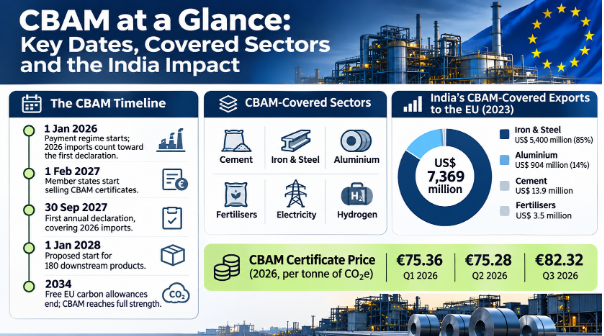
According to the European Commission's CBAM definitive regime page, CBAM was a reporting-only system from 2023 to 2025 and has become a payment scheme from 1 January 2026. It covers cement, iron and steel, aluminium, fertilisers, energy and hydrogen.
The EU importer pays, and the Indian seller feels it through the contract. Importers bringing in more than 50 tonnes a year will have to register as approved declarants and have certifications for the carbon emitted in the making of the products. Hydrogen is not subject to the limit (Article 2a(4) of Regulation (EU) 2025/2083). Buyers are likely to pass on the data request and probably some of the cost to vendors.
The Commission's price page lists €75.36 for the first quarter of 2026, €75.28 for the second and €82.32 for the third. Each certificate covers one tonne of carbon dioxide equivalent, and prices are updated weekly from 2027.
An Indian Tier-1 auto-components exporter in Madurai, Tamil Nadu, reportedly took five weeks to prepare and submit its greenhouse gas (GHG) emissions inventory after receiving a carbon-disclosure request from its European original equipment manufacturer (OEM) buyer.
According to Insight Industrial Services' published case study, the exporter lacked prior experience in GHG accounting. It needed an inventory covering Scope 1, Scope 2 and selected Scope 3 emissions, prepared in line with the GHG Protocol and ISO 14064 requirements. The consultancy reports that the company submitted the required emissions data and retained an export contract worth ₹12 crore annually.
The story shows the practical dilemma facing Indian exporters: responding to emissions-data requests may entail more than just gathering electricity bills and fuel records. Companies may need to develop data gathering processes, calculate emissions across activities and supply chains, and generate a report compliant with the buyer’s needs.
The five-week schedule and commercial result, according to the consultancy that carried out the task. The exporter’s name is not disclosed, and the original dates of the buyer’s request and submission are not public. The timetable should therefore be seen as a case scenario, not an independently validated industry average.
CBAM-covered exports from India to the EU were US$7,369 million in 2023, according to RIS Policy Brief No. 128. That is 8.2% of India's goods exports to the EU. Iron and steel accounted for about US$5.4 billion (85%) and aluminium for US$904 million (14%). Cement (US$ 13.9 million) and fertilisers (US$ 3.5 million) are small.
Aluminium exports roughly halved in one year, from US$1,801 million to US$904 million. The brief links the fall to the compliance burden and uncertainty. The EU buys about 17% of all Indian exports, and a national average of 8.2% can hide firms whose EU share is far higher.
A peer-reviewed study in Nature Climate Change (Vriz, Cojoianu, Fischer and Taschini, June 2026) found that high-emission firms in its EU-India steel data cut export quantities and revenues to the EU during the reporting phase, while low-emission firms held their levels. The paper puts India's direct steel emissions at 2.6 to 2.7 times the EU average in three major product categories.
The vulnerability could rise: on 17 December 2025 the Commission planned to add 180 downstream products, including machinery and appliances, with on average 79% steel and aluminium content. A July 2026 briefing from the European Parliament's research service reports no formal Parliament or Council position yet.
No. The Ministry of Commerce announced the agreement's conclusion on 27 January 2026. It records a "forward-looking most-favoured nation assurance" on CBAM flexibilities granted to other countries, technical cooperation on recognising carbon prices, and the recognition of verifiers.
Argus Media, a trade publication, reported that spokesperson Paula Pinho said there was "no commitment on the part of the EU to change our obligations" and that India would be treated no more favourably than other states. The agreement opens technical talks and gives exporters no exemption.
The Commission allows importers to deduct a carbon price already paid during production. India's Carbon Credit Trading Scheme (CCTS) is the obvious candidate. The government notified emission intensity targets for aluminium, cement, chlor-alkali and pulp and paper in October 2025 (International Carbon Action Partnership), and for 208 more units in refining, petrochemicals, textiles and secondary aluminium on 13 January 2026 (PIB).
Two gaps matter. First, steel is India's largest CBAM export, and its target is still a draft. The Bureau of Energy Efficiency's carbon market page lists the iron and steel rules as a draft and shows no fertiliser target. The environment ministry issued a revised draft for 255 iron and steel units on 26 June 2026, Madhyamam reported. Second, RIS notes that India's scheme is based on emission intensity per unit of output, while the EU system caps absolute emissions. Whether the EU will count a CCTS credit as a carbon price paid is unsettled.
Green hydrogen is the answer to the part of the problem that efficiency and renewable power cannot reach: carbon released by the chemistry of making steel and ammonia. It is not the first move, because it is not yet available at a workable price or scale.
On steel, RIS notes that coal-based blast furnaces dominate Indian production. Scrap-based electric arc furnaces, which melt scrap with electricity, can cut emissions by more than two-thirds, and gas-based direct reduced iron (iron made without a blast furnace) also helps. Hydrogen can replace the gas or coal that strips oxygen from iron ore in that process, and that is the job hydrogen can do. The Press Information Bureau (PIB), the government's press agency, reported in a release of 24 March 2026 that five pilot projects have been sanctioned for hydrogen use in steel.
On cost and scale, a 25 March 2026 release from the Ministry of New and Renewable Energy (MNRE) put the price of green hydrogen for refineries at Rs 397 per kg (Indian Oil) and Rs 387 per kg (Bharat Petroleum and Hindustan Petroleum), including 18% goods and services tax (GST). Commissioned capacity was about 8,000 tonnes a year as of February 2026. Against the National Green Hydrogen Mission target of 5 million tonnes a year by 2030, that is 0.16%. Awarded capacity is higher: the PIB release lists 862,000 tonnes a year awarded to 18 companies, about 17% of the target. On these numbers, treat the hydrogen steel route as a decision for the late 2020s and early 2030s.
Fertiliser is a separate issue. India's fertiliser exports to the EU were only US$3.5 million in 2024 (RIS), so CBAM exposure there is limited. A PIB release of 30 March 2026 frames green ammonia contracts for fertiliser units around energy security and lists prices of Rs 49.75 to 64.74 per kg, against an international benchmark of about €1,000 per tonne (roughly Rs 110 per kg). For the 2027 declaration, the focus is on measurement, verified data, scrap, and renewable power.
Indian steelmakers are starting to include carbon accounting into the day-to-day running of their plants. SAIL (Steel Authority of India Limited) launched a CO₂ dashboard for its Bhilai Steel Plant and Chandrapur Ferro Alloy Plant in August 2026. “The platform allows teams to monitor emissions on a daily basis at the plant and individual shop levels so that they can spot deviations and take corrective action,” the Ministry of Steel, India, said. Its stated methodology is based on the World Steel Association framework, the GHG Protocol and the EU’s Carbon Border Adjustment Mechanism (CBAM).
But better monitoring methods don’t fix every emissions-data challenge, by any means. An examination of data collected from over 70 Indian steel factories revealed discrepancies between stated emissions and fuel consumption and production levels at several plants, Mint said in March 2026. The different ways of calculating also made it hard to have a uniform baseline for emissions. The findings had forced the Steel Ministry to examine the data utilised for India’s carbon market structure.
The practical challenge is therefore twofold: plants need systems that track emissions at an operational level, and they also require reliable processes to reconcile energy consumption, production volumes, and emissions calculations. For suppliers responding to international buyers, the ability to produce consistent, traceable and defensible emissions data matters as much as having a dashboard to display it.
Note: The dashboard details are reported by the Ministry of Steel. The data inconsistencies were reported at the wider sector level and should not be interpreted as findings about SAIL's Bhilai plant specifically.
RFNBO stands for renewable fuels of non-biological origin: green hydrogen and fuels made from it, such as ammonia and methanol. The EU rules for what counts as RFNBO apply to producers outside the EU on the same terms as EU producers, the Commission states. Renewable hydrogen must achieve at least 70% savings in greenhouse gas emissions, which the European Parliament's research service equates to about 3.38 kg of carbon dioxide per kg of hydrogen.
For electrolysers that buy renewable power through the grid, Delegated Regulation (EU) 2023/1184 sets out three tests, as summarised by the same research service:
Electrolysers in operation before 1 January 2028 are exempt from additionality until 1 January 2038, per the same briefing. The revised Renewable Energy Directive sets targets that 42% of hydrogen used in EU industry comes from RFNBO by 2030 and 60% by 2035 (Council of the EU, 9 October 2023). The rules may change. The Commission page schedules a review for July 2028. A September 2026 joint industry letter says the Commission announced it would bring the review forward but has not yet published a proposal and asks that full additionality and hourly matching be delayed until 2035.
India's own definition is separate. MNRE's standard allows no more than 2 kg of carbon dioxide equivalent per kg of hydrogen, averaged over 12 months (PIB, 19 August 2023). That looks stricter than the EU's 3.38 kg, but India measures only up to the plant gate and the EU counts the full life cycle, so the two cannot be compared directly. Do not assume an Indian label satisfies an EU buyer. Model both a strict and a softened EU rulebook before signing long-term purchase contracts.
Take a worked example of 1,000 tonnes of Indian hot-rolled flat steel imported into EU Q3 2026. This gives the CBAM certificate a computed price of €277,600 based on the EU’s default emissions value of 4.28 tonnes of CO₂ equivalent per tonne, the 2026 mark-up, the relevant benchmark adjustment and the official certificate price of €82.32.
This is a sample calculation; this is not a real invoice from the supplier. But it highlights the business importance of emissions data. The computation employed by an EU importer is subject to applicable restrictions and modifications and may alter if installation-specific emissions numbers are verified.
"Indian exporters are already facing practical problems. In October 2026, Down To Earth reported that West Bengal-based Binayak Hi-Tech Engineering encountered delays in client orders from Europe as customers wanted to clarify on CBAM. The company’s managing director also referred to the problems in acquiring the power emissions data needed for the product level calculations, despite having repeatedly asked its electricity supplier for eight to nine months.
The official CBAM communication template of the European Commission indicates what information providers might need to provide: installation details, production routes, product-specific emissions, data sources and supporting verification information.
Together, these examples highlight the issue for Indian manufacturers: preparing a defensible emissions report requires more than calculating a factory-wide carbon footprint. Companies need traceable data that connects production, energy use, purchased materials and the specific products supplied to European customers.
From the above blog, it is clear that understanding policy, certification and incentive requirements is essential for the industry doing business with the EU. Here green hydrogen can play a pivotal role in the future of these businesses. If you are in a similar kind of business or someone looking to enter, we highly recommend building your knowledge of the sector with evACAD’s Advanced Green Hydrogen Master Program.