Recently, IIT Bhubaneswar has introduced something that engineers on the job need to keep an eye on. In May 2026, IIT has introduced a Blended Mode M.Tech in Electric Vehicle Technology, designed for working individuals who cannot take time off work to pursue a full two-year program [News 1]. The programme represents one of the newer IIT initiatives focused specifically on EV technology for working professionals.
Why does that matter? The market value of EV batteries in India is forecasted to increase from USD 2.71 billion in 2025 to USD 15.90 billion in 2034 at a compound annual growth rate of 21.70% [3]. In other words, there will be a huge demand for individuals who can understand the ins and outs of EV batteries, electric drive trains and charging systems.
This article will help you understand the IIT Bhubaneswar Executive M.Tech EV Technology course. You will learn more about its curriculum structure, eligibility criteria, evACAD's role, and practical value for your career.
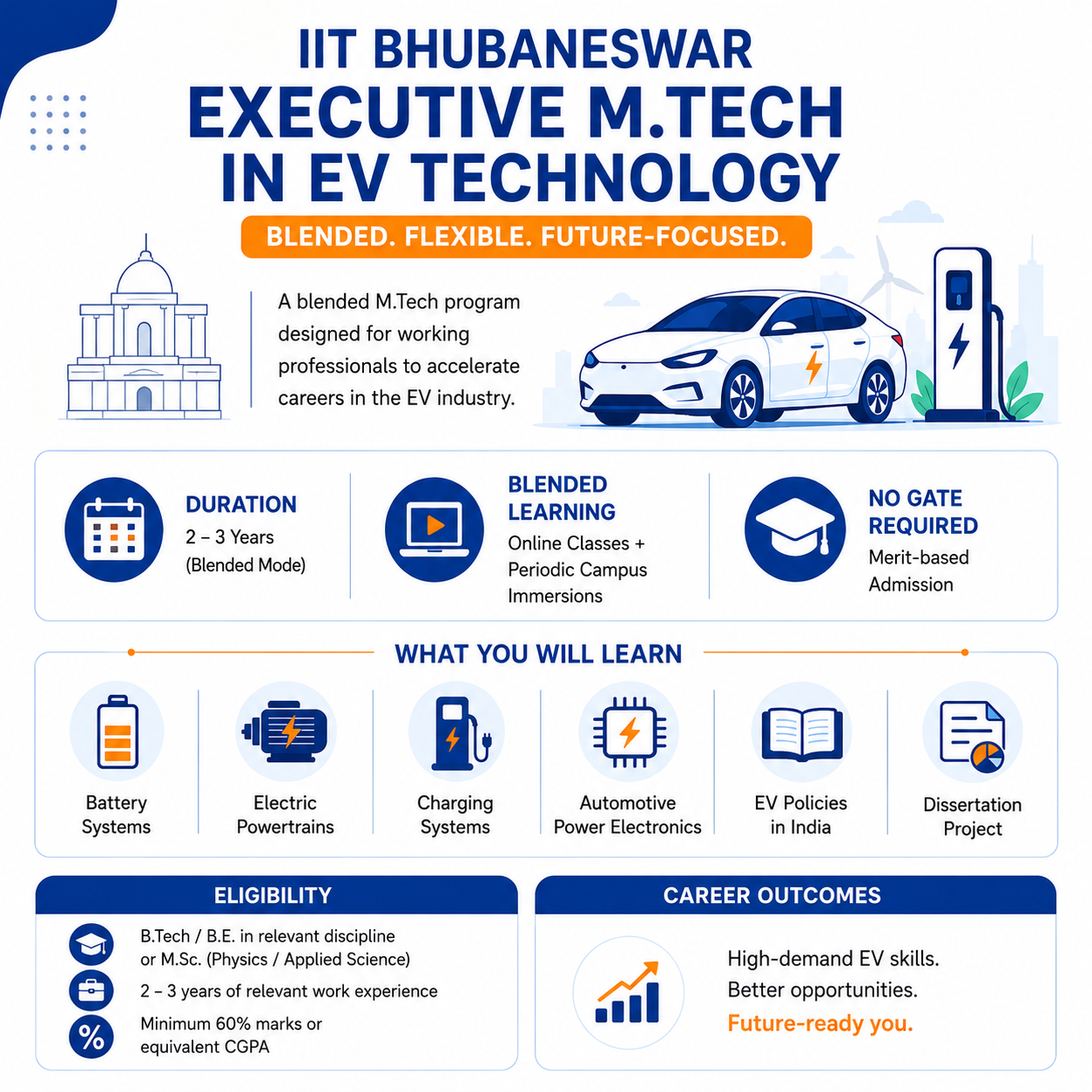
IIT Bhubaneswar has been active in engineering research before. However, this programme is significant because it represents IIT Bhubaneswar's formal participation in postgraduate education dedicated to EVs The programme, IIT Bhubaneswar M.Tech EV Technology, has been developed as a blended programme, which means it includes both online and offline classes held periodically [News 1].
What makes this important? This is because most M.Tech programmes from other IITs require attendance and a GATE score. This particular one doesn't. The programme is meant for practising engineers, managers, and technical leaders who work in the automotive, energy, and manufacturing sectors.
This programme also indicates a certain trend. IITs understand now that traditional classroom-only courses do not address the issue of professional re-skilling. There are 150,000 to 180,000 professionals working in EVs in India today. And about 35% of professionals working in the ICE sector will have to get their skills upgraded for the purpose of working with EVs [1].
The IIT M.Tech EV Technology course is carried out in a blended learning format for two to three years. This means you have to attend online classes through the Internet on weekdays/weekends and also pay visits to the IIT Bhubaneswar campus from time to time.
The syllabus includes:
You will also be undertaking a dissertation project. This is where the course program really becomes relevant. Candidates normally base their dissertations on practical problems that exist within their companies. Should you be working for a manufacturer of automotive parts, your dissertation topic could include enhancing a process involved in assembling a battery pack or designing a motor controller.
Campus immersions usually take up one to two weeks per semester. This offers students opportunities to utilise laboratory facilities and interact with faculty members in person.
In addition to technical know-how, the programme enables participants to gain a system understanding of electric vehicles’ design, battery management, charging infrastructure, and power electronics. This becomes more and more useful as the auto, manufacturing, and energy industries continue to incorporate electric mobility solutions.
Eligibility for the IIT Bhubaneswar Executive M.Tech EV Technology programme is fairly straightforward. Here's what you'll generally need:
There is no involvement of GATE in this admission process. Rather, it follows the following sequence of steps:
Do not take the statement of purpose lightly. Admissions committees will be looking for applicants with strong motivations for choosing the degree and plans for using it. Do not offer generic responses.
Such a program could prove highly beneficial to those working in fields such as automotive engineering, manufacturing, energy, electronics, charging systems, and the like, who wish to move into EV-related positions but do not wish to quit their current employment.
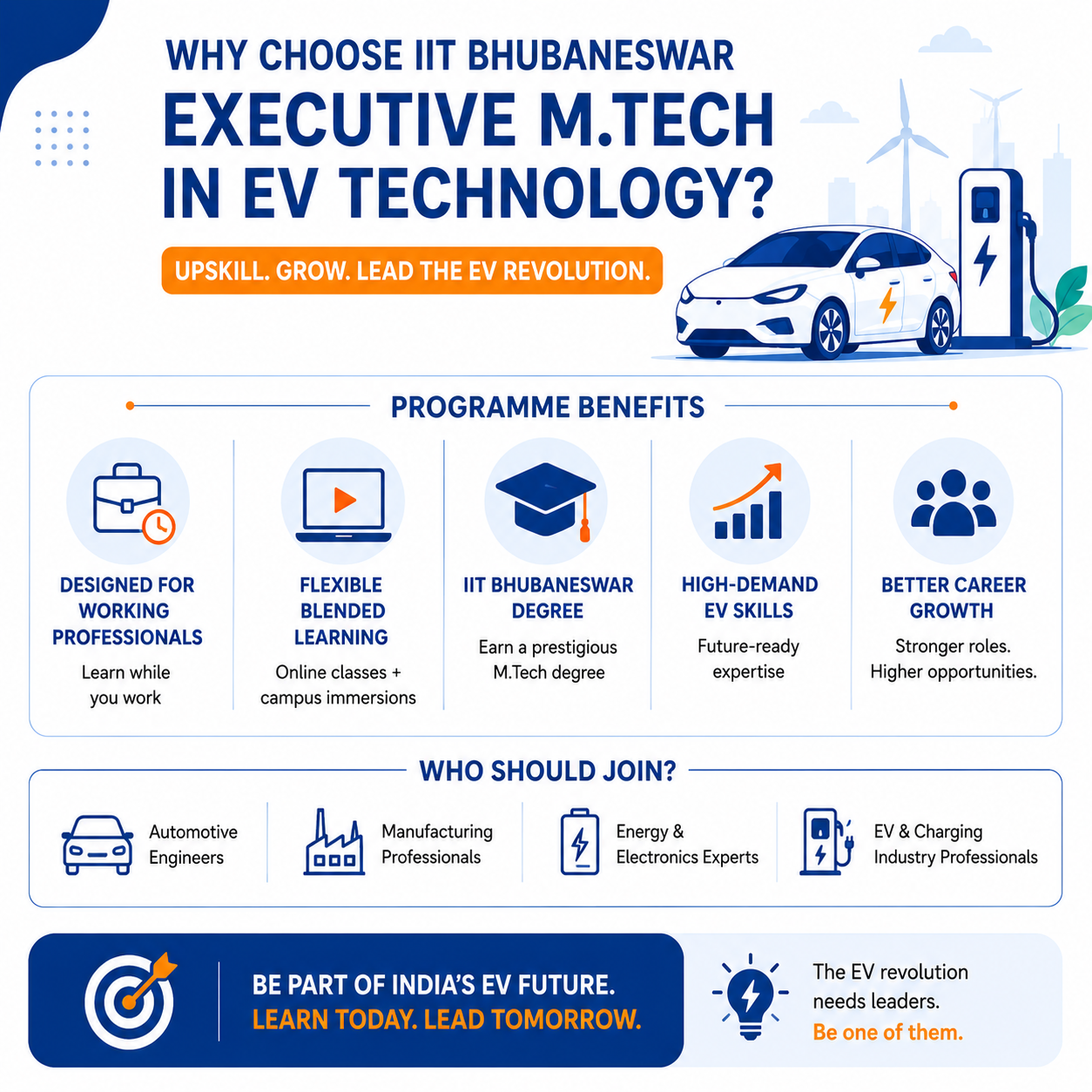
The executive programme offered in conjunction with evACAD does not merely entail brand affiliation for IIT Bhubaneswar; rather, it entails contributions to its operational infrastructure as well.
To elaborate, evACAD plays a significant role in handling the logistics behind the executive programme for working engineers. Consider evACAD to be the connecting link between the academic excellence of IIT Bhubaneswar and the flexibility needed by the working professional. The programme ensures smooth facilitation of course delivery, mentor coordination, and industry projects.
Furthermore, evACAD contributes inputs to the course structure and content as well, ensuring relevance to industrial needs. Even though IIT Bhubaneswar contributes the academic foundation and faculty, evACAD's involvement brings the practicality and relevance required by executive programmes.
As such, despite the fact that EV certification programs usually take less time to complete and tend to focus more on practical skills, the Executive M.Tech offers a postgraduate degree, which is academically richer and has additional research components, making it more valuable in the long term for one's career.
Now, we shall see what opportunities will open up with this type of degree. In terms of direct employment, which would be just for EV-manufacturing firms only, this will grow from 0.10 million in FY2025 to 5.41 million, with a full electric vehicle scenario until FY2047 [2]. The demand curve is rather steep; and this is just the beginning.
With the IIT Bhubaneswar M.Tech EV Technology degree, one could choose any of the following career options:
The IIT Bhubaneswar degree can be seen as positive by several organisations due to the academic reputation of the university. In addition to having relevant work experience, the degree can increase the chances of getting a position in EV.
Individuals who complete this programme could pursue careers as an EV Design Engineer, Battery Systems Engineer, Charging Infrastructure Expert, Power Electronics Engineer, EV Product Development Engineer, Technical Consultant, and EV Research Engineer. Whether or not an individual is qualified for any of these careers depends on their previous experience and area of expertise gained through the program.
Industry Viewpoint
The development of specific graduate courses for EVs indicates a change in the skill set needed by companies in the industry. With the advancement in EV technology, companies will now require individuals who are capable of not only having engineering skills but who also understand batteries, power electronics, charging stations, and energy systems. Such courses are being designed based on industry needs.
The current biggest challenge in the sector is not about a lack of employment opportunities but the fact that there is a dearth of professionals having technical skills for the job role. The requirement here includes people who can deal with issues related to battery systems, power electronics, EV charging, embedded systems, and electrical powertrains.
Unfortunately, a lot of professionals currently employed in the automotive industry, manufacturing industry, and energy sector are educated on the basis of conventional technologies only.
It means that professionals who have a mix of experience in engineering practices, along with an understanding of EVs, can be quite advantageous for companies working within the domain. Such professionals will be more effective in product development, manufacturing, testing, and other related tasks.
It is due to the rising skill gap that EV technology-focused postgraduate executive programs have become quite popular.
Some IITs provide executive/blended M.Tech courses. For example, IIT Madras and IIT Bhilai have their own versions. Then why go for IIT Bhubaneswar's course?
First off, the specialisation. Many other M.Tech courses incorporate Electric Vehicle-related content in general Mechanical or Electrical streams. But this program is entirely focused on Electric Vehicles. All subjects, all lectures, all research projects are connected to the EV field.
The second aspect of choosing this particular M.Tech course is the involvement of the evACAD company. Mentorship, aligning the industry projects and developing professional networks can add additional value to your two-year experience.
Finally, this program is convenient in terms of logistics for people coming from eastern regions of the country. When combining a full-time job with periodic university visits, geography may play an important role.
But again, any course has pros and cons depending on the region and career expectations of its participants.
IIT M.Tech EV Technology from IIT Bhubaneswar is a credible postgraduate program to explore the field of EVs The course structure includes all the essential areas, the learning model suits your professional routine, and the evACAD collaboration gives additional industry insights. In terms of a specialised program for experienced engineers, it represents one of the specialised postgraduate options available for professionals seeking EV-focused education.
The industry of electric vehicles in India has already passed through the experimental stage. Thanks to upcoming gigafactories and increasing EV sales on a yearly basis, experts willing to obtain specialised education today will become the leaders in teams and projects in several years. Professionals considering a transition into EV-focused roles may benefit from evaluating upskilling options early as the sector continues to evolve.
If you're considering the variants of executive M.Tech in EV Technology, evACAD is the resource that will assist you in comparing the programs and understanding their requirements for applicants.