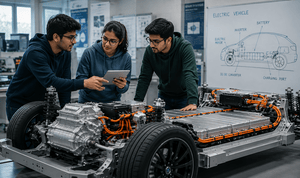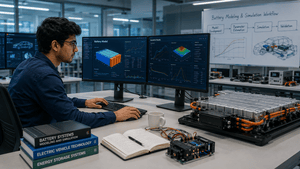
Remove the engine from a vehicle and replace it with a battery and motor, and almost every number on the spec sheet changes its meaning. Displacement stops mattering. Battery capacity and motor output take over. And underneath all that, the engineering changes too: liquid cooling, different structural loads, and a lot more simulation work before anything gets built, because electric drivetrains just don't behave like combustion ones.
The Nexon makes for a clean comparison because Tata sells it in petrol, diesel, and electric form on basically the same body. So whatever differences show up are really about the powertrain.
Start with power. The long-range Nexon EV, the 45 kWh version, uses a permanent magnet synchronous motor putting out up to 142 bhp. The smaller 30 kWh version makes a bit less. Both get the same 215 Nm of torque, straight from Tata's own numbers.
Torque is where you actually feel the difference behind the wheel. A petrol engine needs revs before it hits peak torque. An electric motor delivers all its power instantly, even from a standstill. That's why the Nexon EV feels quicker off the line than its power figure alone would suggest.
Then there's energy storage. Petrol Nexon: 44-litre tank. EV: a 30 or 45 kWh battery. You could try converting litres into kWh and putting the two side by side, but it's a bit of a tricky comparison since a petrol engine burns off most of that energy as heat before it ever reaches the wheels, while an EV's battery-to-wheel losses are much smaller. A full tank technically holds more energy than a battery pack does. Most of it just never gets used.
You can see this in the actual running costs. A petrol Nexon burns through roughly 0.5 kWh-equivalent of fuel per kilometre. The EV manages the same distance on something like 0.13 to 0.15 kWh. That gap, using a third or a quarter of the energy, is basically the whole reason EVs are so much cheaper to run per kilometre.
One more figure worth mentioning: the Nexon EV can climb a 34% gradient. Instant torque from zero rpm helps here too; it's not something a combustion engine can match at low revs.
Cargo vehicles don't care about any of the above unless it shows up in payload and uptime. So it's fair to ask whether an electric three-wheeler actually holds up.
The Piaggio Ape E-Xtra is a decent test case, though it comes in a few trims – E-Xtra, E-Xtra FX, and E-Xtra FX Max – with slightly different numbers depending on which one you're looking at.
Roughly: The payload sits at 506 kg, in line with the diesel and petrol versions in the same class. The range runs 90 to 120 km on a charge, depending on the trim and how loaded it is. An 8 kWh battery drives a motor that ranges from about 5.4 kW up to 9.55 kW across variants. A full charge takes approximately 3 hours and 45 minutes.

Similar analysis has been done for a three-wheeler loader. Piaggio Ape Extra is available in petrol and electric. In passenger…You have CNG, LPG and electric available again - Piaggio Ape City. In fact, in electric, you have in Piaggio Ape City, you have two versions. One is with swappable battery and one is with a fixed battery.
Buses and light trucks have different requirements than passenger EVs. A few things need resetting here.
Most run a single-speed gearbox; thus, the electric motors don't need multiple gears to stay efficient the way an engine does. So top speed stops being the priority; low-end pulling power is. And range drops noticeably under a full load, same as it would for any powertrain moving more weight.
Charging is the bigger adjustment. Diesel takes fifteen minutes at a pump. An electric truck needs at least an hour at a fast charger before it's worth pulling back out. That's a genuine scheduling headache, but many fleet operators have found the lower running costs make up for it. So they plan around charging windows instead of fighting them.
Worth knowing too: hammering a battery with fast charges to 100% and running it down to empty wears it out faster. Most commercial operators aim for something gentler, like a couple of hours on a charger, planned in advance, rather than a rushed top-up, just as standard fleet practice to keep the battery healthy over its working life.


None of these factors – torque curves, gradeability, or battery-to-wheel efficiency – remain theoretical for long once you start working in this space. If any of this resonates with you, there are next steps depending on how deep you want to go.
If you want the full engineering picture – not just motors and batteries, but also the systems thinking that ties them together – then the M.Tech in EV Technology picks up right where this article leaves off as a full academic credential you can pursue alongside your job. [Explore the M.Tech in EV Technology → Click Here]
If it's specifically the drivetrain and battery side that's got your attention, the Professional Diploma in e-Drives and Battery Systems goes deep on exactly that: motor control, battery pack design, and thermal management, in a shorter and more focused format. [Explore the Diploma in e-Drives and Battery Systems → Click Here]
And if you'd rather build this fluency gradually, on your own schedule, our self-paced programs cover the fundamentals and industry context without locking you into fixed timings. [Browse self-paced programs → Click Here]