You have years of experience in the automobile industry or in manufacturing. You've known the ins and outs of production plants. But every time you go through a new opportunity, you realise that the recruiters want you to be an expert in EV technology, batteries and powertrains, which you have no notion about since your B.Tech school didn’t offer these courses.
The market value of electric vehicle technology in India is USD 3.71 billion in 2025 and is predicted to reach USD 191.04 billion by 2034 with a CAGR of 54.94% [1]. This is a market that grows 50-fold in 10 years. Such engineers are needed to make this happen, but they have work to do, as well.
This article will look at the contents of the executive M.Tech courses in EV technology, their suppliers and what these courses can provide to professionals in India.
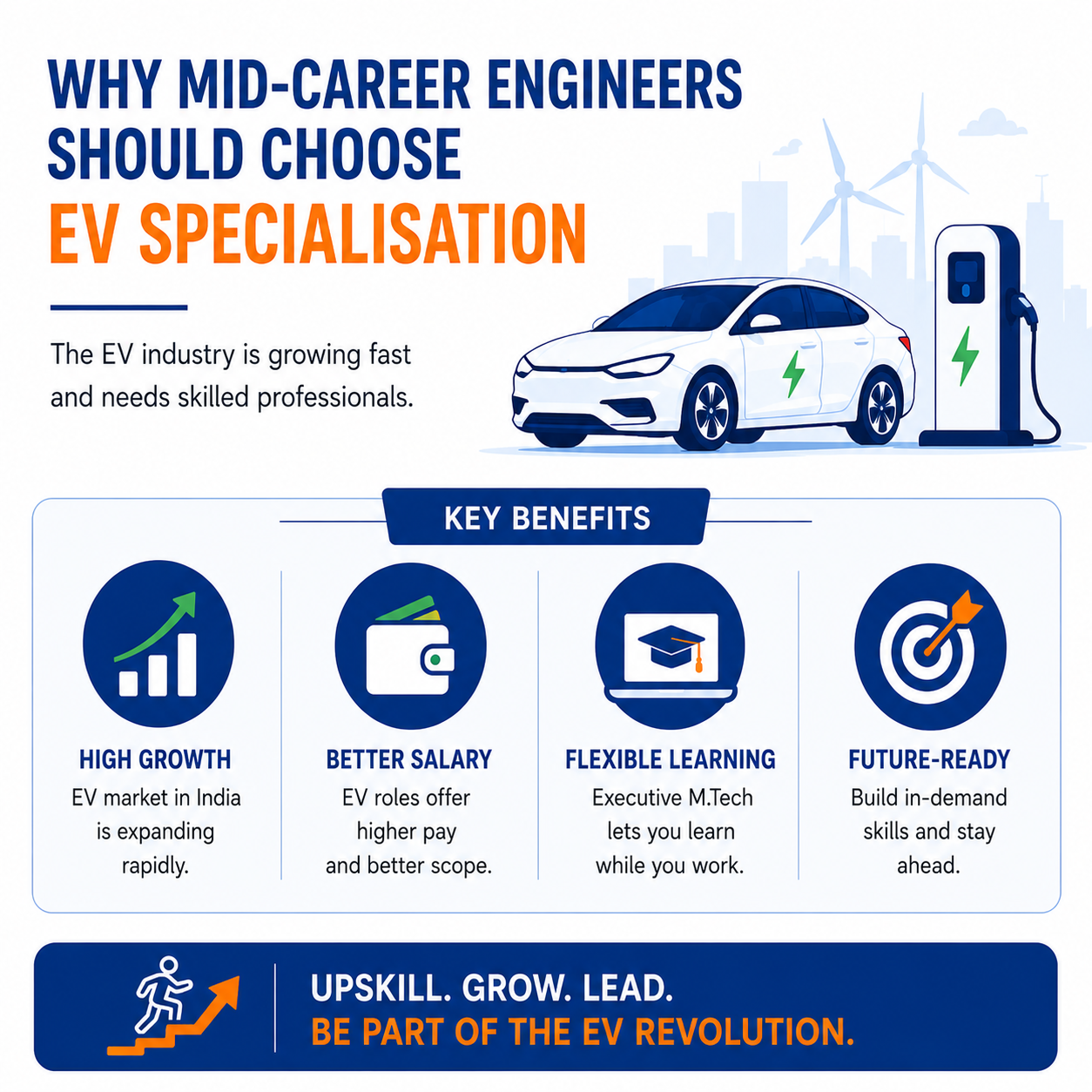
It’s hard to miss these recruiting patterns. Salaries at the entry level for EV roles in India are 45-50% more than for comparable roles within the automotive sector [2]. India's EV sales grew 79% in May 2026, driven by Tata Motors, Mahindra and others [News 2]. Mahindra alone has invested INR 120 billion over the past three years to create its EV division [3].
With each new factory and research centre in this industry, there is a demand for engineers who are conversant with this technology on a system-wide basis. But it wouldn’t be an option for any of the engineers who are presently on the job to take two complete years off. This hybrid mode Executive M.Tech for working professionals brings world-class IIT education to fit in your work life.
The technologies being used in electric vehicles are relatively new, but the problems facing the companies are mostly in the areas of manufacturing, quality assurance, systems engineering, testing, supply chain management and product development, where there is already a lot of experience with qualified engineers.
This is why corporations are not just looking for graduates but also for those who will be able to exploit their wide knowledge in engineering relating to technologies like batteries, power electronics, EV chargers and electric powertrains.
Executive postgraduate programs can help bridge this gap to a great extent.
Executive M.Tech in EV Technology is a PG course for working people. It is a postgraduate programme for working professionals and is offered by approved institutions in a flexible learning approach. This includes online classes during the week or weekends, and occasional trips on campus (once or twice a semester).
The training is delivered over a period of 2-3 years. No need to appear for the GATE test. Your eligibility will be determined based on your educational qualifications, work experience and an informal chat with you. You will finally write and submit a dissertation on some practical subject connected to your profession. Many working professionals lean on AI tools to speed up first drafts of technical write-ups. If this is you, running your dissertation through a Humanize AI before submission can help keep the tone natural and in your own voice.
Not for everyone. But it will suit those like mechanical or electrical engineers who want to get into electric vehicles, those with mid-career experience moving away from internal combustion engines, startup entrepreneurs who build products around electric vehicles or research and development engineers who need credentials as well as experience.
What are they all about? The answer is, they are all practically experienced in the field of electric vehicles, but they do not have the structured knowledge to make the next step. An electric vehicle technology degree for working professionals is not a starting point.
IIT Bhubaneswar launched its Blended M.Tech in Electric Vehicles through evACAD in May 2026, beginning the program in July 2026 [News 1]. No need for GATE. The addition of evACAD brings industry expertise and curricular recommendations from the employer's viewpoint.
IIT Madras is launching an M.Tech in EVs as part of its executive education programme. IIT Madras is reputed to be one of the strongest in terms of brand amongst Indian engineering universities and has great research facilities.
IIT Bhilai launches Executive M.Tech. in Advanced Electrical Vehicle Systems. Location is affordable and convenient for Central India professionals.
In the comparison, fee structure, logistics associated with immersion in the campus from your city, research interests of teachers and industrial association model. Tuition costs range from Rs. 2.5 lakhs to Rs. 5 lakhs.
Another challenge in the EV business is not just creating employment possibilities but the requirement for experts that have the right skills coupled with adequate EV-related know-how.
Development and integration of technologies, including battery management systems, charger technology, power electronics, embedded system technology and energy storage technology, requires specific technical skills, which were not taught in many ordinary engineering schools.
This has therefore enhanced the necessity of planned upskilling programs.
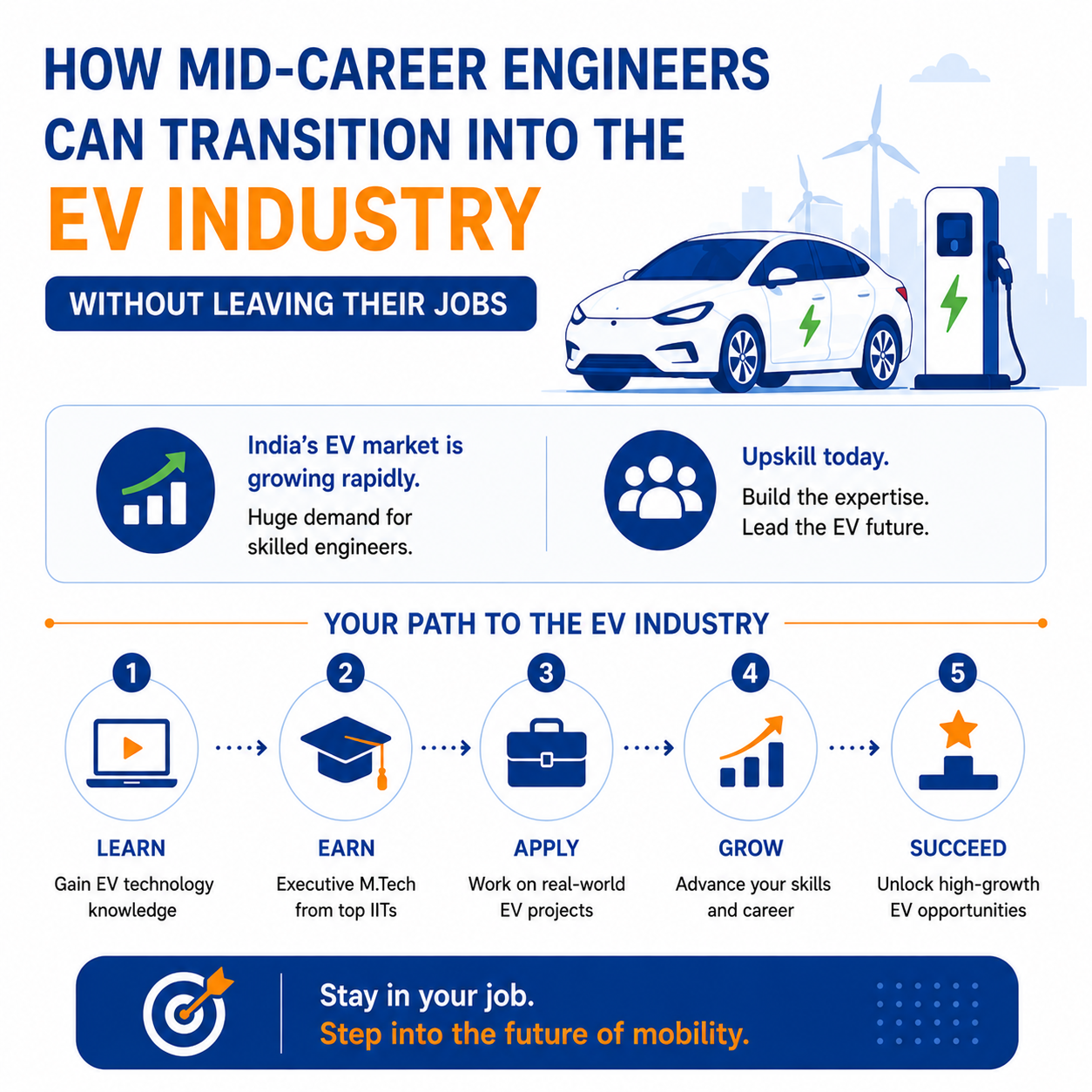
An Executive M.Tech in EV Technology from an IIT opens doors that are hard to reach otherwise:
Qualifications from recognised IITs may be viewed positively by employers because of the institutions' academic reputation and industry recognition.
Based on their previous experience and technical knowledge base, students pursuing a career in EVs at the postgraduate level can pursue job titles including EV Design Engineer, Battery System Engineer, Charging Infrastructure Engineer, Power Electronics Engineer, EV Validation Engineer, Product Development Engineer, Technical Consultant, and EV Research Engineer.
What role will be pursued is determined by an individual’s industrial experience along with the specialisation domain that they wish to venture into. Nevertheless, the common requirement among all these career choices includes having technical knowledge of EVs alongside sound fundamentals of engineering principles.
evAcad Perspective:
Another pattern which we have observed more and more frequently in the EV space is that companies don’t only require employees with experience in EVs specifically. Several companies also place high importance on engineers who already have experience in manufacturing, product development, testing, quality management systems, or industry, and who can bring this knowledge into the world of EV.
Engineers with such skills are likely to be more capable of playing an active role in mobility projects going forward.
There are certain common eligibility criteria. One must have a B.Tech/B.E. degree from a suitable discipline, two or three years of work experience, and at least 60% marks in academic performance. There are four steps in the process, which include the following: online application, candidate profile checking, short interview, and finally, admission with fee payment.
The dates for applying in July 2026 batches are out now. The application form for the programme offered by IIT Bhubaneswar through evACAD will begin receiving applications from May 2026 [News 1]. Do not wait till the last minute.
The ‘Executive M.Tech in EV Technology’ is the answer to scale quicker than the skill pool. It offers a working professional an IIT-recognised graduate program without having to leave your job or appear for GATE.
IIT Bhubaneswar, IIT Madras and IIT Bhilai all have their distinct merits. The course curriculum covers everything that the EV business needs. Its blended mode understands your commitments. The career chances are driven by a booming market.
Ready to browse the courses and find the best fit for you? Then evACAD can guide you all the way to pick the perfect ‘M.Tech for working professionals in India.