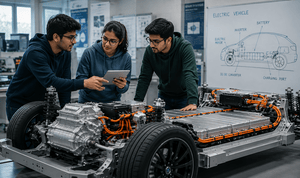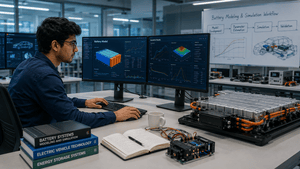
The automobile industry is witnessing one of its largest ever technological revolutions. With increasing use of software, artificial intelligence, computer vision, connectivity, and cybersecurity on top of mechanical engineering in modern automobiles, the importance of engineers who have multiple technical skill sets is increasing in this industry.
India Automotive ADAS Market size will reach a value of USD 1.36 Billion in 2026, from USD 736.4 Million in 2021, at a CAGR of 18.12% [1]. Rapidly expanding market size is generating huge demand for engineers with specialised knowledge in ADAS software, sensors, functional safety, embedded systems, and connected vehicle technologies in OEMs, Tier 1s, and automotive technology companies.
In this blog, we discuss the topics that should be covered in an effective “ADAS course for engineers”, why India is fast becoming a global centre of ADAS development and how to enter this field with an automobile engineering background.
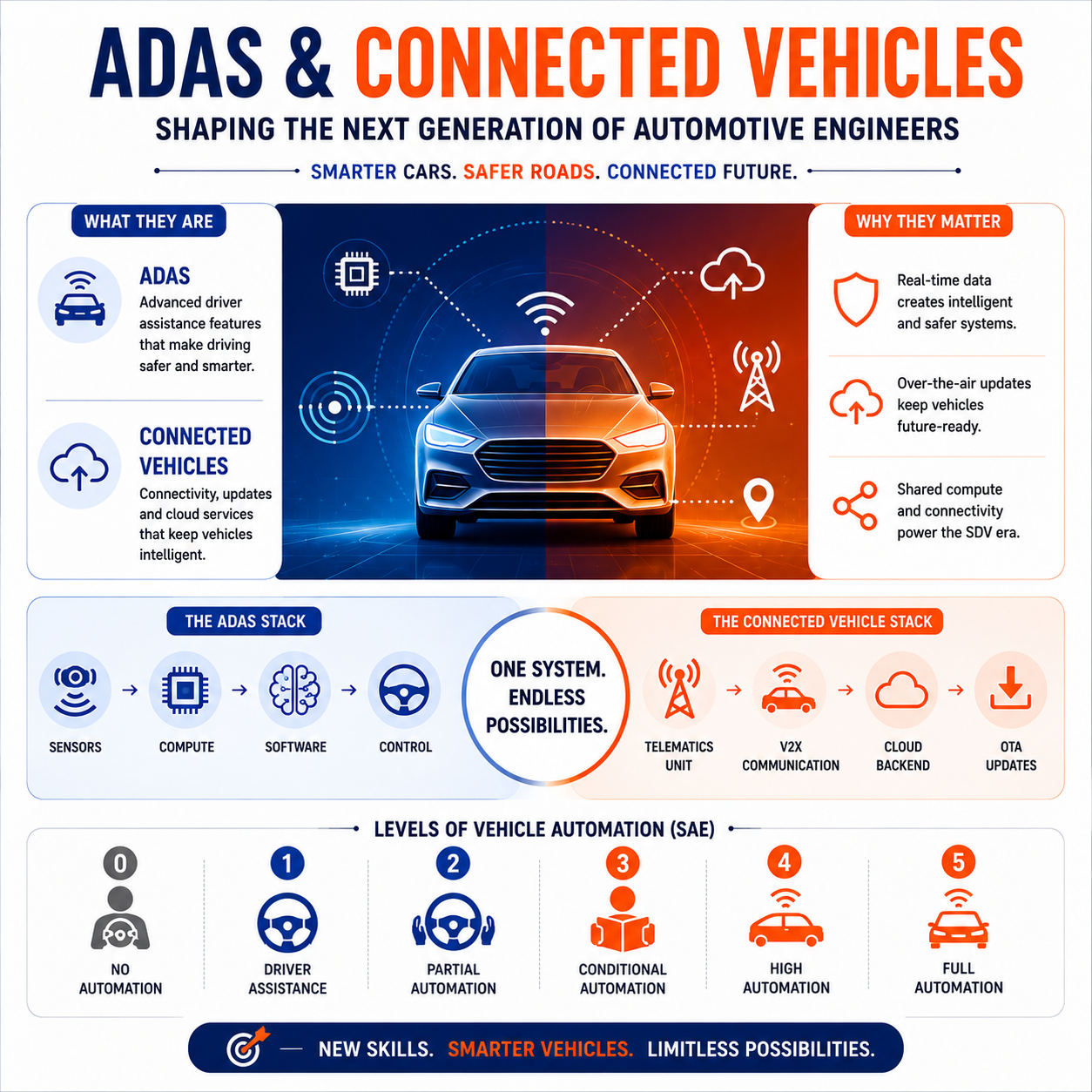
ADAS includes lane-keeping, adaptive cruise control, automatic emergency braking, blind spot detection, and parking assist. Connected cars include telematics, OTA update capability, V2X messaging, and cloud-based diagnostics.
Although the evolution of ADAS and connected vehicles occurred separately from each other, the current generation of software-defined vehicles is combining both of these systems into one. This is because connected cars have OTA updating, cloud diagnostics, and V2X communication capability, while ADAS creates continuous sensor input data for vehicle intelligence and autonomy.
The cameras, radars, ultrasonics, and LiDAR sensors contribute to a compute domain where the perception, fusion, planning, and control processes happen. The engineers who have a good grasp of not only the sensors but also the software pipeline utilised in perception, sensor fusion, planning, and control are highly sought after.
Telematics control unit, cellular V2X, DSRC, cloud backend, and OTA update pipeline. The cybersecurity considerations that are incorporated into the modern connected vehicle architecture include those that have been established by the United Nations Economic Commission for Europe (UNECE) in Regulations R155 and R156.
With the software-defined vehicle, ADAS and connectivity share hardware infrastructure like computing power, memory space, and bandwidth. This means an automotive engineer becomes a systems software engineer in one job description.
Understanding SAE Levels of Driving Automation helps engineers distinguish between today's driver assistance technologies and future autonomous vehicles.
Most vehicles currently sold in India operate at Level 1 or Level 2, making ADAS expertise immediately relevant to today's automotive industry.
India did not become an ADAS hub by accident. Three forces converged in the last two years, and together they created a hiring wave with real duration.
Higher scores have been given to ADAS in Bharat NCAP. The Ministry of Road Transport and Highways plans to mandate AEBS, DDAWS, and LDWS for passenger cars having more than eight passengers starting April 2026 [News 1]. Regulatory measures are driving up the demand.
The installation rate for ADAS in Indian passenger cars has gone up from 8% in 2023 to more than 25% in 2026 due to the regulation of Bharat NCAP [2]. The consumer awareness regarding safety systems, such as adaptive cruise control, lane departure warning, automatic emergency braking, and blind spot detection, is increasing, leading to ADAS inclusion in many other vehicles.
The engineering hubs for ADAS from global OEMs operate in cities like Bengaluru, Pune, Hyderabad, and Chennai. India is not only the market anymore but also the place from which ADAS software is developed and validated.

Every ADAS role builds on four skill layers. Where you sit on each layer decides your seniority, your compensation, and how quickly you move up.
C++ and Python fluency, Linux and RTOS familiarity, matrix math, probability, and signal processing. If your ICE background missed these, this is your starting line.
Sensor fusion, Kalman filters, perception model training, path planning, motion control, ISO 26262 functional safety, and ISO 21448 SOTIF. These are the skills that command senior salaries.
Autosar (classical and adaptive), MISRA C++, model-based design with Simulink, and HIL and SIL testing. These fall in the intersection between hardware and software. These skills span many disciplines and can therefore be very useful when linking together embedded software with automotive engineering.
MQTT protocol, AWS/Azure IoT infrastructure, cybersecurity in accordance with UNECE R155/R156 regulations, and OTA update platforms. "Connected vehicle technology training" is precisely where the frontier is headed at present.
Unlike general automotive software, ADAS impacts the safety of the vehicle. Software developers must have functional safety knowledge when designing ADAS systems to make sure the system is predictable during normal and failure states. The guidelines, such as ISO 26262 and SOTIF, assist manufacturers in reducing any safety hazards throughout the development process.
Tata Motors, Mahindra, Maruti, Hyundai India, Bosch India, Continental, Aptiv, ZF, KPIT, Tata Elxsi, L&T Technology Services, Wipro. ADAS in India will be moving into an integration phase because of the emergence of centralised electronics and domain controller architectures [News 2].
Lane markings that vanish. Two-wheelers weaving through traffic. Cattle. Auto-rickshaws cutting four lanes. Perception models trained primarily on European or North American driving conditions often require significant adaptation for Indian roads, where diverse traffic behaviour, inconsistent lane markings, mixed vehicle types, pedestrians, animals, and varying infrastructure create unique challenges for ADAS development.
Transitioning into ADAS from a traditional automotive background is easier than the vocabulary suggests. Most engineers do not need to become software architects overnight. They need the right pathway.
Mechanical engineers move towards functional safety, HIL testing, and integration. Electronics engineers move to sensing technology and ECUs. Software engineers move to perception and planning. Engineers from each discipline have their own way of moving into ADAS using their existing expertise and gaining new systems/software engineering skills.
Sensor principles, perception pipelines, sensor fusion, planning algorithms, functional safety, basic AUTOSAR principles, and practical assignments based on real-world data. India still relies on the import of radar sensors, LiDARs, high-resolution cameras, and ASIL-D-certified electronic control units, with import dependence ranging from 70 to 80 per cent [4]. These issues will provide the basis for future localisation, product development, and research. evACAD offers comprehensive online courses covering these essential topics in detail.
Autonomous driving in India on Indian roads will be here within ten years from now. However, engineers for each current L2 and L2+ car must be hired right now.
"The India ADAS market is expected to grow with a CAGR of 20.60% from 2026 to 2035, and it will touch almost USD 17.96 billion by 2035 from USD 2.76 billion in 2025." [3]
evACAD Perspective:
Many automotive organisations have started to hire engineers who know how to develop software as well as vehicle systems. Individuals who can integrate knowledge about embedded software along with functional safety and system integration can be very helpful in various stages of the ADAS development process.
Automotive engineering is becoming more and more software-based. ADAS, connected cars, AI, cybersecurity, and cloud connectivity are revolutionising the ways of designing, developing, testing, and maintaining vehicles.
For engineers with a background in mechanical, electronics, electrical, software, and automotive engineering, specialising in such technologies presents an opportunity to be involved in one of the most rapidly developing fields of the mobility industry. In light of continued efforts by India’s automotive industry in developing intelligent and connected cars, professionals with cross-domain knowledge in ADAS will continue to be sought after.
evACAD's Smart Mobility ADAS, Autonomous, Connected program is tailored specifically for those engineers making such a transition. This program addresses the whole stack that Indian OEMs and Tier-1s are hiring for at present, ranging from sensor fundamentals to perception and functional safety to connected cloud.
[1] The India Automotive ADAS market is estimated at USD 1.36 billion in 2026 and projected to reach USD 3.12 billion by 2031 at 18.12% CAGR, with passenger cars accounting for 71.80% of the market in 2025 and two-wheelers growing fastest at 19.20% CAGR through 2031. (Source: Mordor Intelligence, 2026)
[2] India's passenger vehicle ADAS fitment rate has risen from an estimated 8% in 2023 to over 25% by 2026, driven by Bharat NCAP and GSR safety mandates. (Source: IndexBox, 2026)
[3] The India ADAS market is projected to grow at 20.60% CAGR between 2026 and 2035, reaching nearly USD 17.96 billion by 2035, from USD 2.76 billion in 2025. (Source: Expert Market Research, 2026)
https://www.expertmarketresearch.com/reports/india-adas-market
[4] Import dependence for ADAS core components remains at 70-80% for radar, LiDAR, high-resolution cameras, and ASIL-D-certified ECUs, creating a large localisation and engineering demand runway. (Source: IndexBox, 2026)
1. "Ministry of Road Transport and Highways Proposes Mandatory AEBS, DDAWS, and LDWS for Vehicles Carrying More Than Eight Passengers from April 2026" - Mordor Intelligence, January 12, 2026
2. "India ADAS Market Entering System-Integration Phase as Centralised E/E and Domain-Controller Architectures Become Industry Standard" - IndexBox, March 1, 2026