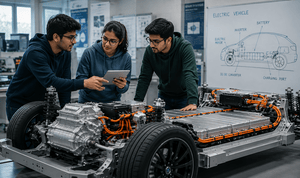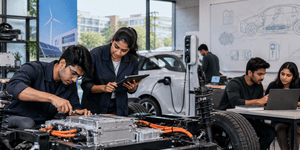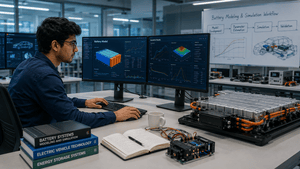
Picture this: you're no longer working on a car. You're building a computer on wheels. Or to be more accurate, a power bank with tires. That’s what today’s electric vehicles (EVs) are becoming.
The auto industry is no longer just about horsepower and fuel efficiency—it’s undergoing a systems overhaul. And the phenomenon driving this shift is called CASE:
Connected | Autonomous | Secured | Electric
Together, these pillars are shaping the vehicles of the future—and they demand new capabilities, new technologies, and new talent. In fact, more than 60% of global automotive companies are investing in EV job training and reskilling by 2025.
In India alone, SIAM forecasts a need for 200,000 EV-ready professionals by 2030, which translates to roughly 30,000 new skilled workers every year.
The sought after job roles now include IoT and cloud specialists, battery scientists, energy distribution experts, and control systems engineers—working together to build clean, connected, and intelligent transport solutions. For professionals across engineering, IT, and energy domains, this is not a diversion from their current career path — it is an extension of their expertise in a booming industry.
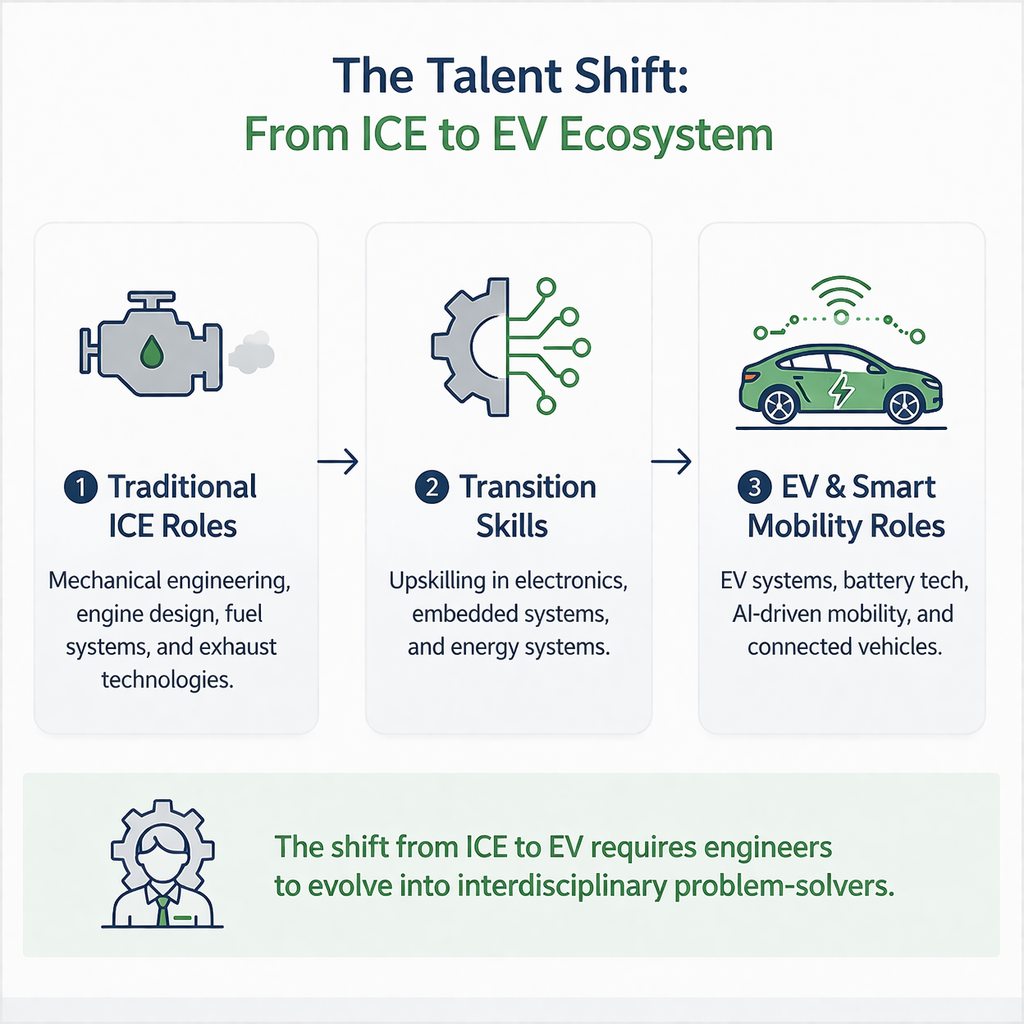
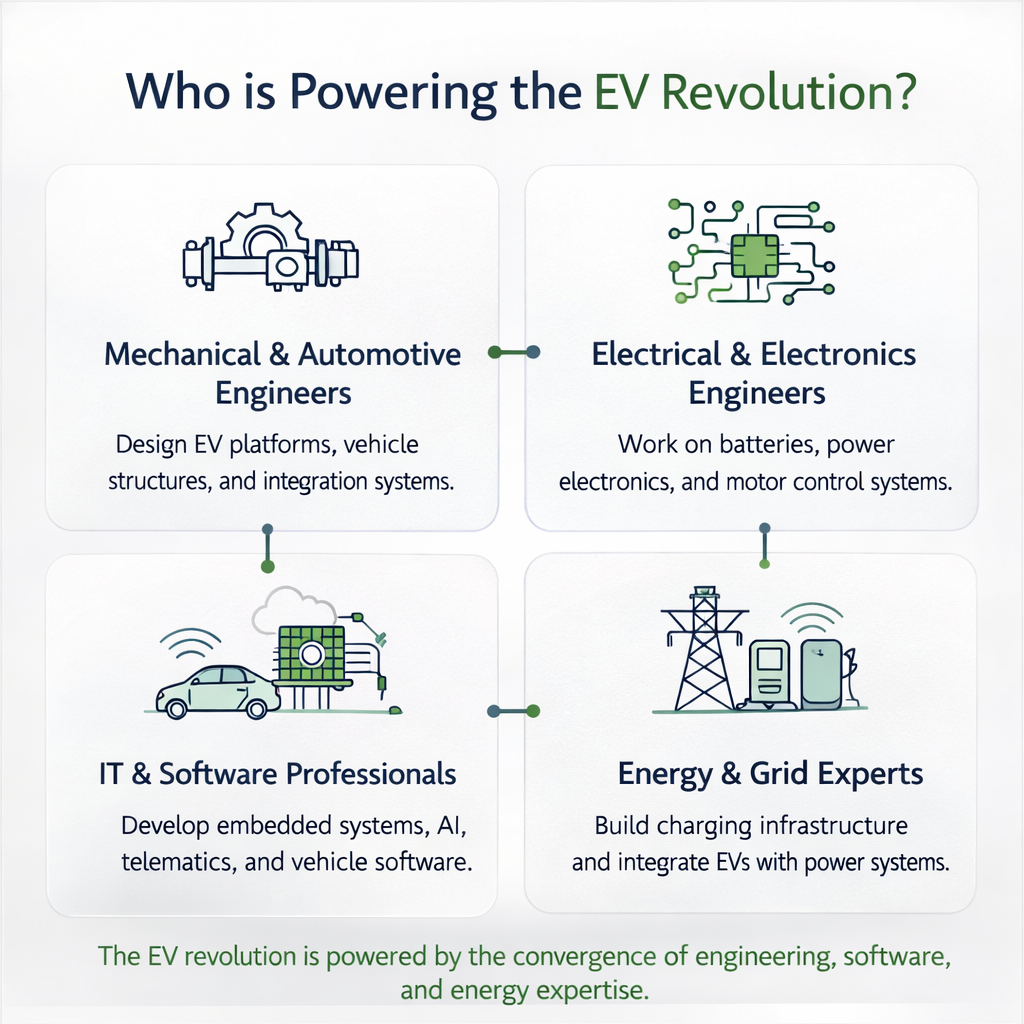
Engineers, from Mechanical Engineering, Automotive Engineering, Electrical Engineering, Electronics Engineering & Energy disciplines, have always been the backbone of innovation, and in the EV world, their roles are evolving rather than being replaced. Mechanical engineers who once designed IC engines are now working on thermal management for batteries, lightweight EV chassis, and electric drivetrains. Electrical and electronics engineers, who’ve built careers around circuitry, embedded systems, and automation, are now leading the charge in areas like battery management systems (BMS), power electronics, and traction motor controllers.
By 2025, the EV industry in India alone is projected to create over 10 million direct and indirect jobs, according to estimates from NITI Aayog and the Rocky Mountain Institute. A significant portion of these roles will require domain expertise that engineers already have—combined with a specialized understanding of EV-specific systems.
Modern EVs are essentially intelligent machines on wheels. From embedded firmware to cloud connectivity, the role of software and data is central to their performance. IT professionals—including software developers, data engineers, and cybersecurity analysts—are playing a pivotal role in building the brains behind EVs.
With experience in programming languages like Python or C++, and knowledge of AI and machine learning, software engineers are driving the development of smart control systems, advanced driver-assistance systems (ADAS), and predictive diagnostics. Cloud architects and IoT specialists are enabling real-time vehicle monitoring, while cybersecurity experts protect critical systems from potential threats, ensuring safety in an increasingly connected environment.
Beyond the vehicle itself, the EV revolution depends on energy infrastructure. Electric charging stations at scale require robust support from energy professionals—those who understand power distribution, load balancing, and renewable energy integration.
Professionals from oil & gas, thermal, solar, and wind domains are now central to the rollout of charging stations, solar-powered EV hubs, and battery enabled storage systems (BESS). As cities move toward smart mobility solutions, energy experts are essential in developing new innovative technologies such as grid-aware charging, demand forecasting, and V2G (vehicle-to-grid) models.
With government incentives and climate commitments pushing for cleaner transport, the shift to EVs is aligning tightly with energy sector transformation. It's a dual transition—and one that calls for cross-functional talent with both power and mobility know-how.
What sets professionals apart in the EV economy is not just what they know, but how fast they can adapt.
If you already work in simulation tools, embedded systems, high-voltage design, or automation, you're already halfway there. The rest is about assimilating & integrating EV-specific knowledge: lithium-ion chemistries, power electronics, electric motor topologies, and intelligent control.
This is where specialized EV courses and reskilling programs make the difference. They empower professionals to pivot into high-demand roles in these new & upcoming industries.
As India’s leading EV skilling and upskilling platform, evACAD partners with premier institutions to offer hands-on, application-focused programs tailored for the future of mobility. Whether you're a fresher entering the field or a mid-career professional looking to reskill, evACAD provides structured, industry-relevant education designed for real-world impact.
These programs reflect evACAD’s mission: to bridge the skill gap between traditional industries and the EV revolution by integrating real-world applications with academic excellence.
For professionals from engineering, IT, and energy domains, entering the EV space is less about changing careers and more about making a strategic shift. As the world accelerates towards low-carbon transportation, skilled individuals who act now will take lead in a sector defined by innovation, sustainability, and long-term relevance.
Electric mobility isn't just a trend—it's an evolution of the automotive & transport industry. And this evolution will need not just fresh minds, but also experienced hands with the vision to shape the future of mobility.
https://rmi.org/insight/indias-electric-mobility-transformation/
https://initiatives.weforum.org/reskilling-revolution/home
reddit.com+6reddit.com+6economictimes.indiatimes.com+6business-standard.com+15worldmetrics.org+15reuters.com+15