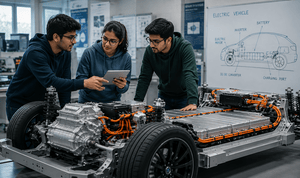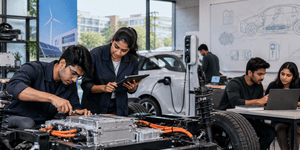
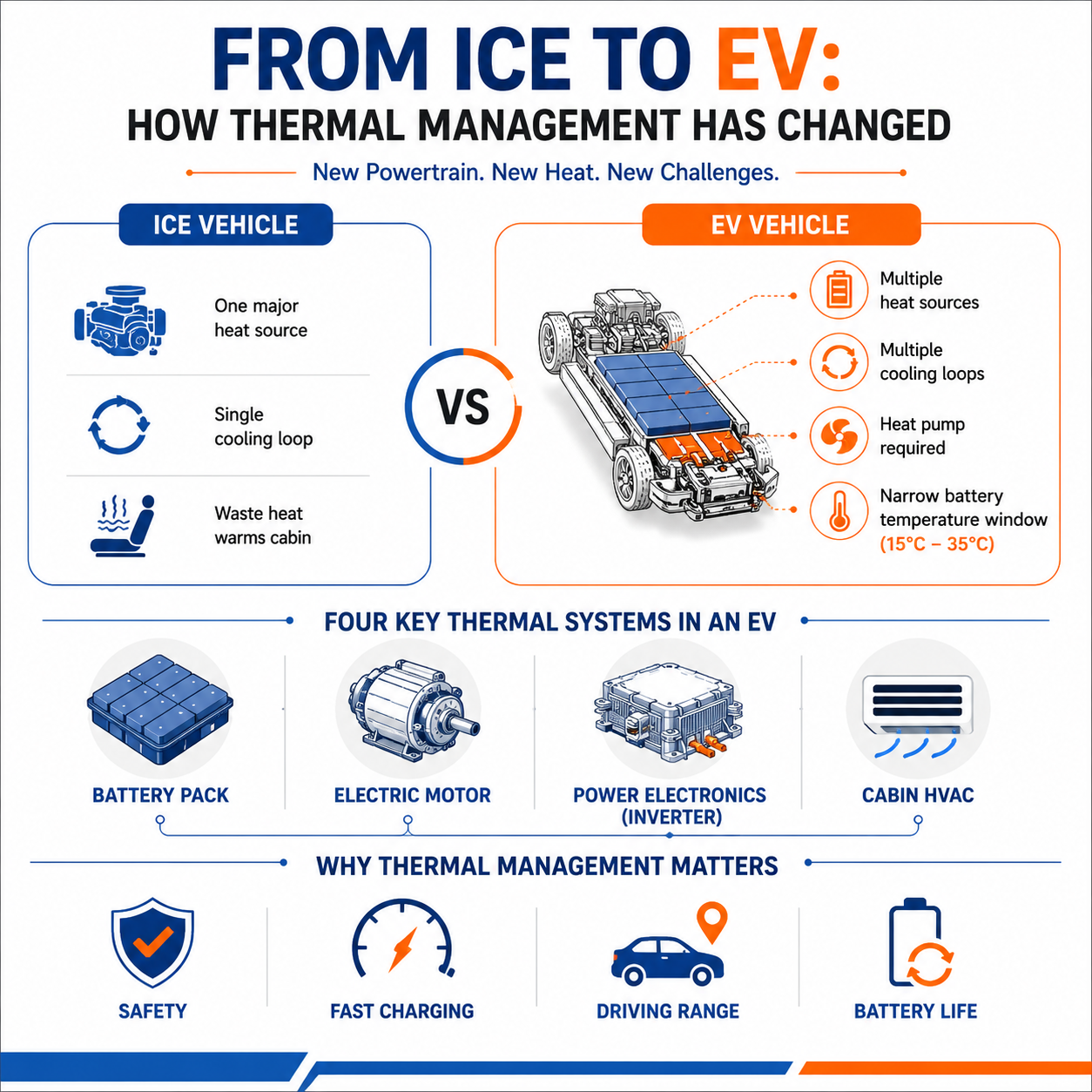
Thermal management in conventional internal combustion engine (ICE) automobiles for many decades has been all about controlling the temperature of engines. Although such systems were rather sophisticated, the heat source has always been one.
However, electric cars have introduced a completely new set of challenges. Thermal management becomes vital for batteries, electric motors, power electronics, charging, and even climate control. This makes thermal management one of the key engineering disciplines when it comes to modern-day EVs
The cumulative revenue from the global market for EV thermal management systems is forecasted to rise from USD 32.45 billion in 2026 to USD 78.67 billion in 2034, at a CAGR of 16.1%. The fast-paced adoption rate of electric vehicles in India, along with investments in battery manufacturing and localisation, will play a pivotal role in this rise.
If your profession has been focused on ICE cooling so far, this blog post is for you. Here you will find information on why EV thermal engineering is much more challenging, what three domains you should learn, and how to switch careers in months.
ICE engineers often assume thermal management has just moved to different components. It did not. The physics changed, tolerances tightened, and failure modes multiplied.
The best performance of the lithium-ion batteries normally occurs between 15°C and 35°C. High operating temperatures cause faster deterioration of cells, whereas too high temperatures may lead to thermal runaway based on cell chemistry, SOC, and fault modes. Hence, adequate thermal management is critical for safety, battery longevity, and consistent performance of vehicles.
An ICE gives you free cabin heat. An EV does not. That is why every winter, EV owners mention a range drop. Heat pumps and integrated loops now do that job.
Although the majority of traditional vehicles have only one cooling loop for the engine, today’s electric cars usually have several integrated cooling loops that can help maintain the temperatures of batteries, electric motors, inverters, onboard chargers, and the HVAC system. There is no unified approach; the design of the system depends on the automaker.
An EV thermal engineer is three specialists in one head: batteries, motor, inverter, and cabin HVAC. Each domain has its own physics, tools, and failure library.
Battery Thermal Management Systems (BTMS) play the role of keeping the batteries in the optimum temperature range so that their performance and efficiency are optimised. There are different types of cooling systems used by modern-day electric vehicles, such as liquid cooling, cooling using refrigerants, immersion cooling, and cooling using phase change materials.
The market size of BTMS is forecasted to grow from USD 4.5 billion in 2026 to USD 13.2 billion by 2035, owing to increased funding into energy efficiency and battery safety [2]. AI-powered thermal management and battery health prediction are gaining popularity among upcoming innovations for EVs
AI thermal management system with predictive analytics is becoming the innovation of the year in 2026 [News 1]. Electric vehicle battery cooling is the field which pays.
The motors that have high power density and SiC inverters produce high temperatures in small spaces. Cooling systems using oil for stators, hairpin winding, and oil cooling for power modules are common.
Thermal management of electric motors and power electronics is an important factor for improving the efficiency of vehicles and their performance. The efficiency of thermal management has become increasingly important in electric vehicles.
Heat pumps are no longer optional. They extract low-grade heat from ambient air, motor loops, or battery loops to warm the cabin. Understanding refrigerant cycles and integrated thermal architecture is now a baseline skill.
The thermal management system impacts much more than simply the reliability of components. The temperature of the battery is important to charging speeds, regeneration of braking energy, driving distance, and also degradation of the battery over time. Thermal management helps keep the battery within its optimal operating range for both rapid charging and normal driving conditions.
EV thermal engineering happens in software long before it happens on a bench. Tool stack fluency has become an interview filter at every serious Tier-1 in the country.
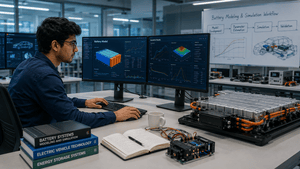
The process of developing batteries is an intricate combination of many parameters, including electrochemical processes, thermodynamics, fluid dynamics, and control systems. Therefore, simulations play a very important part in achieving optimal performance before actual prototypes are created.
This is the design environment that exists currently. GT-SUITE, KULI, Simcenter Amesim, ANSYS Fluent, Star-CCM+. Many potential employers tend to hire those individuals who have experience in using simulation software.
Bionic designs such as bionic battery cooling plates and bionic fans have been demonstrated by MAHLE at the 2026 industry [News 3].
In model-based development, the thermal model is the design. You iterate it, calibrate against test data, and hand it to controls teams. ICE engineers used to hand off CAD. EV engineers hand off models.
In India, there were about 2.3 million EVs in 2025, accounting for 8% of all new vehicle registrations, thus making the Asia-Pacific region dominate the world EV BTMS market [4].
There are several thermal design challenges associated with India. Due to very high ambient temperature, heavy traffic, dusty environment, humidity, and challenging driving terrains, the design of the thermal system needs to be tuned according to local environments as opposed to cold weather design only.
Engineers designing EVs for Indian conditions frequently address challenges such as:
Understanding these real-world operating conditions helps engineers develop more reliable thermal management systems.

You do not need to restart your career. You need a focused six-to twelve-month reskilling plan, weighted toward fundamentals first and tools second.
Introduction to electrochemistry, lithium-ion failure mechanisms, refrigeration cycles, fundamentals of heat pumps, and thermal modelling techniques. Start by gaining a solid understanding of battery fundamentals, heat transfer principles, refrigerants, heat pumps, and thermal modelling before jumping into more complex electrical architecture and vehicle integration concepts.
Simulation hands-on, BTMS, motor & inverter module design, heat pump system design, and India case study applications. An EV thermal management course without simulation is a certificate, not a skill.
There are openings in Tata Motors, Mahindra Electric, Ola Electric, Ather Energy, TVS Motor Company, Bajaj Auto, MAHLE, Valeo India, as well as other Tier 1 companies. There is a chance to work in battery thermal design, CFD analysis, thermal simulation, thermal testing, HVAC design, integration, calibration, and battery pack development.
Modine has established a 100,000 sq ft plant in Chennai to manufacture thermal management products locally in India [News 2].
evACAD Perspective:
One thing that has been observed to be a trend in the EV thermal engineering hiring process is the requirement of a person who is able to work in all these domains of GT-SUITE, physical coolant circuits, testing, and vehicle-level integration.
As an ICE engineer, you have this cross-domain approach inherently embedded in you since you have experience working in all these areas: CAD, testing, calibration, and production. Just add thermal EV knowledge to this approach, and you get your desired profile. Explore our online courses to get started.
The shift towards electric mobility is redefining the nature of work in thermal engineering. Contemporary electric vehicles require engineers to be well-versed in batteries, electric motors, power electronics, heating and ventilation, and comprehensive thermal management solutions and not just cooling subsystems alone.
Today’s mechanical, automotive, electrical, and thermal engineers, who acquire knowledge and skills in these specialised fields, will surely find themselves very relevant to the upcoming EVs of the future. As the EV ecosystem in India continues to grow in size, thermal management know-how will continue to be among the most sought-after engineering skillsets across all OEMs, Tier 1 companies, battery makers, and research institutions.
The evACAD's EV Thermal Management: Batteries and Motors program is precisely aimed at engineers who are making such a transition. It shifts you from an ICE mindset to an EV-ready perspective through simulation and case studies based in the Indian context.
[1] The global EV thermal management system market is projected to grow from USD 32.45 billion in 2026 to USD 78.67 billion by 2034 at 16.1% CAGR, driven by battery efficiency and safety requirements. (Source: Intel Market Research, 2026)
https://www.intelmarketresearch.com/electric-vehicle-thermal-management-system-market-35612
[2] The Battery Thermal Management System market is expected to grow from USD 4.5 billion in 2026 to USD 13.2 billion by 2035 at 12.7% CAGR. (Source: Global Market Insights, 2026)
https://www.gminsights.com/industry-analysis/battery-thermal-management-system-market
[3] The global automotive thermal management market is estimated at USD 71.7 billion in 2026, forecast to reach USD 97.0 billion by 2033, with battery thermal management projected to hold the largest share. (Source: Market Minds Advisory via GlobeNewswire, 2026)
[4] India's EV market reached 2.3 million units in 2025, accounting for 8% of new vehicle registrations, driving Asia-Pacific to lead the global EV Battery Thermal Management Systems market with the strongest gigafactory expansion. (Source: Global Insight Services, 2026)
1. AI-Enabled Battery Thermal Management Systems Emerge as the 2026 Innovation Frontier - Global Insight Services, March 2, 2026
2. Modine Unveils 100,000 sq ft Manufacturing Unit in Chennai for In-Region Thermal Management Production - Coherent Market Insights, August 2026
https://www.coherentmarketinsights.com/market-insight/automotive-thermal-management-market-5215
3. MAHLE Showcases Bionic Battery Cooling Plate and Bionic Fan for EV Thermal Efficiency at 2026 Industry Event - MarketsandMarkets, 2026