EV in the Current Education System: Powering the Future of Engineering
last updated
July 7, 2026
As global vehicle electrification accelerates, so does the need for a well-trained workforce that can design, build, and maintain the EV ecosystem. The International Energy Agency’s Global EV Outlook 2025 shows the global EV stock reached nearly 58 million vehicles at the end of 2024, and that’s expected to surge further by 2030. But this expansion demands significantly more from our education systems.
Why EV Education Matters
The transition to electric mobility is reshaping the automotive landscape. Governments and industries worldwide are investing heavily in EV technologies, creating a pressing need for engineers proficient in this domain. EV education equips students with the necessary skills to design, develop, and maintain electric vehicles, addressing the industry's evolving requirements.
Challenges in the Current Curriculum
Despite the rising relevance of electric vehicles, many technical institutions have not yet aligned their curricula to meet the needs of the EV ecosystem. The key challenges include:
1. Fragmented Learning Across Departments
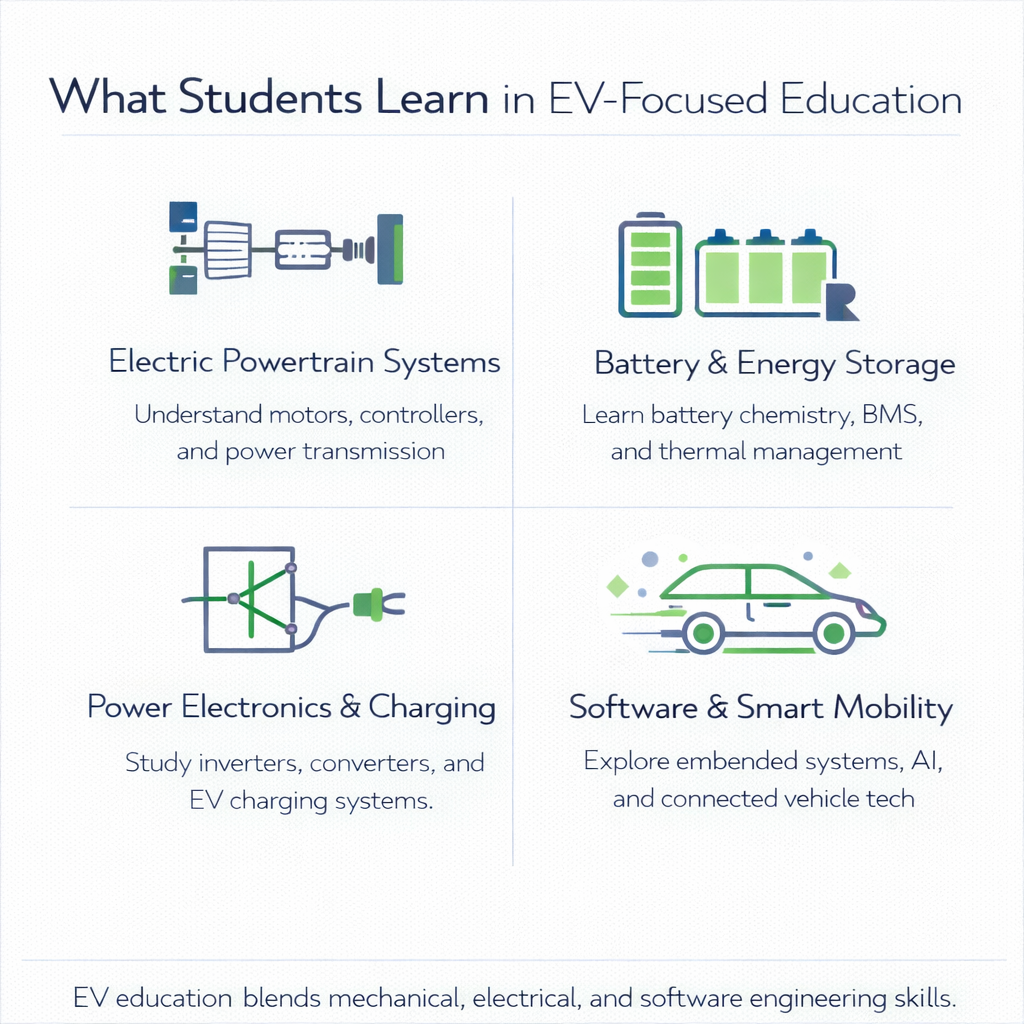
Courses such as Power Electronics, Electrical Machines, and Embedded Systems are taught in silos across various engineering branches like Electrical, Mechanical, and Electronics. These subjects are rarely contextualized for EV applications, leaving students to connect the dots on their own.
2. Lack of Structured EV-Focused Programs
Very few institutions offer a cohesive and progressive track of EV courses (e.g., from fundamentals to application to validation). Instead, students might only encounter scattered electives or workshops, making it hard to build a holistic understanding of the fundamental level of electric vehicles.
3. Limited Availability of Minors/Honors Programs
Some forward-looking institutions (like SPPU, AIKTC, KJSCE) offer minors or honors in EVs, but these are not yet widely adopted, especially at Tier-2 and Tier-3 engineering colleges. There's a need for national-level frameworks to encourage EV specialization tracks.
4. Absence of Advanced and Emerging Topics
Even when EV content is introduced, it often stops at basic levels. The following advanced topics, crucial for modern EV design and deployment, are typically missing:
Battery Thermal Management Systems (BTMS)
Vehicle Control Unit (VCU) Architecture & CAN Communication
Battery State Estimation Algorithms (SoC, SoH)
Functional Safety (ISO 26262) and Cybersecurity for EVs
Model-Based Systems Engineering (MBSE) for EV Development
Battery Recycling and Second-Life Applications
1D and 3D Simulation for EV Subsystems (e.g., ANSYS, MATLAB/Simulink)
Charging Infrastructure Planning and Grid Load Impact
High-Voltage Safety and Diagnostics
5. Insufficient Hands-On Exposure
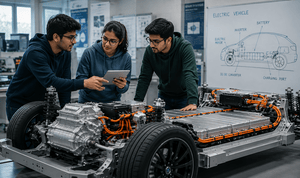
Most EV education remains theoretical. Access to lab-scale EV kits, BMS simulators, motor testing benches, or real-world case studies is limited, especially in conventional engineering colleges.
Blending EV Education with Current Technical Curriculum
To bridge the gap, institutions can:
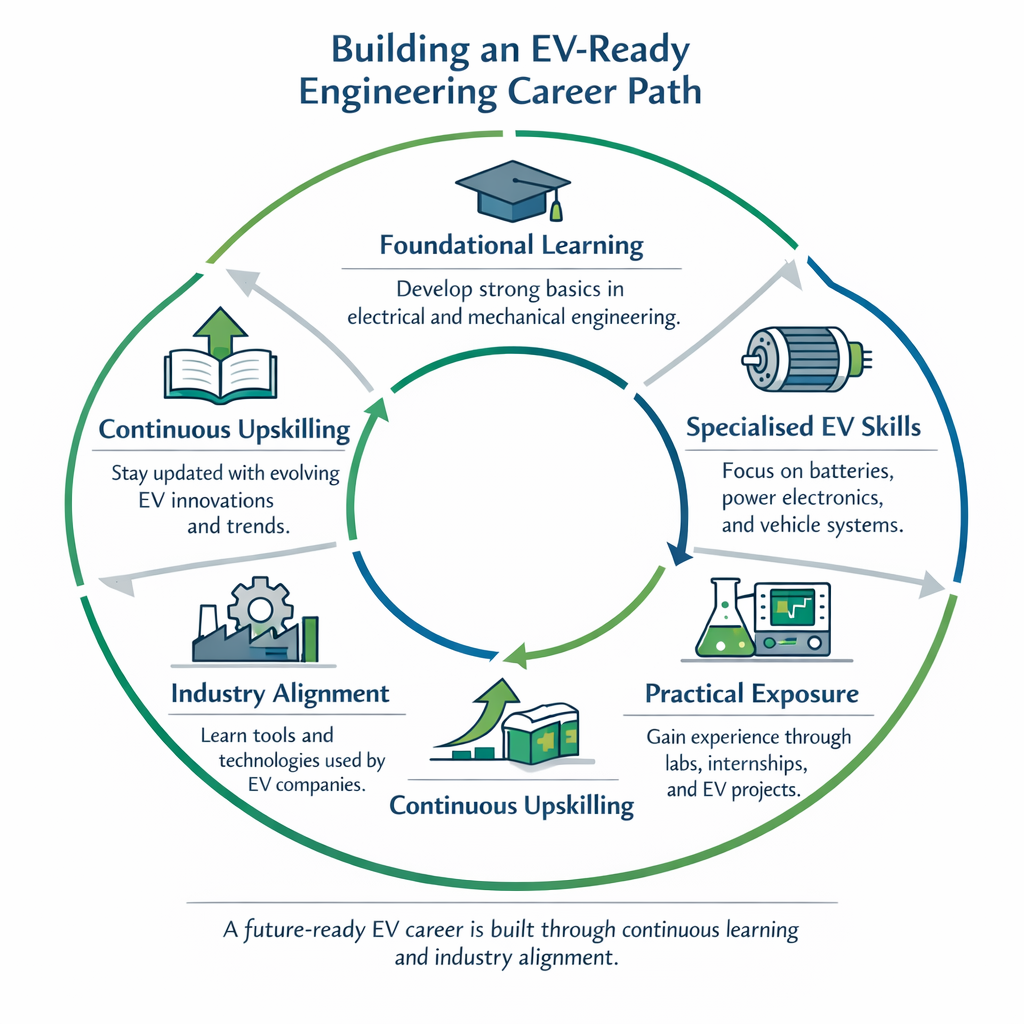
Develop Interdisciplinary Courses: Combine elements from electrical, mechanical, and computer engineering to create EV-centric programs.
Add EV Modules to Core Courses: Integrate modules on BMS, EV powertrains, or energy storage systems into traditional subjects.
Partner with Industry and Certification Bodies: Institutions can collaborate with bodies like ISIEINDIA or ASDC for certifications and hands-on training.
Examples of EV Integration in Education
Several institutions are already embedding EV-focused content in their technical curricula. Below are a few such examples:
VNIT Nagpur – Executive M.Tech in Electric Vehicle Technology A full-time postgraduate program focused on EV components, vehicle-level integration, and validation methods. It blends theoretical foundations with practical exposure through labs and case studies.
Power Electronics (inverters, converters, chargers)
Thermal Management Systems
Charging Infrastructure and grid interface
Vehicle Control Units (VCUs) and embedded systems
Simulation Tools like MATLAB/Simulink for EV modeling
Why This Matters: Benefits for All Stakeholders
As the global electric vehicle (EV) ecosystem grows at an unprecedented pace, embedding EV-related content into engineering education isn’t just an academic upgrade—it’s a strategic move with transformative outcomes across the value chain. Here's how each stakeholder stands to gain:
For Students: A Launchpad to the Future
Job-Ready Skills: Students develop practical expertise in high-demand areas such as electric vehicle powertrain design, battery management systems (BMS), and embedded control systems—skills critical for roles in top EV companies.
Higher Employability: According to a recent report by TeamLease Services, the EV and allied infrastructure sector in India is projected to grow workforce demand at a 7.1% net employment change in the second half of FY 25, outpacing broader industrial growth at 6.33% in H2 FY 24. These figures far exceed the earlier 2024 projection of 10 million combined roles, highlighting an even stronger acceleration in EV employment demand.
Diverse Career Tracks: With specializations in areas like EV design, charging infrastructure, energy storage, or EV diagnostics, learners can branch into R&D, field service, product development, and project management.
Future-Proofing Careers: As traditional ICE (internal combustion engine) vehicles phase out, hybrid and electric vehicle course graduates will be better equipped to thrive in a transitioning job market.
For Institutes: Academic Relevance and Industry Alignment
Attracting Top Talent: Institutes offering cutting-edge electric vehicle courses with a certificate gain a competitive edge in student admissions, especially among career-focused learners. Stronger Industry Collaborations: Academic institutions that adopt EV technology courses are better positioned to attract MoUs and funding from OEMs, battery companies, and green tech startups.
Expanded Research Opportunities: Integration of hybrid and electric vehicle content opens doors to sponsored research in battery innovation, renewable integration, and mobility-as-a-service (MaaS).
NAAC/NBA & NEP 2020 Alignment: Offering future-relevant programs such as diploma/ PG Certificate in electric vehicle technology, aligns institutions with national educational quality benchmarks and NEP’s emphasis on experiential learning.
For Industry: Closing the Skill Gap, Accelerating Innovation
Ready Workforce: Companies benefit from a talent pool trained in model-based development, power electronics, vehicle control units (VCU), and EV diagnostics, cutting onboarding and training time.
Improved Product Time-to-Market: When engineers already understand how hybrid vehicles work or how to design and test electric drivetrains, project cycles become more efficient.
Plug-and-Play Technicians: Technicians trained through electric vehicle mechanic courses and EV repair courses can hit the ground running, critical for OEMs and service network expansion.
Localization of Talent: With EV courses near industrial hubs, companies can recruit locally, reducing attrition and increasing workforce stability.
Boost to R&D: Access to institutes offering EV design courses and hybrid electric vehicle working modules helps fill specialized roles in innovation teams focusing on battery tech, autonomous driving, and energy efficiency.
Conclusion
Electric vehicles are not just the future—they are the now. Integrating EV education into mainstream engineering curricula ensures that students graduate ready to contribute meaningfully to the green mobility revolution. By fostering interdisciplinary learning, updating legacy syllabi, and partnering with industry, educational institutions can play a pivotal role in shaping the engineers of tomorrow.
Why is EV education still lagging in most engineering institutions in India?
Most institutions teach power electronics, electrical machines, and embedded systems in silos without contextualising them for EV courses. The result is fragmented learning that leaves students unable to connect disciplines into a cohesive electric vehicle curriculum, making it difficult to build job-ready skills for the rapidly expanding EV powertrain and battery sectors.
What advanced topics are missing from the current electric vehicle curriculum in India?
Key gaps in the electric vehicle curriculum include Battery Management Systems, Vehicle Control Unit architecture, Battery State Estimation algorithms, functional safety standards like ISO 26262, charging infrastructure planning, and EV powertrain simulation using MATLAB and ANSYS. These topics are essential for closing the EV skill gap at leading OEMs and tech providers.
How can engineering institutions bridge the EV skill gap through interdisciplinary programs?
Institutions can close the EV skill gap by developing interdisciplinary EV courses combining electrical, mechanical, and computer engineering, adding Battery Management Systems and EV powertrain modules to core subjects, and partnering with certification bodies like ASDC for hands-on EV technology training that reflects real industry requirements.
What career benefits do students gain from completing structured EV technology training?
Students with structured EV technology training develop job-ready expertise in EV powertrain design, Battery Management Systems, and embedded controls. The EV sector in India is projected to grow workforce demand at 7.1% in FY25, making EV courses a strong investment for higher employability and diverse career tracks across R&D, diagnostics, and product development.
Which institutions are currently offering strong EV education programs in India?
VNIT Nagpur offers an Executive M.Tech focused on EV powertrain integration and validation, while IIT Bhubaneswar's Advanced Certificate covers traction motors and Battery Management Systems for working professionals. Both programs exemplify how structured EV technology training can bridge the EV skill gap between academic theory and industry expectations.