
As nations accelerate their race toward net-zero emissions, a central question looms large: How should carbon be priced? Among the many tools available to governments, two dominate the global conversation—carbon taxes and cap-and-trade systems. Both aim to put a financial cost on carbon emissions, discourage polluting behavior, and encourage cleaner alternatives. But they differ in structure, incentives, and political appeal.
For policymakers, the debate isn’t just theoretical. Choosing the right carbon pricing instrument means balancing economic efficiency, fairness, political feasibility, and administrative simplicity. The right solution may vary depending on a country’s industrial profile, governance capacity, economic maturity, and climate ambition.
Carbon pricing is a market-based approach to reducing greenhouse gas (GHG) emissions by internalizing the external cost of pollution. Rather than treating clean air and climate stability as free goods, these instruments assign a price to emissions, making pollution an economic liability.
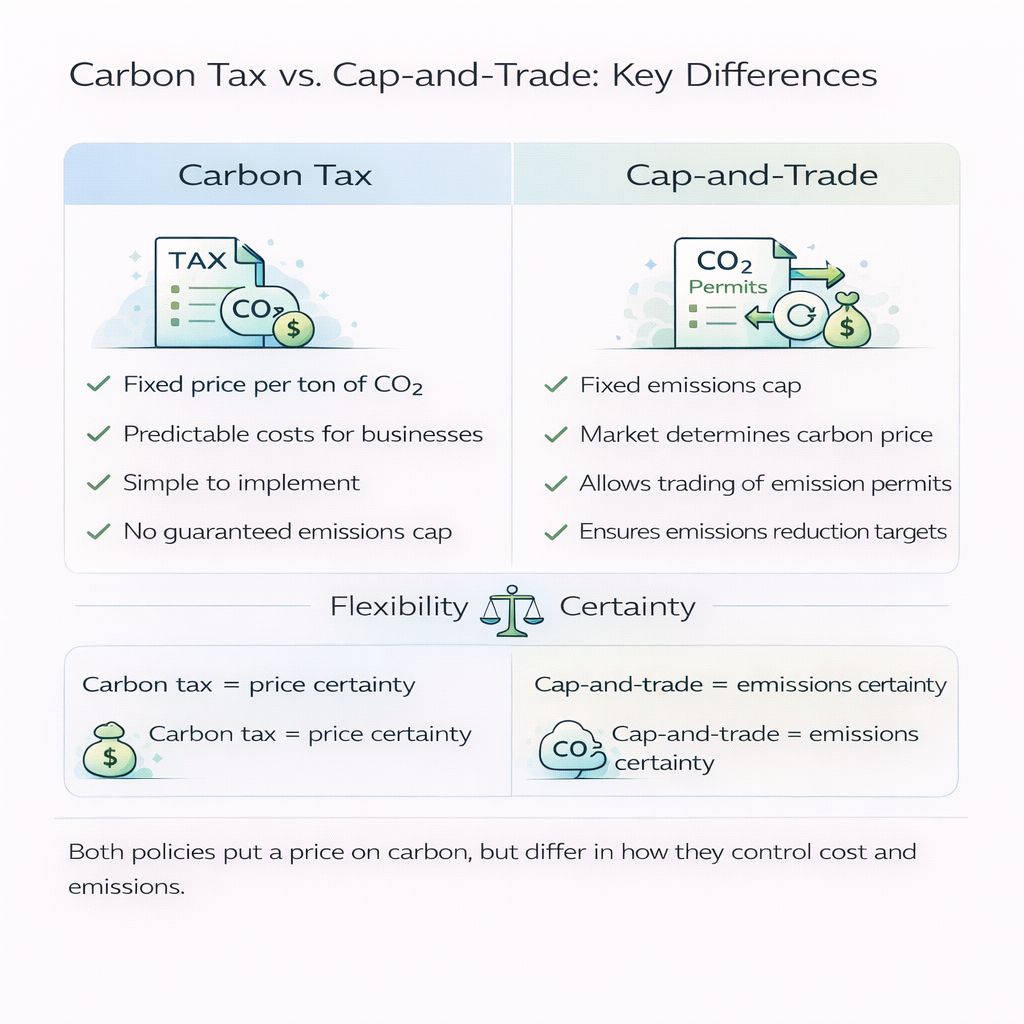
A carbon tax directly sets a price per tonne of CO₂ emitted. Emitters pay a fixed fee for each unit of pollution. This approach gives price certainty, allowing businesses to plan their investments and consumers to adjust behavior. Revenues from carbon taxes can be used to fund climate programs, offset other taxes, or be redistributed to households as carbon dividends.
By contrast, a cap-and-trade system (also known as an emissions trading system or ETS) sets an overall limit—or “cap”—on emissions for a specific sector or economy. The government issues a fixed number of allowances, and companies can trade them in a regulated market. The market determines the price, creating flexibility and potential cost-efficiency. Those who can cut emissions cheaply do so and sell allowances to others who face higher abatement costs.
Economically, both systems aim to achieve emissions reductions at the lowest possible cost, but they do so in different ways. A carbon tax offers predictable prices, which helps businesses make long-term investment decisions, especially in carbon-intensive sectors like energy and transport. Investors in renewable energy, for example, can better forecast returns if they know the carbon tax rate five or ten years in advance.
On the other hand, cap-and-trade systems provide certainty in environmental outcomes. Because the total number of allowances is fixed, policymakers can guarantee how much pollution will be reduced in a given year. However, the price of allowances can fluctuate based on market dynamics, sometimes leading to volatility and regulatory uncertainty, particularly in the early phases of implementation.
To mitigate this, modern cap-and-trade systems often include price floors and ceilings to avoid extreme swings. Similarly, taxes can be indexed or gradually increased over time to reflect changing climate targets.
Globally, both mechanisms are widely used. Carbon taxes are in place in over 30 countries, including Sweden, Canada, and South Africa. Sweden, a pioneer in this space, has one of the highest carbon tax rates in the world—over $130 per tonne—and has still maintained robust GDP growth.
Cap-and-trade systems are more prevalent in advanced economies. The EU Emissions Trading System (EU ETS) is the world’s largest and most mature carbon market, covering power, industry, and aviation sectors. California’s linked cap-and-trade market with Québec has also been praised for its innovative design and climate ambition. China launched its own national ETS in 2021, initially covering the power sector, with plans to expand.
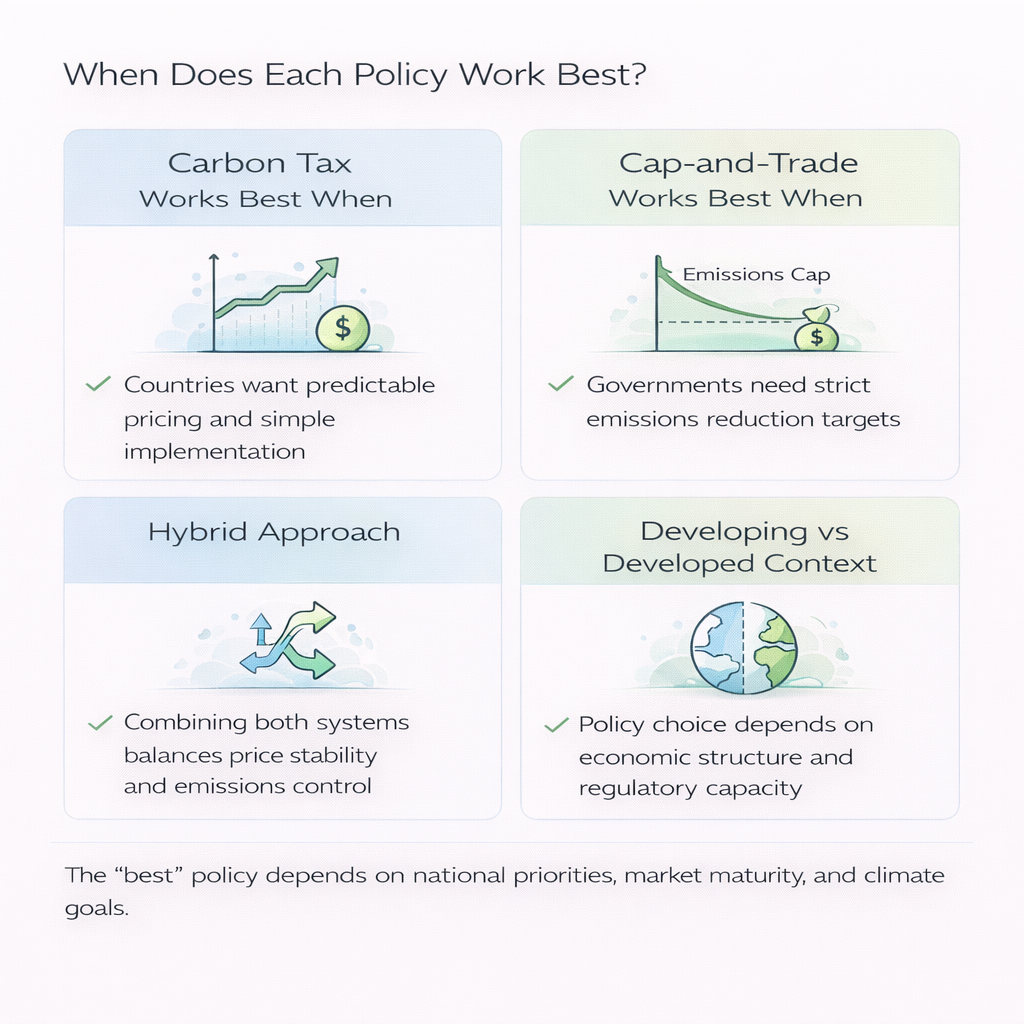
In practice, many jurisdictions use hybrid models, applying a carbon tax in some sectors (like transport or buildings) while using cap-and-trade for others (like electricity or heavy industry).
While economists often favor carbon taxes for their simplicity, politicians may find cap-and-trade more attractive. This is because cap-and-trade systems hide the cost of carbon within a market mechanism, avoiding the public backlash often associated with visible taxes. Furthermore, governments can allocate allowances for free, at least initially, to ease the transition for industries and avoid competitiveness concerns.
Carbon taxes, though transparent and easy to administer, can be regressive if not paired with redistribution mechanisms. Lower-income households typically spend a higher share of income on energy and transport, making them more vulnerable to price shocks. Well-designed carbon taxes often include rebates, subsidies, or tax cuts to neutralize this impact.
In emerging economies, where energy poverty and informal markets are prevalent, cap-and-trade may face data and enforcement challenges. A carbon tax, if simple and targeted, can offer a more viable entry point for climate pricing policy.
The ideal carbon pricing strategy depends on context. A country with robust monitoring systems, strong institutions, and a developed energy market may benefit from a cap-and-trade system, particularly if emissions reduction targets must be strictly enforced. Countries that seek simplicity, transparency, and predictable pricing, especially those with constrained administrative capacity, may prefer a carbon tax.
For large economies like India, a phased approach might be optimal. Starting with a moderate carbon tax on fossil fuels and high-emission sectors could lay the foundation, followed by a sectoral emissions trading system for industries with more capacity. India’s experience with Perform-Achieve-Trade (PAT) schemes and the upcoming carbon market framework under the Bureau of Energy Efficiency offer a strong institutional base for building either mechanism.
Ultimately, both tools are effective when designed well. The real victory lies in political will, public trust, and institutional capability. No pricing system works in isolation.
Complementary policies, such as green subsidies, regulatory standards, and public investment, are essential to amplify and sustain impact.
Carbon pricing is not just an economic tool; it’s a moral signal. Whether through a tax or a trading system, pricing pollution sends a clear message: emitting carbon carries a cost, and the cost must no longer be externalized to future generations.
As countries debate between carbon taxes and cap-and-trade, one thing is clear: the world needs leaders who can understand, design, and implement the appropriate mechanisms with both economic and social sensitivity.
This is where IIM Kashipur, in collaboration with evACAD, is making a significant contribution. The PG Executive Program in Net Zero Strategy & Sustainability Leadership equips professionals with the skills to navigate complex issues like carbon markets, green finance, and climate policy. Designed for mid- and senior-level leaders, the program blends deep academic insight with real-world case studies, from the EU ETS to India’s emerging carbon market. Participants also gain exposure to tools for carbon accounting, policy design, and business strategy, all critical for organizations preparing to meet net-zero targets.
With features like immersive campus learning at IIM Kashipur, access to global sustainability experts, and current industry case studies, the program helps professionals go beyond theory and become active architects of sustainable transitions in their industries.
In other words, while governments set the price on carbon, it is the next generation of business, policy, and sustainability leaders, trained through initiatives like this program, that will determine how effectively these policies reshape economies and societies.


.webp)
.jpg)
.jpg)