
Learn EV thermal management for batteries, motors, chargers and power electronics — covering heat generation, heat transfer and thermodynamics fundamentals, passive and active cooling systems, cooling system design and controls, thermal runaway prevention, and thermal safety in electric vehicles.
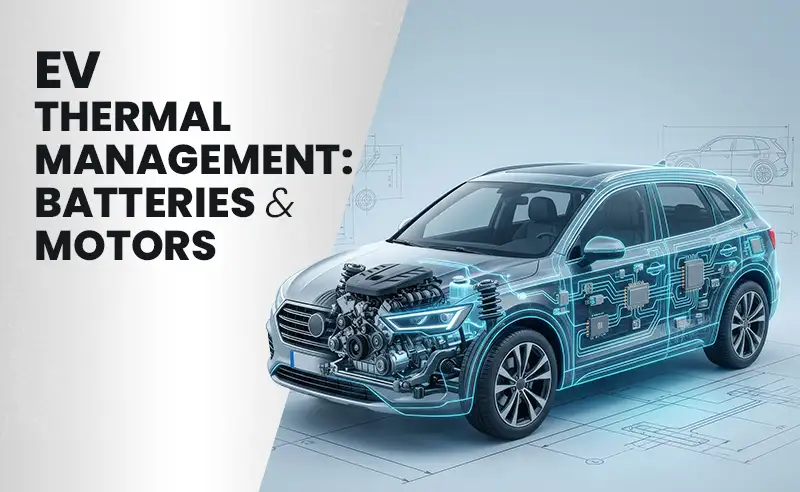
The EV Thermal Management: Batteries & Motors course gives engineers a practical understanding of how heat is generated, transferred and controlled across electric vehicle subsystems. Learners study heat generation in battery packs, traction motors, chargers, charging ports and power converters, and understand how rising temperature affects EV performance, efficiency, range, battery life and safety. The programme builds a clear foundation in thermodynamics and heat transfer before applying those principles to real EV cooling system design.
The course then moves into battery thermal management and motor thermal management — internal resistance losses, cell balancing effects, DC bus losses, thermal runaway behaviour across Li-ion sub-chemistries, motor copper and iron losses, and the impact of heat on magnetic flux and torque in induction, permanent magnet and switched reluctance motors. Participants explore passive and active cooling technologies including air-cooled and liquid-cooled systems, heat exchangers, radiators, heat pipes, phase change materials and coolant selection, along with methods for sizing a cooling system against a given duty cycle.
Learners also work through cooling system design and control logic, thermal monitoring and protection systems, thermal event detection, air vent and duct design, and fire safety measures for electrical and battery fires. By the end of the programme, participants can analyse thermal loads, size and design cooling systems, and specify thermal protection strategies that improve the performance, reliability and safety of modern electric vehicles. This EV thermal management course suits mechanical, automotive, electrical and battery engineers moving into e-mobility.
This programme equips learners with the knowledge required to design, analyse, and manage thermal systems that enhance the performance, reliability, efficiency, and safety of modern electric vehicles.

Learn how heat is generated inside a battery pack through internal resistance losses, cell balancing and DC bus losses, and how temperature affects capacity, ageing and charge acceptance. Understand thermal runaway in lithium-ion chemistries, propagation between cells, sub-chemistry trigger temperatures, and the strategies used to keep packs within a safe operating temperature band.
Understand motor losses — copper, iron, frictional and brake resistor losses from regenerative braking — and how the resulting heat affects magnetic flux, torque and continuous power capability. Compare cooling requirements and heat dissipation approaches across induction motors, permanent magnet motors and switched reluctance motors used in EV traction applications.
Build the engineering fundamentals behind every cooling decision: conduction, convection and radiation, thermal equilibrium and the Zeroth law, the First Law of Thermodynamics, internal energy, specific heat and enthalpy. Apply energy balances to closed, open, steady and unsteady flow systems and work with thermal properties of materials in solid, liquid and vapour phases.
Learn to select between passive and active cooling and size a system for a given duty cycle. Work with heat exchanger types — fins, radiators, heat pipes and phase change materials — analyse and design them against the cooling requirements of battery packs, motors and power converters, and specify coolant properties, ageing and replacement intervals.
Understand the protection layer that sits above the cooling system: thermal sensing and monitoring, progressive battery load management, thermal cut-offs, charger thermal protection and current throttling, and thermal event detection with warning and control. Cover pressure release valves, breathers, fire retardants, and extinguisher classes for electrical and battery fires.
Bring the subsystems together at vehicle level — thermal control logic, system activation and deactivation, hysteresis control and redundancy planning, plus the design of air vents and ducts and their effect on vehicle aerodynamics. Learn how battery, motor, charger and power electronics cooling are balanced within a single integrated vehicle thermal architecture.
Thermal management is one of the defining engineering challenges in electric vehicle development. Lithium-ion cells deliver their best performance, efficiency and cycle life inside a narrow temperature window, and every excursion outside that window has a cost. Low temperatures increase internal resistance and reduce usable range and charge acceptance; high temperatures accelerate aging, degrade capacity and, in the worst case, initiate thermal runaway. Traction motors face a parallel problem — copper and iron losses raise winding and magnet temperatures, which reduces magnetic flux, forces power derating and limits continuous torque. Chargers, charging ports and power converters add further heat loads, particularly during DC fast charging.
An effective EV thermal management system keeps every one of these subsystems inside its safe operating window under real-world duty cycles: fast charging, hill climbing, high ambient temperatures, stop-start city traffic and sustained highway running. That means selecting between passive and active cooling, sizing heat exchangers and coolant loops correctly, designing thermal control logic with sensible hysteresis and redundancy, and building in monitoring, thermal cut-offs and fire protection. Getting it right improves range, charging speed, battery life, warranty cost and occupant safety at once — which is why thermal engineers are among the most consistently sought-after roles in the EV industry. This programme covers those decisions end to end, from where the heat comes from to how the cooling system and its control strategy are designed, validated and protected, alongside the EV control systems logic that governs them.

Mr. Vikrant Vaidya, President – evACAD.
Vikrant brings 24+ years' experience in global automotive design and product development across multiple EV and hybrid vehicle platforms, specialising in model-based design, calibration, testing and system integration — including the thermal behaviour of battery and e-powertrain systems. He is a Six-Sigma Green Belt and holds 3 inventions in battery and hybrid electric vehicles. He earned his Master's degree in Energy Systems Engineering from the University of Michigan and his Bachelor's in Mechanical Engineering from Nagpur University.
• Mechanical, automotive and thermal engineers moving into electric vehicle development
• Battery pack design and BMS engineers who need to size and validate pack cooling
• Electrical and powertrain engineers working on traction motors, chargers and power electronics
• CAE, CFD and simulation engineers supporting vehicle thermal analysis
• Product development, validation and testing engineers responsible for thermal sign-off
• Final-year engineering students and recent graduates targeting EV thermal and battery roles
Learners who want the wider vehicle-level context first can begin with electric vehicle design and integration and return to this programme for the thermal specialisation.
As EV volumes scale, thermal performance has become a direct commercial issue — it decides fast-charging speed, usable range, warranty exposure and safety compliance. That has created steady demand for engineers who can size, design and validate thermal systems. This programme helps learners build relevant skills for roles such as EV Thermal Management Engineer, Battery Thermal Engineer and Cooling System Design Engineer, working on pack and powertrain cooling architecture.
Related opportunities include Thermal Simulation / CFD Engineer, Battery Pack Design Engineer, Powertrain Thermal Integration Engineer, HVAC and Vehicle Thermal Systems Engineer, Battery Safety Engineer, and Validation & Testing Engineer with thermal responsibility. Engineers who pair thermal knowledge with EV modeling and simulation skills are also positioned for virtual thermal validation and digital-twin-based development roles. These skills apply across EV OEMs, battery pack manufacturers, automotive tier-1 suppliers, engineering service providers, charging infrastructure companies and energy storage organisations in India and globally.


