
Learn EV modeling and simulation techniques for electric vehicle development, including model-based development, vehicle simulation, battery and motor modeling, digital twins, virtual validation, and MIL, SIL & HIL testing.
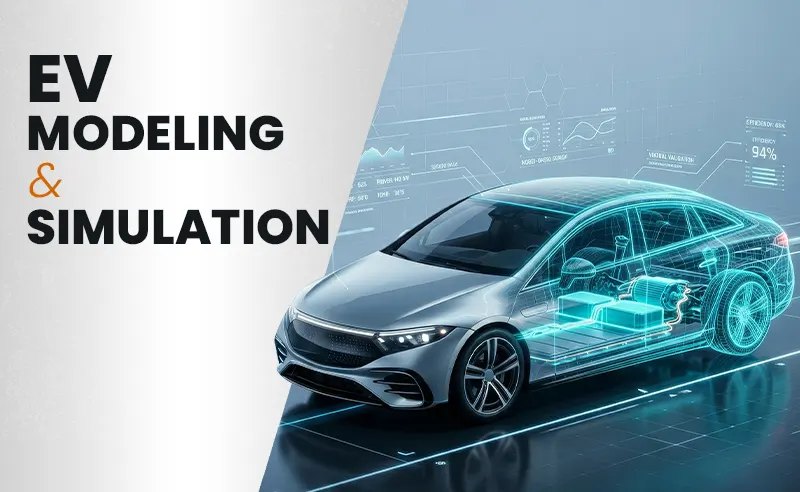
The EV Modeling & Simulation programme provides practical knowledge of simulation techniques used throughout the electric vehicle development lifecycle. Learners explore model-based development, vehicle and subsystem modelling, and simulation workflows that help engineers evaluate EV performance before physical prototyping. The programme covers battery and motor modelling, regenerative braking, vehicle dynamics, energy flow, and system-level simulation for real-world EV applications.
Participants also learn how digital twin development and virtual validation can support faster and more reliable vehicle development. The curriculum introduces controller validation and Model-in-the-Loop (MIL), Software-in-the-Loop (SIL), and Hardware-in-the-Loop (HIL) testing, enabling learners to understand how control strategies and vehicle systems can be tested under different operating conditions.
Through practical simulation workflows and industry-focused applications, the programme helps learners develop the skills required to model, analyse, test, and validate electric vehicle systems. This EV modeling and simulation course provides a strong foundation for engineers working on vehicle performance, battery systems, electric powertrains, vehicle dynamics, controls, and virtual validation.

Learn model-based development techniques for electric vehicle systems, including system modelling, simulation workflows, requirements analysis, and virtual testing. Understand how engineers use mathematical and simulation models to develop, evaluate, and validate EV subsystems efficiently before physical implementation.
Develop practical knowledge of electric vehicle and system simulation to analyse vehicle behaviour, subsystem interactions, performance, and energy flow. Explore 1D and 3D simulation approaches for vehicle dynamics, system-level modelling, and virtual evaluation throughout the EV development lifecycle.
Learn battery and electric motor modelling techniques used to evaluate EV performance, energy consumption, efficiency, and operating behaviour. Understand how battery, motor, and regenerative braking models support simulation-based development, system analysis, and virtual validation of electric powertrain components.
Understand digital twin concepts for electric vehicles, using virtual representations of vehicle systems to analyse performance and behaviour. Learn how digital models can support simulation, monitoring, lifecycle analysis, and virtual validation while reducing dependence on physical prototypes during EV development.
Explore virtual validation techniques for evaluating EV systems and vehicle performance before physical testing. Learn how simulation-based validation can identify design issues early, compare system performance, optimise vehicle parameters, and reduce development time and physical prototyping costs.
Gain an understanding of MIL, SIL, and HIL testing for EV controller and system validation. Learn how Model-in-the-Loop, Software-in-the-Loop, and Hardware-in-the-Loop testing help engineers evaluate control strategies, software behaviour, and system performance under simulated operating conditions.
Electric vehicle (EV) modeling and simulation play a critical role in modern EV development by allowing engineers to evaluate vehicle systems and performance before physical prototypes are built. Model-based development and 1D/3D simulation help engineers analyse vehicle behaviour, system interactions, and design performance throughout the development lifecycle. Simulation can also be used for battery and motor modelling, vehicle dynamics, energy consumption, and regenerative braking analysis.
Virtual validation enables engineers to identify performance issues earlier, optimize designs, and reduce the time and cost associated with physical prototyping. Digital twin approaches further support virtual representation and analysis of EV systems for performance evaluation and lifecycle studies. Simulation-based controller testing using Model-in-the-Loop (MIL), Software-in-the-Loop (SIL), and Hardware-in-the-Loop (HIL) methodologies helps validate control strategies and system behaviour under different operating conditions. By combining these techniques, EV engineers can accelerate development, improve system reliability, and make data-driven design decisions. As electric vehicles become more complex, EV modeling and simulation provide an efficient approach to developing, testing, and validating advanced vehicle systems before real-world deployment.

Mr. Vikrant Vaidya, President – evACAD.
Vikrant brings 24+ years' experience in global automotive design and product development across multiple EV and hybrid vehicle platforms, specialising in model-based design, calibration, testing and system integration — including the thermal behaviour of battery and e-powertrain systems. He is a Six-Sigma Green Belt and holds 3 inventions in battery and hybrid electric vehicles. He earned his Master's degree in Energy Systems Engineering from the University of Michigan and his Bachelor's in Mechanical Engineering from Nagpur University.
The growing adoption of electric vehicles (EVs) is creating demand for professionals with expertise in EV modeling, simulation, virtual validation, and model-based development. This programme can help learners build relevant skills for roles such as EV Simulation Engineer, Model-Based Development Engineer, and Vehicle Simulation Engineer, working on virtual development and performance analysis of electric vehicles.
Career opportunities also include Battery Modeling Engineer and EV Powertrain Simulation Engineer, focusing on battery performance, electric powertrain behaviour, energy consumption, and system optimisation. Learners can also pursue roles such as Vehicle Dynamics Engineer, Digital Twin Engineer, and Virtual Validation Engineer, applying simulation techniques to vehicle performance and digital engineering workflows. Additional opportunities include Controls Engineer, HIL/SIL Testing Engineer, EV Systems Engineer, and Automotive Simulation Engineer, where professionals work on controller validation, system integration, testing, and advanced automotive simulation. These skills are applicable across EV manufacturers, automotive suppliers, engineering service companies, and mobility technology organisations.


