Building Skilled Workforce for Industry

Empowering organisations with job-ready talent, customised training solutions, and specialised hiring support for the Electric Vehicle (EV), Clean Energy, and Sustainability sectors.

5000+
Professionals Trained
50+
Corporate Partners
100+
Industry Projects Delivered

We help organisations and professionals stay ahead of disruption in e-Mobility, Energy Storage, and Sustainability Technologies through industry-aligned learning and workforce development.

Our Services

Comprehensive solutions designed to meet your organisation’s talent, training, and hiring needs.

Learner Talent Pool
Access a diverse, pre-trained pool of industry-ready learners equipped with hands-on project experience, technical portfolios, and domain specializations. Gain faster onboarding with ready-to-deploy professionals in EV and clean energy roles.
Download Brochure
Corporate Training Programs
Empower your workforce with upskilling programs built around your organisation’s technology and project roadmap.

Developed in collaboration with leading faculty, top-notch Institutes, and industry experts, our programs cover:

1. Sustainability & Net Zero Strategy
2. Battery Systems & Energy Storage
3. Hydrogen & Green Energy
4. EV System Engineering, and so much more!
Learn more
Specialised Training & Hiring
From short-term project-specific training to end-to-end talent deployment, evACAD delivers bespoke hiring and training solutions for OEMs, Tier-1 suppliers, and clean energy companies.
Let’s talk
Practical Pedagogy

Real-World Learning

Project-based learning
Industry mentorship
Real-World Case Studies
Hands-on Experience

We blend academic depth with real-world learning through a pedagogy co-developed with top universities and EV industry partners.

Key Features:

🧩 Project-Based Learning

🔧 Hands-On Technical Practice

🤝 Industry Mentorship

📈 Case Studies from Real Projects

🧑‍🏭 Capstone Simulations and Tool Training (e.g., Scilab, Excel-based modeling)

Learners graduate ready to contribute from day one with demonstrable experience and problem-solving skills.

Research & Industry Collaboration

EV, Energy & Sustainability Innovation Driven by evACAD & pManifold

evACAD, along with its parent company pManifold, collaborates with global and national stakeholders to drive research, consulting, and policy projects shaping the EV and energy transition.

e-Mobility
2024
e-Truck and Charging Strategy in Mining
Techno-commercial feasibility study of electric truck deployment for coal transportation and power generation logistics.
View Abstract
Energy Storage
2024
Design of BESS for Load Management
Study on integrating Battery Energy Storage Systems (BESS) and Renewable Energy for peak load management in distribution networks.
View Abstract
Sustainability
2025
Net Zero Blueprint: A Decarbonization Roadmap
A roadmap for Corporates to move from theory of Net Zero & Emission profiles to practical levers, design and alignment with global frameworks
View Abstract

Flagship Academic Program

Offered by IIM Kashipur in collaboration with evACAD

A one-of-its-kind leadership program designed for mid-to-senior professionals driving sustainability, ESG, and energy transformation initiatives.
Icon-bullets
Dual Certification from IIM Kashipur and evACAD
Icon-bullets
2 Days Campus Immersion at IIM Kashipur
Icon-bullets
Expert Faculty from IIMs, NITI Aayog, and Industry
Icon-bullets
Focus on Green Finance, Climate Policy, Hydrogen, and Carbon Markets
Icon-bullets
IIM Kashipur Executive Alumni Status
evACAD-IIMK-campus
Learner Innovation

Industry Projects

Our learners have worked on real-world projects that address current industry challenges and developments, demonstrating their capabilities

EVacad Garage Program

E2W for Ride-Sharing

Design and develop an electric 2-wheeler for shared mobility using Scilab-based 1D simulation.
Technology Used:
Scilab
Key Concepts:
e-Powertrain architecture
1-D simulation
Sub-systems integration
Scilab
EVacad Garage Program

Fuel Cell EV Powertrain

Comprehensive powertrain design ensuring optimal performance and safety for Fuel Cell EVs
Technology Used:
Scilab
Key Concepts:
Powertrain design
energy management
fuel cell integration
Scilab
EVacad Garage Program

Solar-Powered Mini EV

Development of a compact solar e-car for urban commute with solar-assisted charging.
Technology Used:
Scilab
Excel
Key Concepts:
motor sizing
solar integration
range optimization
Scilab, Excel

Our Corporate Collaborations

evACAD and pManifold have partnered with leading organisations across the EV and Energy spectrum for workforce development, applied research, and Live Consulting Projects, including:
logo-tirexlogo-Hulladeklogo-BOstonwaterlogo-reversemindlogo-Neoenrglogo-carbonMasterevACAD-TillidevACAD-TillidevACAD-TillidevACAD-Tillid
Sustainability Partner
logo-greengine

Insights & Thought Leadership

Stay ahead of the curve with insights from evACAD experts, industry researchers, and sustainability leaders.
Featured Blogs

Join Hands with evACAD to

Build a future-ready workforce in EV and Clean Energy
Develop tailored upskilling programs for your teams
Hire from our pool of trained professionals
Collaborate on industry projects and research

Ready to Partner with Us?

Connect with us
Master class on
"Advanced Energy Storage
& Battery Systems
in e-Mobility"

28th Nov`23 | 5pm
Register for free
e-Book
Lead the Transition to a Green Future
Access our latest report on Net Zero Strategy and gain insights on why Net Zero is becoming critical for industries and communities.
Cover of The Net Zero Blueprint ebook showing a circular green forest clearing with intersecting paths and an orange curved line design on a blue background.
Understand why Net Zero Matters
Identify the opportunities
Gain Frameworks to get going
Download e-Book
Provide your official contact details so that we can share the latest insights and reports that will benefit your organisation
Your e-Book has been sent to your email.
In case you did not receive it,

Download Here
Oops! Something went wrong while submitting the form.
X
Program Brochure
Lead the Transition to a Green Hydrogen Future
Download our comprehensive program guide and see how the Green Hydrogen Master Program can help you build an industry-ready career in the emerging hydrogen economy.
evACAD-earth
30-hour Advanced Certificate
Self-paced + Live Expert Sessions
Specialist → Expert → Master
Get Program Brochure
Provide your basic information & get a personalised brochure sent to your email.
Thank you!
You may download the Brochure

Get Brochure
Oops! Something went wrong while submitting the form.
X
Talk to Advisor over call
Logos of IIM Kashipur and EVACAD side by side separated by a vertical line.
Enterprise EV Workforce Transformation Platform

Build EV-Ready Teams with an Enterprise Capability Platform

Translate technical requirements into scalable workforce capability through role-based learning, practical labs, external experts, and sustainability readiness programs.

We design, build, and scale EV capability across systems, people, and sustainability.
Capability Pillars
Capability
Translate technical demand into role-based learning.
Capacity
Blend internal L&D with external experts.
Compliance
Carbon accounting, ESG, and Net Zero readiness.

A Capability Translation Model for EV Companies

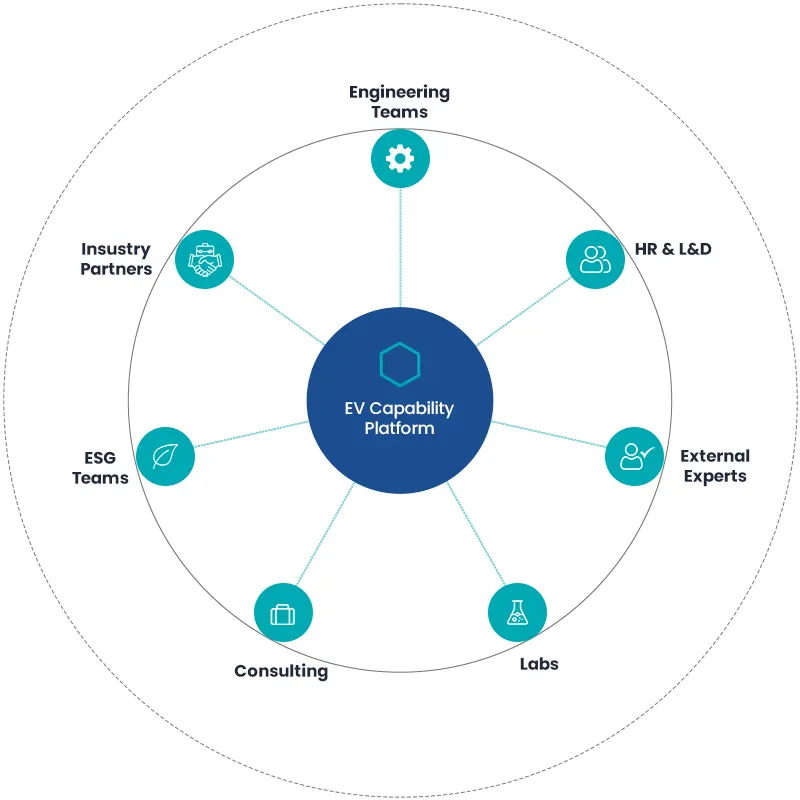
The EV Capability Platform enables organizations to design, build, and scale workforce capability by connecting engineering requirements with structured learning, practical labs, external expertise, and sustainability readiness.
Engineering Capability Alignment
Capture skill requirements, proficiency levels, and capacity demand from technical teams.
Convert complex engineering inputs into role-based capability requirements.
Decide the right balance between systematic learning and practical experience.
Workforce Capability Delivery
Prioritize common learning requirements across roles and functions.
Manage L&D budgets, employee goals, and learning calendars.
Augment internal capability with external trainers, consulting, and laboratories.
Future-Ready Compliance
Teach Carbon Accounting, ESG, and Net Zero readiness.
Support sustainability-led capability development.
Align workforce capability with business expectations.
Higher Productivity
Better Quality
Stronger Hiring Decisions
Lower Rehiring Cost
Improved Retention

Trusted Across the EV Ecosystem

OEMs
Battery Manufacturers
EV Startups
Industry Associations
Academic Partners

Why EV Companies Need a Capability Partner Now

The EV industry is evolving rapidly, creating increasing demand for specialised engineering capability, structured workforce development, and future-ready sustainability practices. Organisations require a scalable capability partner to bridge these growing demands.
Chart Arrow Rise

EV Growth is Accelerating

  • Vehicle programs are scaling rapidly across two-wheelers, three-wheelers, passenger vehicles, and commercial EVs.
  • Speed has become a competitive advantage.
Pulse

Technical Complexity is Rising

  • Battery systems
  • Battery Management Systems
  • Power Electronics
  • Wiring
  • Integration
  • Testing
  • Diagnostics
  • Capability can no longer remain generic
Prize

Talent Readiness is Lagging

  • The workforce is not always job-ready on day one.
  • Structured learning combined with practical exposure is becoming essential.
Security Lock

What Companies Feel Internally

  • Engineering teams know what capability is required.
  • HR & L&D struggle to translate engineering requirements into structured learning.
  • The result is fragmented execution and weak business ROI.

Bridging Engineering Requirements with Workforce Execution

1st
Engineering Teams

Engineering teams provide:

  • Skill Requirements
  • Battery Systems
  • BMS
  • EV Systems
  • Required Proficiency
  • Training vs Experience Balance
  • Capacity Requirements
  • Number of People Required
Circled 2
Capability Translation Layer
White check mark inside a white circle on a transparent background.
Convert technical language into role-based capability.
White check mark inside a white circle on a transparent background.
Decide:
Build
Augment
Outsource
White check mark inside a white circle on a transparent background.
Translate demand into a structured learning architecture.
White check mark inside a white circle on a transparent background.
Balance systematic learning with practical exposure.
Circled 3
HR & Learning Teams

Manage:

  • Common Minimum Training Needs
  • Budget Per Head
  • Program Prioritization
  • L&D Calendar
  • Employee Goals
  • Learning Progression
Our role is to make the transition from technical demand to executable learning simple, scalable, and measurable.

An End-to-End EV Capability Operating Model- NEED ICONS HERE

Requirement
01
Capture Demand
Skills, proficiency, and capacity requirements
Wrench
02
Build Capability Map
Role definitions and competency planning 
Design
03
Design Learning Architecture
Internal and external capability delivery
Schedule
04
Schedule & Deliver
Business-aligned execution
Business
05
Measure Business Impact
Capability and performance outcomes

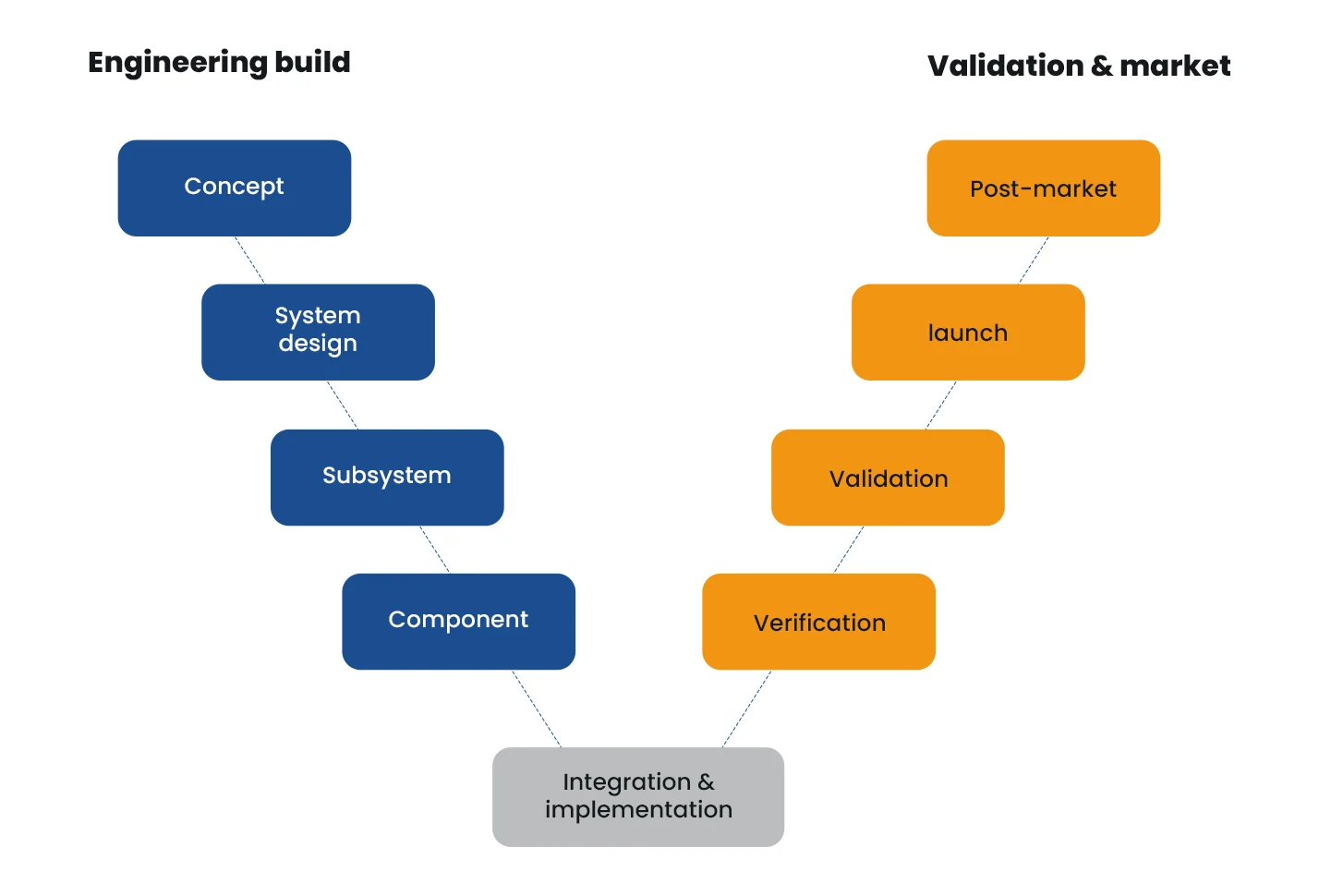
Engineering Capability Across the EV Lifecycle

Capability is built across the engineering lifecycle and validated through testing, deployment, and market execution.Training must align with every phase of the product lifecycle.
A Flexible Model for Scaling EV Capability

BUILD
  • Develop internal workforce capability through structured role-based learning pathways.
  • Deliver programs across engineering, manufacturing, service, and sales.
  • Support learning through practical laboratories and applied learning.
AUGMENT
  • Access a curated network of EV experts, trainers, consultants, and domain specialists.
  • Support advanced engineering capability when internal bandwidth is limited.
OPTIMIZE
  • Create the right balance between internal capability and external expertise.
  • Improve scalability.
  • Reduce cost.
  • Maintain governance and delivery quality.
The objective is not to choose one model.
The objective is to choose the right combination for every capability gap.

Role-Based Capability Journeys for EV Teams
NEED TEXT for Each card here

Core Skills - Engineering - NEED POINTERS
OEMs
Battery Manufacturers
EV Startups
Industry Associations
Academic Partners
Progression Graphic - NEED POINTERS
Foundation
Intermediate
Advanced
Journey Components NEED POINTERS
Learning Path
Practical Labs
Assessments
Certification
Core Skills - Manufacturing - NEED POINTERS
OEMs
Battery Manufacturers
EV Startups
Industry Associations
Academic Partners
Progression Graphic - NEED POINTERS
Foundation
Intermediate
Advanced
Journey Components NEED POINTERS & Logos
Learning Path
Practical Labs
Assessments
Certification
Core Skills - Service - NEED POINTERS
OEMs
Battery Manufacturers
EV Startups
Industry Associations
Academic Partners
Progression Graphic - NEED POINTERS
Foundation
Intermediate
Advanced
Journey Components - NEED POINTERS & Logos
Learning Path
Practical Labs
Assessments
Certification
Core Skills - Sales - NEED POINTERS
OEMs
Battery Manufacturers
EV Startups
Industry Associations
Academic Partners
Progression Graphic - NEED POINTERS
Foundation
Intermediate
Advanced
Journey Components - NEED POINTERS & Logos
Learning Path
Practical Labs
Assessments
Certification
Core Skills - Leadership - NEED POINTERS
OEMs
Battery Manufacturers
EV Startups
Industry Associations
Academic Partners
Progression Graphic - NEED POINTERS
Foundation
Intermediate
Advanced
Journey Components - NEED POINTERS
Learning Path
Practical Labs
Assessments
Certification

Why EV Companies Need Capability Transformation Now

EV Growth is Accelerating
Global EV adoption is doubling year-on-year, outpacing workforce readiness cycles and increasing capability demand.
Technical Complexity is Rising
Battery systems, BMS, power electronics, diagnostics, and integration require deeper technical specialisation.
Talent Readiness is Lagging
Organisations continue to face workforce readiness challenges as technical requirements evolve.
White document icon with a blue checkmark on a blue background.
Fragmented Learning Execution
Disconnected training execution reduces workforce performance and business ROI. Use enterprise icons and concise supporting content.

Bridging the Gap Between Engineering Requirements and Workforce Execution

Engineering Teams

  • Skills Required
  • Capability Requirement
  • Capacity Demand

Capability Translation Layer

evACAD translates engineering demand into an executable workforce strategy.

HR & L&D Teams

  • Learning Strategy
  • Budget Alignment
  • Workforce Planning
  • Outcome Measurement

Practical Labs That Convert Learning into Performance

Battery Lab
BMS Lab
Power Electronics
Simulation
Testing Infrastructure
Diagnostics
1st
Classroom Foundation
Circled 2
Practical Labs
Circled 3
Simulation
Circled 4
Live Projects
Circled 5
Job Readiness

Carbon Accounting, Net Zero and ESG are Part of Future Capability

Carbon Accounting
  • Teach carbon footprint concepts.
  • Reporting basics.
  • Operational understanding of emissions accounting.
Net Zero Readiness
  • Build understanding of reduction pathways.
  • Connect sustainability goals with business actions.
ESG Compliance
  • Prepare organizations for reporting requirements.
  • Support stakeholder expectations.
  • Strengthen sustainability governance.
Our role is to make the transition from technical demand to executable learning simple, scalable, and measurable.

Business Impact of Capability Alignment

KPI Dashboard Cards

Productivity
  • Faster onboarding.
  • Less dependency on senior engineers.
Quality
  • Fewer errors.
  • Lower rework.
Hiring
  • Better role fit.
  • Reduced hiring mismatch.
Hiring
  • Better role fit.
  • Reduced hiring mismatch.
Rehiring
  • Lower replacement cost.
  • Reduced retraining.
Retention
  • Clear growth paths.
  • Higher employee engagement.
Capability alignment is not just a training outcome.
It is a business outcome that improves speed, quality, cost, and talent stability.

ROI Framework

Investment
Platform Licensing
$X per learner
Lab Infrastructure
$Y per session
Expert Facilitation
$Z per program
L&D Management
Internal Allocation
Capability Transformation
Skill Attainment Rate
+45%
Program Completion
+72%
Lab Utilisation
92%
Competency Coverage
100%
Business Return
Productivity Gain
+32%
Error Reduction
-52%
Retention Improvement
+67%
Time-to-Productivity
-60%
Investment
Platform Licensing
$X per learner
Lab Infrastructure
$Y per session
Expert Facilitation
$Z per program
L&D Management
Internal Allocation
Capability Transformation
Skill Attainment Rate
+45%
Program Completion
+72%
Lab Utilisation
92%
Competency Coverage
100%
Business Return
Productivity Gain
+32%
Error Reduction
-52%
Retention Improvement
+67%
Time-to-Productivity
-60%

Investment

Platform Licensing
$X per learner
Lab Infrastructure
$Y per session
Expert Facilitation
$Z per program
L&D Management
Internal Allocation

Capability Transformation

Skill Attainment Rate
+45%
Program Completion
+72%
Lab Utilisation
92%
Competency Coverage
100%

Business Return

Productivity Gain
+32%
Error Reduction
-52%
Retention Improvement
+67%
Time-to-Productivity
-60%

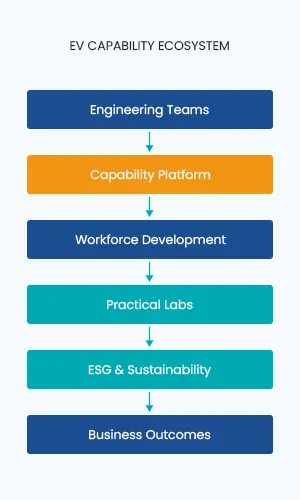
A Connected EV Capability Ecosystem

Why EV Companies Choose evACAD

EV-Domain Expertise
Deep technical knowledge across battery systems, power electronics, Battery Management Systems, EV architecture, and emerging mobility technologies delivered by domain practitioners.
Practical-First Learning
Every capability program combines structured learning with practical laboratories, simulations, and real-world industry projects.
White document icon with a blue checkmark on a blue background.
Industry-Aligned Capability
Capability frameworks are aligned with OEMs, Tier-1 suppliers, battery manufacturers, EV startups, and service network requirements.
Consulting & Execution
We do not only design capability programs.We manage end-to-end execution, delivery, trainer coordination, governance, and business outcome measurement.
ESG Integration
Carbon Accounting, ESG, and Net Zero readiness are integrated into capability frameworks instead of being treated as separate initiatives.
Scalable Delivery Model
Programs designed to scale across geographies, team sizes, and deployment models.

Illustrative Enterprise Use Cases

OEM Engineering Upskilling

Business Challenge

A leading OEM required more than 600 engineers to transition from Internal Combustion Engine technologies to Electric Vehicle technologies within 18 months.

Key Outcomes

  • Role-based capability pathways deployed.
  • Battery and BMS practical learning programs delivered.
  • 38% faster time-to-competency.
  • Standardized implementation across four manufacturing facilities.

Service Network Transformation

Business Challenge

A national EV service network required standardized diagnostics and repair capability across more than 200 technicians.

Key Outcomes

  • Unified competency framework.
  • Diagnostics and simulation laboratories deployed.
  • 52% reduction in post-program technical errors.
  • Scalable regional delivery model.

Battery Workforce Readiness

Business Challenge

Gigafactory expansion required rapid workforce capability development across battery manufacturing, quality systems, and production processes.

Key Outcomes

  • Accelerated onboarding programs.
  • Battery chemistry and manufacturing process capability.
  • 60% reduction in onboarding time.
  • Quality KPIs achieved within 90 days.

ESG Capability Development

Business Challenge

An automotive organization required ESG reporting capability aligned with EU Taxonomy and CSRD expectations.

Key Outcomes

  • Cross-functional ESG capability program.
  • Carbon Accounting workshops.
  • Governance framework implementation.
  • Full CSRD compliance readiness.

Why One Managed Training Partner Instead of Multiple Trainers

Single Governance Model
  • One SPOC
  • Common planning
  • Unified reporting
  • Standardized quality control
Standardized Learning Experience
  • Consistent curriculum
  • Standardized assessments
  • Uniform learner experience across multiple locations
Reduced Coordination

Lower coordination effort compared with managing multiple independent training vendors.

Trainer Continuity Technical capability programs often slow down when individual trainers become unavailable.
evACAD maintains a pool of technology specialists and industry trainers with backup resources to ensure uninterrupted delivery.

Supporting Your Experts

Supporting Internal SMEs
Your organization already possesses deep domain expertise. Our role is to support your excellence and growth - not replace your experts.
Reduce SME Workload
Allow internal Subject Matter Experts to remain focused on engineering, innovation, product development, and customer commitments.

Knowledge Transfer Framework

Capture expert knowledge through

  • Structured learning assets
  • Workshops
  • Mentoring
  • Repeatable learning programs
Knowledge Transfer Framework
Capture expert knowledge through:
Structured learning assets
Repeatable learning programs
Mentoring
Workshops

Investment in Your Future Leadership

A practical, industry-focused program designed to deliver long-term career growth and real expertise in EV powertrain and battery technologies.
Basic Programs
₹60K - ₹1.6L
(Basic content + hands-on + certificate)
Our Program
₹1.7L
(Industry-relevant content + hands-on + certification + industry visits + workshops)

Why One Managed Training Partner Instead of Multiple Trainers

Settings
APQP Alignment
  • Training roadmaps aligned with APQP phases.
  • Role-based competency mapping.
  • Support capability development across
    • Design
    • Validation
    • Manufacturing
    • Quality
    • Continuous Improvements
Protect
Data Protection
  • NDA-based engagements.
  • Protection of Intellectual Property.
  • Protection of confidential product information.
  • Controlled access to learning content.
  • Controlled learner data management.
Settings
Information Security

Compliance with organizational information security requirements throughout learning delivery.

Evolving into an Enterprise Capability Partner

Capability Maturity Framework
  • Role-wise competency matrices.
  • Capability maps.
  • Proficiency assessment.
  • Certification framework.
Digital Learning Ecosystem
  • Learning Management System
  • Learning Analytics
  • Microlearning
  • Knowledge Repository
  • AI-assisted assessments
  • Continuous Learning
Capability Governance
  • Quarterly capability reviews
  • Leadership dashboards
  • Succession planning
  • Annual capability roadmap
Business Impact Dashboard
  • KPIs linked to
  • Onboarding Time
  • Productivity
  • Quality
  • Hiring Efficiency
  • Retention
  • Compliance
  • Training ROI

Frequently Asked Questions

Everything you need to know about the program
What is the EV Capability Platform?

The EV Capability Platform enables organizations to design, build, and scale workforce capability by connecting engineering requirements with structured learning, practical labs, external expertise, and sustainability readiness.

Which industries can benefit?

The platform is trusted across the EV ecosystem, including OEMs, Battery Manufacturers, EV Startups, Industry Associations, and Academic Partners.

Can capability programs be customized?

Capability programs are designed to scale across multiple locations, geographies, departments, business units, and workforce sizes.

How do practical laboratories support workforce development?

Practical labs move learning from theory to application, shorten ramp-up time, improve confidence and retention, create job-ready teams, enable faster adoption of engineering standards, and strengthen quality and productivity.

Can you work alongside our internal L&D team?

Our role is to support your excellence and growth, not replace your experts. We reduce SME workload so internal Subject Matter Experts can remain focused on engineering, innovation, product development, and customer commitments, while complementing internal capability using technology specialists and experienced industry practitioners.

How do external experts integrate into delivery?

Organizations can access a curated network of EV experts, trainers, consultants, and domain specialists to support advanced engineering capability when internal bandwidth is limited.

What ESG capability programs are available?

Programs cover Carbon Accounting (carbon footprint concepts, reporting basics, operational understanding of emissions accounting), Net Zero Awareness (reduction pathways connected to business actions), and ESG Compliance (reporting requirements, stakeholder expectations, and sustainability governance).

How is business impact measured?

Business impact is tracked through a Business Impact Dashboard with KPIs linked to Onboarding Time, Productivity, Quality, Hiring Efficiency, Retention, Compliance, and Training ROI.

Can capability programs be delivered across multiple locations?

Yes. A single managed training partner provides a standardized learning experience with consistent curriculum, standardized assessments, and a uniform learner experience across multiple locations.

How do we begin an engagement?

Schedule a consultation with our capability team to discuss your workforce capability challenges and explore how the EV Capability Platform can support your organization.

Talk to Our Capability Team
Discuss your workforce capability challenges with our experts and explore how the EV Capability Platform can support engineering capability, workforce development, practical learning, and sustainability readiness.
Schedule Consultation