
The global conversation on climate finance often focuses on what’s already green, such as solar parks, wind farms, or electric buses. But what about the industries that aren’t green yet, like steel, cement, shipping, heavy manufacturing, or chemicals? These represent some of the largest emitters and the toughest to decarbonise. Ignoring them means leaving a massive share of emissions and economic value untouched.
This is where transition finance comes in. It is the funding mechanism that enables carbon-intensive sectors to evolve rather than be excluded. According to the International Energy Agency (IEA), transition finance “refers to financial activities that can contribute to emissions reductions, particularly in sectors that are difficult to decarbonise and in emerging markets and developing economies.”
In a world racing toward net zero, the investment community faces a vital question: should capital avoid high-emission industries or help transform them? Increasingly, the answer lies in supporting credible transition pathways, not simply divestment. This mindset is reshaping sustainable finance, giving rise to new instruments, taxonomies, and accountability frameworks focused on transformation rather than exclusion.
For India and other emerging markets, transition finance is not optional; it is essential. With economic growth still intertwined with fossil fuels and heavy industries, the journey to net zero must pass through the industrial backbone.
Transition finance refers to financial flows directed at decarbonising essential but emission-intensive sectors. Unlike green finance, which funds activities that are already sustainable, transition finance supports industries that are actively transforming their processes to align with long-term climate goals.
This includes funding for:
The key distinction is that the use of proceeds may not be green today, but must be aligned with science-based decarbonisation pathways, such as those defined by the Science-Based Targets initiative (SBTi) or national net-zero roadmaps.
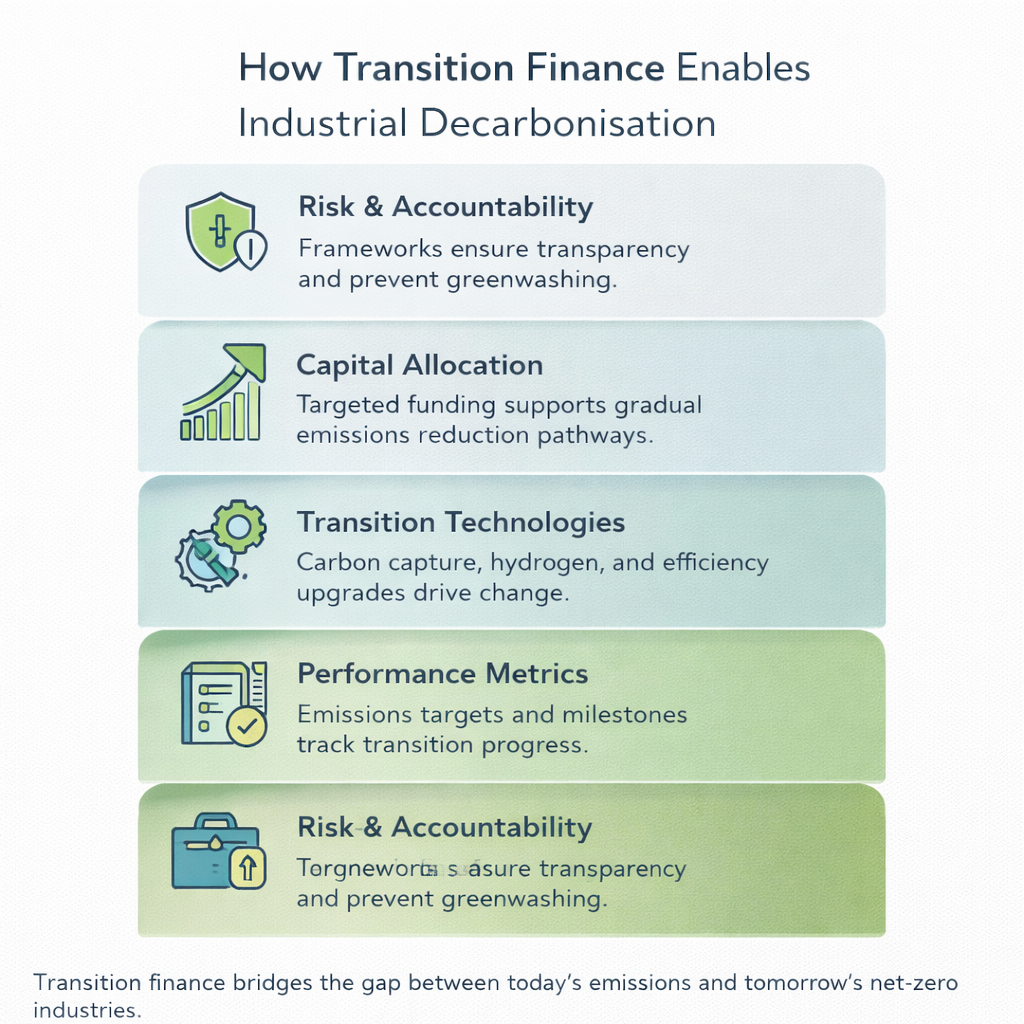
For years, ESG investing operated on the principle of divestment, excluding fossil fuels or high-pollution sectors from portfolios. While this approach created awareness, it also reduced funding for companies genuinely trying to change. Transition finance challenges that notion by urging investors to engage with emitters who have time-bound, credible plans to decarbonise.
In India, where coal still accounts for over 70% of electricity generation and core sectors such as steel and cement drive infrastructure growth, transition finance could bridge the gap between climate ambition and economic reality. Early examples include Tata Steel’s green steel initiatives and JSW Cement’s energy-efficient processes, both signalling industrial readiness for transformation.
The rise of transition finance is giving shape to new financial instruments. Transition bonds, similar to green bonds but designed for carbon-heavy industries, are gaining ground globally. Sustainability-linked loans (SLLs) are also emerging, with interest rates tied to emissions reduction targets.
Governments and multilateral banks are setting up transition funds, blended capital pools that de-risk early-stage industrial decarbonisation. Others offer tax incentives, interest subsidies, or carbon credits for verified progress.
India’s draft climate finance taxonomy (2024) includes a category for “enabling and transitional activities,” signalling regulatory support for financing industries in transition. The challenge now is ensuring transparency and accountability so that transition finance does not become a backdoor for greenwashing.
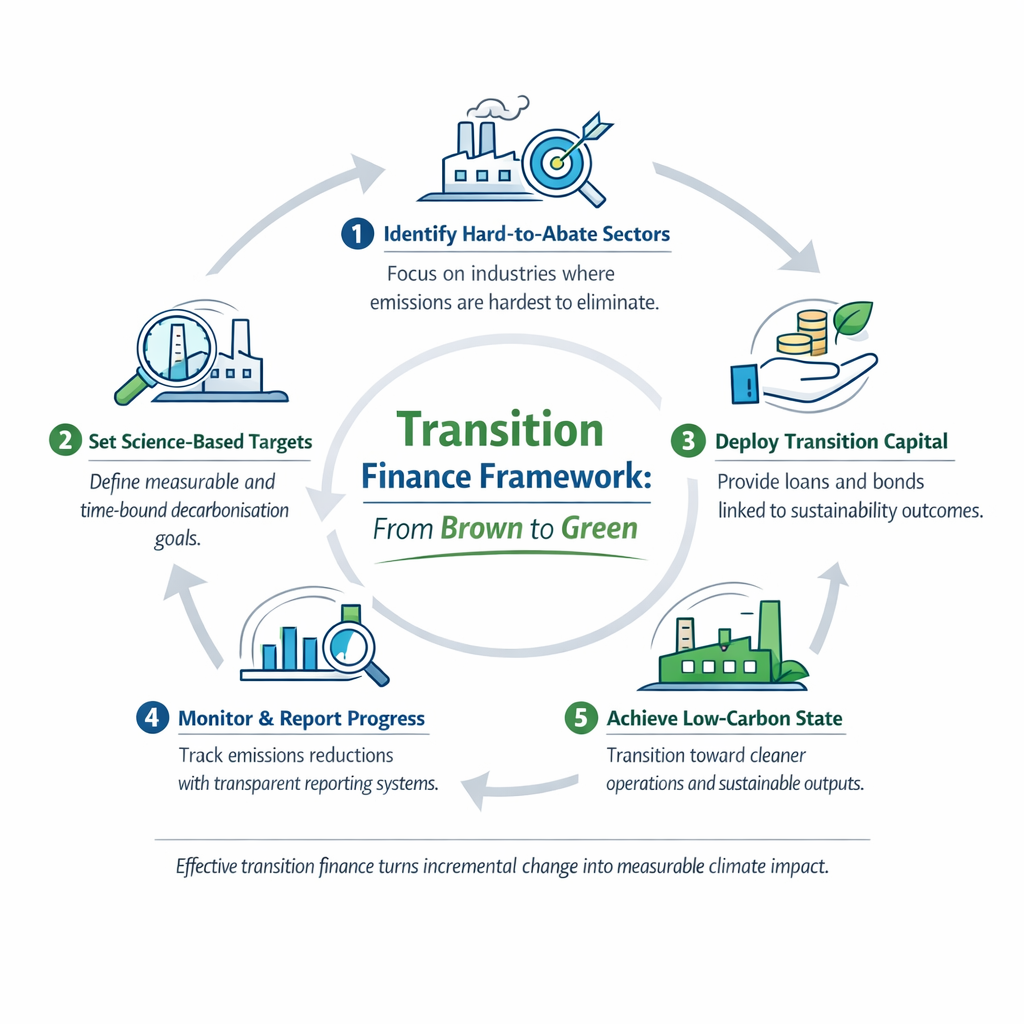
The credibility of transition finance depends on ambition, measurability, and governance. Companies must commit to science-aligned targets, disclose interim milestones, and link financing terms to performance. Independent verification and transparent reporting are critical to prevent misuse.
One major risk is ambiguous claims, where firms rebrand business-as-usual investments as “transitional” to access cheaper capital. Regulators like the UK government are developing stricter definitions and disclosure standards.
For developing economies, another challenge is the availability of affordable capital. Many lack access to concessional funds for high-risk industrial retrofits. This is where international climate finance can play a catalytic role through guarantees, co-investment mechanisms, and project preparation support.
As global pressure to decarbonise accelerates, the ability to finance not just the green, but also the greening, will define the next era of climate action. India’s economic trajectory, and that of many emerging economies, requires a transition that is both climate-aligned and inclusive. By developing transparent frameworks and partnerships, India can mobilise the finance needed to modernise its industrial base without sacrificing growth or livelihoods.
If we truly believe in net zero, we must fund the journey, not just the destination.
In this context, sustainability strategy and climate finance leadership are no longer optional. They are essential skills for business leaders. The ability to navigate green finance, ESG, carbon markets, and transition strategy is what will differentiate tomorrow’s executives.
Recognising this, the Indian Institute of Management Kashipur (IIM Kashipur), in collaboration with evACAD, has launched the Post Graduate Executive Programme in Net Zero Strategy & Sustainability Leadership, a first-of-its-kind initiative to prepare professionals and senior management for this transformational change.


.webp)
.jpg)
.jpg)