Some of the high-paying EV jobs in India are Design Responsible Engineer, Battery Engineer, Product Development Engineer, Validation Engineer, Embedded Systems Engineer, Power Electronics Engineer, and EV Charging Infrastructure Engineer.
Senior engineering roles in EV design, battery systems, BMS, power electronics and vehicle integration usually pay more because they require deep technical expertise and hands-on project experience.
The pay premium is most acute in the first few years of a career change from ICE to EVs For professionals making a transition from internal combustion engine (ICE) to EV roles, there is usually a pay bump of 45-50% at entry-level roles in between.
Registered EVs in India surged from 1.74 lakh in FY 2019-20 to 19.68 lakh in FY 2024-25, according to data accessed by the Ministry of Heavy Industries through the VAHAN portal. That growth is creating demand for engineers, technicians, product teams, testing teams, charging professionals and battery specialists. Government schemes and new battery gigafactory investments are providing further impetus to India’s own EV hiring, driving particularly sharp salary growth in battery and power electronics roles. The PM E-DRIVE scheme has an outlay of ₹ 10,900 crore and supports electric two-wheelers, three-wheelers, e-ambulances, e-trucks, e-buses, charging infrastructure and testing agencies.
The EV market is also growing around the world. Global sales of electric cars are expected to exceed 20 million in 2025 and reach 23 million in 2026, the International Energy Agency said.
Jobs in the green and energy transition, such as autonomous and electric vehicle specialists, are among the fastest-growing job categories tracked by the World Economic Forum. The overall category is expected to grow 45% from 2025 to 2030 (WEF Future of Jobs Report 2025).
Engineers switching from ICE roles into EVs typically secure an immediate pay hike. At the entry level, the premium is at 45–50%. That gap narrows steadily with seniority: by the time professionals reach the Senior Vice President level with 30 years of experience, EV and ICE pay converge at roughly INR 70–100 lakhs per annum in India, reflecting how skill scarcity (not pay scale) drives the early-career premium.
Note: The salary ranges below are indicative. EV salary data in India is still not as standardised as that for IT or general automotive roles. The above-quoted figures are to be used as directional benchmarks, not fixed market rates.
A Design Responsible Engineer, often called a DRE, owns a specific vehicle subsystem through design, development, testing, supplier coordination, and final integration. In EVs, a DRE may work on: Traction motors, Battery packs, Power converters, On-board chargers, Thermal management systems, Braking systems, Wiring harnesses, and Vehicle control units.
This position is usually a senior role. It needs strong automotive fundamentals, design review experience, testing exposure, supplier management, and system-level thinking.
A senior DRE in India may earn ₹18–30 lakh per year depending on employer, location, subsystem and experience. This is a guide range only and not a guaranteed market rate salary.
Battery engineering is one of the most important EV career areas. Battery packs affect vehicle range, safety, charging time, lifecycle cost, thermal behaviour, and customer experience. Battery engineers may work on the following: Cell selection, Battery pack layout, Battery Management Systems, Thermal design, Battery safety, Abuse testing, State of charge and state of health estimation, Battery validation, and Battery manufacturing support.
In India, battery engineering salaries vary widely. Early-career battery engineers may start in the lower salary band, while professionals with strong BMS, thermal, testing, or pack-integration experience can move into higher-paying roles.
Compensation for battery engineering is much higher in global markets, particularly in the US. However, do not compare global salary figures directly with Indian salaries, since the cost of living, equity compensation, taxation and labour market structures are different.
A Battery Management System Engineer works on the electronics and software that monitor and control the battery pack.
A BMS protects the battery from unsafe operating conditions. It monitors voltage, current, temperature, state of charge, state of health, charging limits, and fault conditions.
Key skills: Embedded C or Model-based Development, Battery algorithms, CAN communication, Cell balancing, Diagnostics, Basic functional safety, Testing and calibration, Battery data analysis.
BMS roles often command a higher salary than general EV roles due to the combination of battery knowledge, embedded systems, controls and safety-critical thinking
Power electronics engineers work on high-voltage systems that control energy flow inside an EV.
They may work on traction inverters, DC-DC converters, on-board chargers, motor controllers, charging systems, power semiconductor selection, thermal performance and EMI/EMC considerations.
This is an important role, as power electronics directly affect efficiency, charging performance, reliability and cost of the vehicle.
Professionals with sound knowledge of inverters, converters, motor drives and high-voltage safety can fetch a higher salary band, especially in OEMs, Tier-1 suppliers and EV component companies.

Product Development Engineers help to translate an EV concept into a working, manufacturable and validated product.
Possible responsibilities include: coordinating component design, engineering change management, supplier coordination, prototype development, testing support, failure analysis, vehicle integration, and cost and manufacturability improvements.
Product Development Engineers in EV roles with mid-level experience could earn approximately ₹8-15 lakh per year based on company, vehicle category and technical depth.
Validation Engineers test EV systems to ensure they are safe and reliable in real-world and extreme conditions.
They could be working on: Battery validation, Motor & inverter testing, Vehicle-level durability testing, Thermal testing, Charging validation, Environmental testing, Field failure analysis, Regulatory and homologation support
Validation is important because EVs combine mechanical, electrical, electronic, software, and thermal systems. A small design issue can affect safety, range, charging, or durability.
Engineers with specific EV testing experience, exposure to battery testing and vehicle-level debugging skills can move into stronger salary bands.
Charging infrastructure is becoming a major employment area as EV adoption increases.
Charging professionals may work on the following: Charger installation, Site surveys, Electrical load assessment, Charger commissioning, Grid connectivity, Public charging operations, Charger maintenance, Software and payment integration, and Safety compliance.
Charging infrastructure roles may pay less than core R&D roles at the start, but career growth can be strong for professionals who combine electrical engineering, project execution, grid knowledge, and charger technology.
EV Technicians work on vehicle service, diagnostics, assembly, troubleshooting, and repair.
Typical Activities: EV Inspection, Battery pack handling, High-voltage safety checks, Motor and controller diagnosis, Wiring and connector checks, Charger-related troubleshooting, Software diagnostic tool usage, Component replacement
Salaries of EV technicians in India are generally lower than engineering salaries, but skilled technicians are crucial to the EV ecosystem. Public salary submissions show a wide range, often in the ₹2-6 lakh per year range, depending on experience, city, employer and vehicle segment.
The best-paid EV roles usually require more than basic EV awareness. They require subsystem depth and practical application.
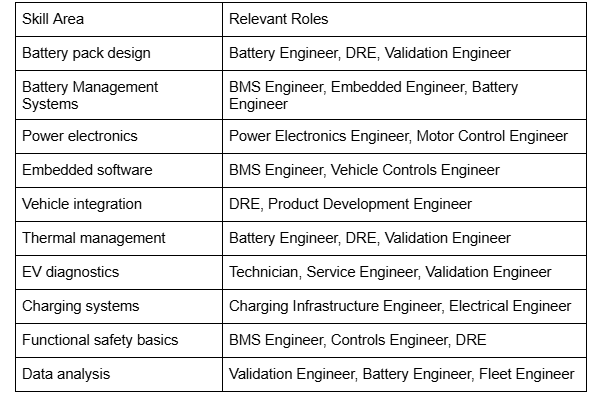
Choose the role based on your background.
If you are a mechanical engineer
Consider:
If you are an electrical engineer
Consider:
If you are an electronics or ECE engineer
Consider:
If you are a diploma holder or a technician
Consider:
EV careers in India are growing because electric mobility is expanding across vehicles, batteries, charging, software, and services. Specialised roles such as DRE, battery engineering, BMS, power electronics, embedded systems, validation, and vehicle integration typically offer the best salary opportunities.
The best way to evaluate EV salaries is to avoid broad generalisations and instead focus on skill depth. Engineers who can work on real EV subsystems, solve engineering challenges, and understand safety and validation will be better positioned for careers than those who only have a surface-level understanding of EVs.
If you want to get into EV engineering, first figure out which subsystem is closest to your background. Battery systems, electric drives, power electronics, embedded systems, vehicle integration, diagnostics or charging infrastructure.
Explore evACAD’s EV programs to build structured, industry-relevant skills for electric mobility careers.