The total EV registration in India for FY 2025-26 exceeded 25 lakh units, which was a 24% year-over-year increase, with EV penetration growing to an estimated 8.5% of all vehicle registrations in India. (Source: JMK Research & Analytics, April 2026). The hiring funnel for the electric vehicle industry hasn't seen this level of activity in the last five years.
For those who've been observing the EV industry jobs trend on the sidelines, 2026 could be a pivotal year where the idea of the sidelines becomes irrelevant. Companies looking to hire need candidates who can work on battery pack designs, embedded software, charging network, and vehicle validation.
This blog covers roles currently hiring, salary ranges for those positions, and the exact skills that mark a potential employee.
The more vehicles there are, the more individuals will be required to manufacture, design, and repair those vehicles. The mathematics behind the expansion is very straightforward.
A sales figure of 2 million+ electric vehicles in India during FY 2025-26 represents a large increase in numbers, with each electric vehicle sold contributing to increased demand for its maintenance and upgrades, along with infrastructure. Such government policies as PLI for batteries, FAME scheme, and local initiatives are attracting investments in the segment.
The field of EVs is one of the quickest-growing job sectors within engineering, where the availability of engineers specialising in batteries, software, and charging stations is insufficient to meet demand in places such as Pune, Bengaluru, and Chennai.
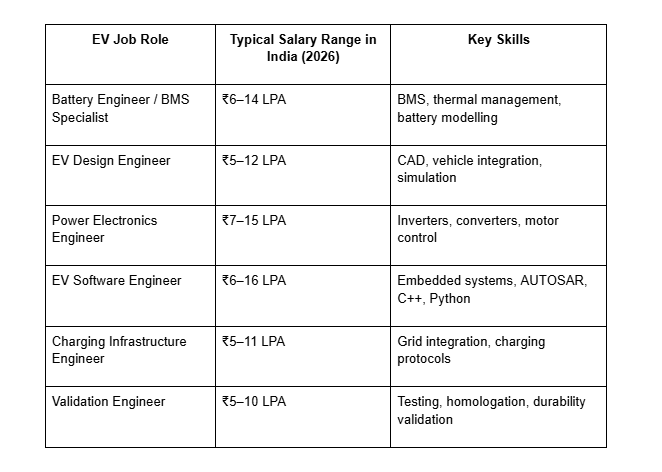
Not all EV industry jobs are equal in demand or compensation. Here are the roles that companies are actively struggling to fill.
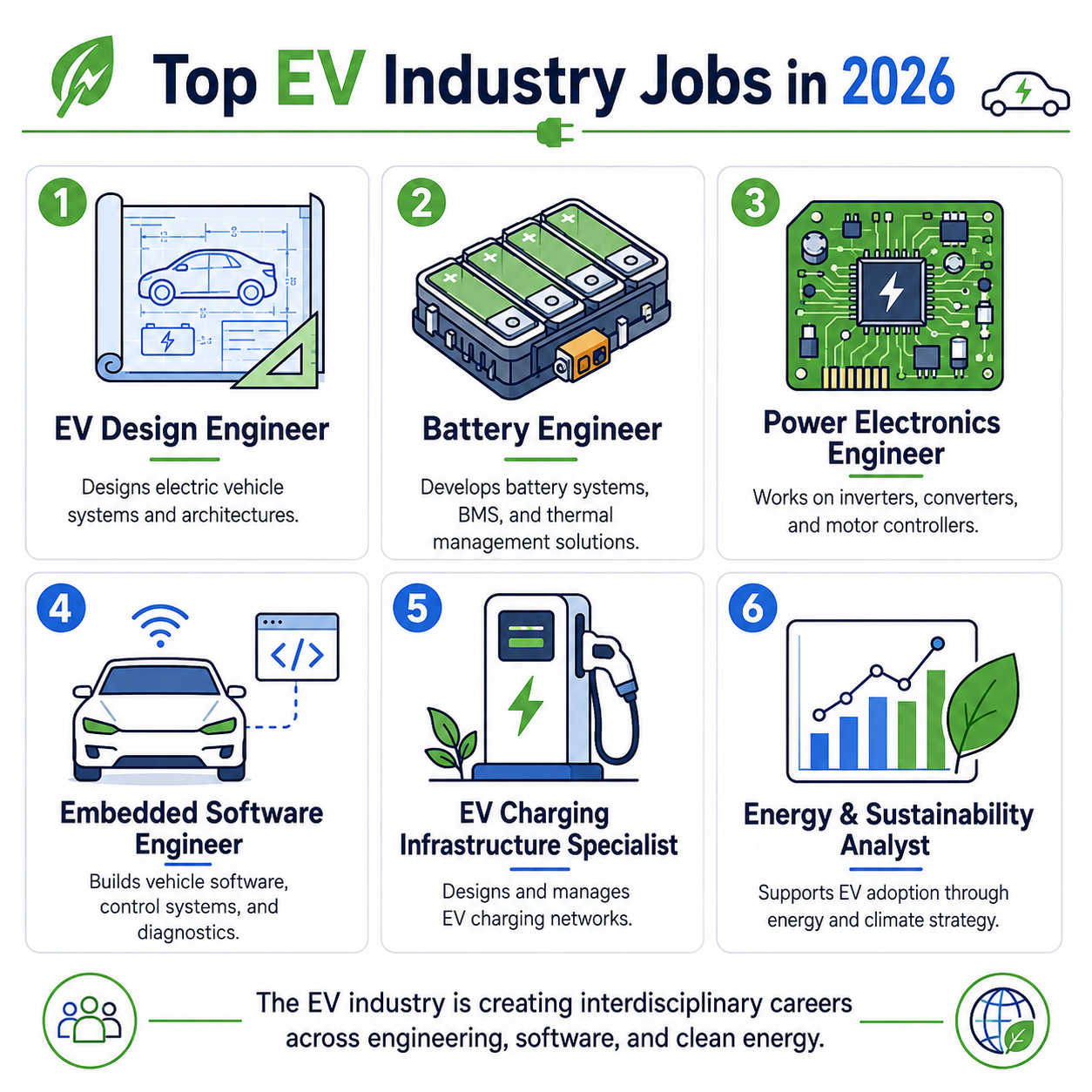
Undoubtedly, the most sought-after profession today. You’ll be tasked with designing battery packs, developing thermal management systems, and creating algorithms for their safety and efficiency.
Engineer positions related to BMS and power electronics are known to offer starting salaries of around Rs. 6-12 lakhs annually in India, with highly skilled engineers and team leaders earning much more than that. Thus making it one of the best-paying paths in EV engineering.
If you are looking for the ability to design the look, feel, and performance of the EV from a systems perspective, this is your job. The responsibility of design engineers includes the architecture, packaging, and integration of the components.
Inverters, converters, motor controllers. All of these transform the battery energy into mechanical energy. The field of power electronics sits right between electrical engineering and automotive engineering, and the job market is growing faster than the talent pool in 2026.
Electric cars are built on software technology. The software developers in our company require automotive expertise as well as proficiency in languages like C++, Python, and AUTOSAR.
Planning and installing the charging networks is required. It includes site selection, grid integration, intelligent charging protocols, and compliance. Given India’s ambitious plans for charging network installations, this function is scaling rapidly.
Before an electric vehicle is delivered to its owner, it undergoes intense testing. The validation engineers are responsible for conducting tests related to durability, performance, safety standards, and homologation. This is highly detailed work, but there aren’t enough people capable of doing it.
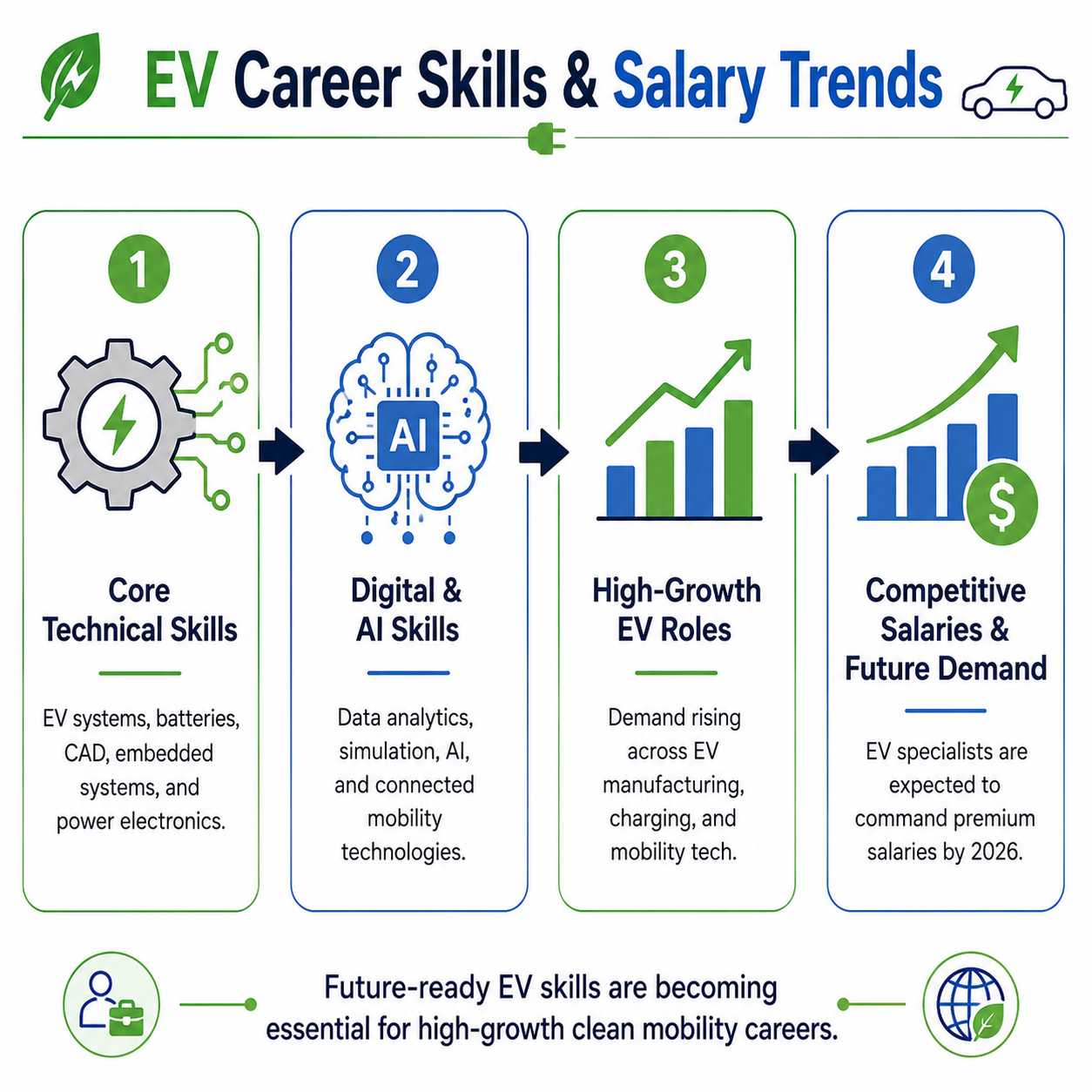
Your skill set directly determines your pay bracket. Here are the competencies that attract top compensation according to Guvi's 2026 analysis:
The pattern is clear: the more specialised your skill set, the higher the salary ceiling. Generalists get hired. Specialists get paid.
Location does matter. Recruitment of EV engineers is limited to only a few select cities, and it helps to know which hub suits your area of specialisation.
Pune dominates due to the presence of many automotive OEMs and Tier-1 vendors. Bengaluru is good for EV software and connected cars. Chennai's manufacturing prowess makes it attractive for manufacturing and validation engineers. Hyderabad is fast developing. Major employers include Tata Motors, Mahindra Electric, Ather Energy, Ola Electric, Bosch, and Valeo.
Preparation separates candidates who get interviews from those who get offers. Here's what actually moves the needle:
The job opportunities in India’s electric vehicle industry are no longer an abstract concept but a reality. The number of electric vehicles in India in FY 2025-26 will be 25 lakh, and due to initiatives such as PLI for batteries and PM E-DRIVE, the need for skilled personnel is rising.
It doesn’t matter whether it is a battery system or charging station, or any other technology; what is most important for you at this point is to build up your skills in one domain that does not exist elsewhere.
All of the above-mentioned opportunities can be accessed through the programs offered by evACAD, including those of basic certification courses and even those of post-graduate M.Tech programs. Get yourself enrolled in evACAD’s well-structured courses, ranging from basic certification courses to post-graduate M.Tech courses, to gain that domain knowledge which is now required by EV companies to hire people.