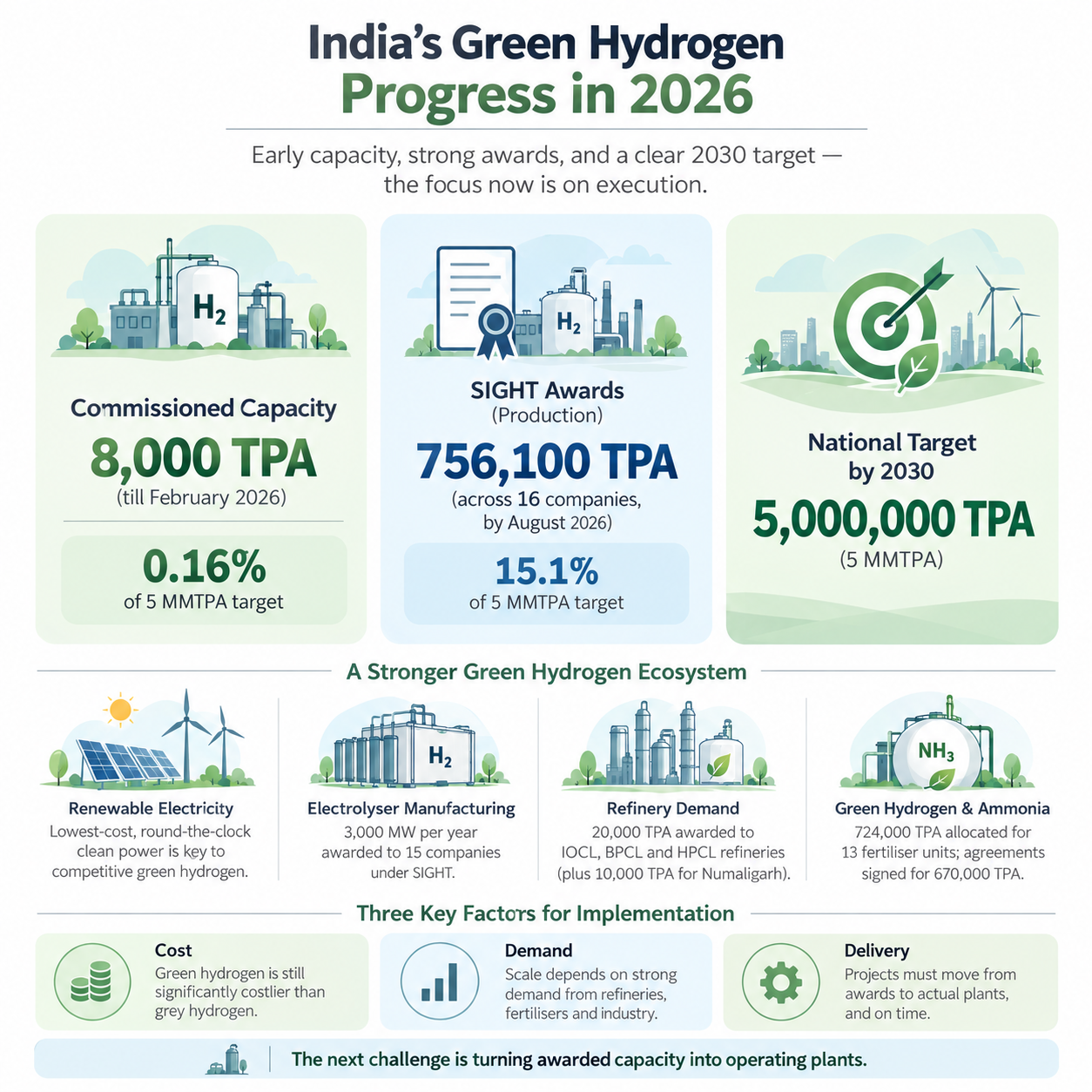
India had commissioned about 8,000 tonnes per annum (TPA) of green hydrogen production capacity by February 2026. That is 0.16% of the National Green Hydrogen Mission (NGHM) target of 5 million metric tonnes per annum (MMTPA) by 2030. The Minister of State for New and Renewable Energy, Shripad Yesso Naik, gave this figure in the Rajya Sabha on 25 March 2026.
On paper, much more has been awarded. The Strategic Interventions for Green Hydrogen Transition (SIGHT) programme had awarded 862,000 TPA of production capacity by May 2025. By August 2026 the awarded figure had fallen to 756,100 TPA across 16 companies. Minister of State Shripad Yesso Naik gave this figure in a written reply in Parliament, reported by the Business Standard on 12 August 2026. Fifteen companies hold awards for 3,000 megawatts (MW) a year of electrolyser manufacturing.
The mission has spent ₹292 crore of its ₹19,744 crore outlay as of 6 August 2026 (same parliamentary reply). For investors, developers and learners, the key question is how much of the awarded capacity turns into plants and how quickly. Three factors will determine this: cost, demand, and delivery.
The 862,000 TPA award equalled 17.2% of the 2030 target. The reported August 2026 figure of 756,100 TPA equals 15.1%. Commissioned capacity equals 0.16%.
The award book shrank by 105,900 TPA, about 12% of the May 2025 figure. This suggests some awards were cancelled or surrendered.
SECI's competitive bidding for refineries discovered green hydrogen prices of:
Without GST, they are about ₹336 and ₹328 per kg.
In the same reply, the minister cited the World Bank Group report "Electrolysers for Hydrogen Production". It estimates that renewable electricity makes up about 50% to 70% of the cost of green hydrogen, about ₹235 per kg. By that estimate, electricity alone costs more than grey hydrogen made from natural gas.
The Council on Energy, Environment and Water (CEEW) puts grey hydrogen at about $1.6 to $1.7 per kg at a gas price of $8 per million British thermal units. At an assumed ₹85 to the US dollar, that is roughly ₹136 to ₹145 per kg. On that basis, the discovered green price without GST is about 2.3 to 2.5 times the cost of grey hydrogen. The exact ratio depends on gas prices and the exchange rate.
Research bodies expect the gap to close by around 2030, though not yet. The NITI Aayog and RMI report "Harnessing Green Hydrogen" (June 2022) gives:
Green ammonia prices look better. SECI's 13 auctions discovered ₹49.75 to ₹64.74 per kg, or ₹49,750 to ₹64,740 per tonne. The government compares these figures with an international benchmark of about ₹110 per kg. The first auction, in August 2025, set ₹55.75 per kg (about $641 per tonne) for 75,000 TPA to Paradeep Phosphates. The press release put grey ammonia at $515 per tonne in March 2025. So green ammonia still costs more than grey ammonia, but the gap is much smaller than it is for hydrogen.
There is no notification from MNRE, the Ministry of Power or the Ministry of Petroleum and Natural Gas that requires any sector to buy a minimum share of green hydrogen. A green hydrogen consumption obligation for refineries and fertiliser plants was discussed in 2021, but it has not been notified.
Demand today comes from auctions run by SECI on behalf of buyers:
These are real contracts, but they are voluntary and cover a small share of India's hydrogen use. A project that is not in one of these auctions still faces off-take risk. Lenders usually want a guaranteed buyer or credit support before they fund such a project.
Parliamentary replies give precise year-wise figures
These three years add up to ₹700 crore allocated and ₹250.12 crore used, or 1.27% of the outlay. By 6 August 2026, total spending had reached ₹292 crore, or 1.48% (parliamentary reply reported by Business Standard). The Union Budget 2026-27 allocates ₹600 crore to the mission, double the 2025-26 figure.
To use the full ₹19,744 crore by 2029-30, the mission would need about ₹4,863 crore a year for four years. That is simple arithmetic ((₹19,744 crore minus ₹292 crore) ÷ 4), and it assumes spending is spread evenly. In practice, SIGHT production incentives are paid only after plants produce, so spending will lag commissioning by design. Slow early spending partly reflects plants that have not started yet. A component-wise breakdown of the ₹292 crore has not been published.
Fifteen companies hold SIGHT awards for 3,000 MW a year of electrolyser manufacturing. One example: L&T will supply high-pressure alkaline electrolysers for the IOCL Panipat plant from its facility at Hazira, Gujarat (L&T press release, 21 July 2025). Domestic stack production matters because imported stacks and components raise project capital costs.
In October 2025, the MNRE recognised three ports as Green Hydrogen Hubs under Component B2 of the revised guidelines for Hydrogen Valley Innovation Clusters and Hubs (27 June 2025):
Recognition under Component B2 comes without direct funding. It lets projects in these zones use benefits from other central and state schemes.
Work at the ports so far:
Hub status gives developers planning certainty. It does not create export buyers.
Four Hydrogen Valley Innovation Clusters have been awarded: Jodhpur, Odisha, Pune and Kerala.
In road transport, 12 pilot projects will deploy 70 hydrogen vehicles (27 buses and 43 trucks) with 16 refuelling stations on 21 routes:
Other pilots:
The Carbon Credit Trading Scheme (CCTS) was notified in June 2023. It now sets binding greenhouse gas emission intensity targets for 490 obligated entities in seven sectors (PIB release 2217239, 22 January 2026):
Targets for iron and steel were still at the draft stage in mid-2026. Targets for fertilisers had not yet been notified.
The inclusion of refineries matters for green hydrogen. Refineries are among India's largest users of grey hydrogen. An entity that misses its target must buy Carbon Credit Certificates (CCCs) or pay environmental compensation. The Central Pollution Control Board will set the compensation "equal to twice the average price at which Carbon Credit Certificates (CCCs) are traded during the trading cycle of that compliance year", according to the International Carbon Action Partnership (ICAP) India CCTS factsheet.
On the voluntary offset side, the Bureau of Energy Efficiency (BEE) lists "Hydrogen production from electrolysis of water" (methodology BM EN01.002) as an approved offset methodology.
As of late September 2026, we found no official record of a first CCC trade or a discovered price. ICAP's India CCTS page still states that "the first CCC trading is expected to be launched by mid-2026. "Power Minister Manohar Lal Khattar announced that timeline at the Prakriti conference. The Ministry of Power's CCC trading regulations were notified in early 2026. Until a price appears, nobody can say whether carbon costs will change refinery procurement.
IOCL's 10,000 TPA green hydrogen unit at its Panipat Refinery and Petrochemical Complex in Haryana is the largest single green hydrogen project in India. IOCL describes it as "India's largest-ever green hydrogen project to date" and states that it is "slated for commissioning by December 2027."
L&T Energy GreenTech won the contract under SIGHT Mode 2B. It will build, own and operate the plant, supplying 10,000 tonnes a year to IOCL for 25 years at the discovered price of ₹397 per kg including GST.
What the project would change:
The policy and players are more or less now aligned and started moving in the right direction. This moment is the right time for those looking to get an edge in this up-and-coming domain or to transition to this domain and skill up. Check out our Green Hydrogen Master Programme, which covers the entire length and breadth of the green hydrogen value chain. Or you can visit our home page evacad.com


.jpg)

