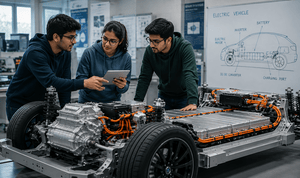
Electric vehicle battery technologies and innovators

last updated
April 9, 2026

All roads in electric vehicle technology and design lead to the battery, so it’s no surprise that most of the research in this industry is focused on the battery. There’s intense competition between BEV and hydrogen fuel-cell vehicles, and even in terms of the battery technology that will provide faster charging, cost less and increase battery life.

In this post, we take a look at the top 10 electric vehicle battery technologies and innovators that may come to replace traditional lithium-ion EV batteries.

Electric vehicle battery technologies

  1. Lithium-Ion variants:

a)Solid-State Batteries: Solid-state batteries replace the liquid electrolyte in lithium-ion batteries with a solid electrolyte. This improves safety, energy density, battery range and charging speed.

b) Lithium-Sulfur Batteries: Lithium-sulfur (Li-S) batteries use sulfur as the cathode material. Li-S batteries can significantly increase EV driving range and reduce the battery cost, since sulfur is more abundant and environmentally friendly than other metals.

c) Silicon Anodes: Silicon, with a higher energy storage capacity than graphite, could replace graphite anodes. EVs can provide longer ranges, shorter charging times, and be more cost-effective.

d) Graphene: Advantages of using graphene in EV batteries include high energy density, faster charging, longer cycle life, and it is a lightweight and ultrathin material. Reducing the battery weight is one of the toughest challenges for battery and EV designers. However, graphene has its own challenges in terms of manufacturing, scaling, and concerns of stability and safety over thousands of charging cycles.  

  1. Sodium-ion Batteries: Sodium-ion batteries are now available as a cheaper alternative to lithium-ion batteries. The energy density of sodium-ion batteries is lower, but it reduces the cost of battery production, increases its accessibility, and has a reduced environmental impact compared to lithium-ion batteries.
  1. Aluminum Air: Aluminum-air cells are a type of metal-air battery that use aluminum as the anode and oxygen from the air as the cathode, with water or an electrolyte solution serving as the electrolyte. Advantages include high energy density, refuelability, and lighter overall weight compared to conventional batteries.
  1. Flow Batteries (Redox): Flow batteries use two electrolyte solutions separated by a membrane. The advantage is longer range and rapid charging (by replacing the electrolyte), but that is offset by the larger size of the tanks required and the weight of the batteries. Flow batteries are also being used for providing charging stations in remote and high-temperature environments.

Top 10 electric vehicle battery innovators

  1. Store Dot

StoreDot is an Israeli technology company that specializes in the development of fast-charging battery solutions, including a unique lithium-ion battery technology that uses nanomaterials and organic compounds. 

This technology enables significantly faster charging times compared to traditional batteries. StoreDot claims that their batteries can be fully charged in just a few minutes, which is a significant improvement over the hours required for conventional charging.

  1. Log9 Materials

Log9 has launched India’s first indigenous battery cell, TiB, based on Lithium Titanium Oxide (LTO) chemistry, offering enhanced safety, long life, low-temperature performance, and rapid charging.

Their RapidX series of batteries are built to be durable in tropical conditions, with an operating temperature range of -40° to 65° Celsius for up to 40,000 charge-discharge cycles.

  1. Nyobolt

Nyobolt's core technology revolves around solid-state batteries, aiming to address the limitations of current battery technologies, such as the risk of thermal runaway, limited energy density, and slower charging speeds. 

By utilizing solid-state electrolytes, Nyobolt aims to deliver safer, more efficient, and longer-lasting energy storage solutions.

  1. Faradion

Faradion is a UK-based company that specializes in the development and commercialization of sodium-ion battery technology. 

Photo credit - https://faradion.co.uk/4

Reliance New Energy Solar Ltd., a unit of Reliance Industries, has acquired a 100% stake in Faradion at a £100 million valuation, and is additionally investing £25 million more for accelerating the company’s sodium-ion battery’s commercial roll out.

  1. VSUN Energy

VSUN Energy, a subsidiary of Australian Vanadium Limited, has developed a vanadium redox flow battery (VRFB) that can deliver renewable energy in remote locations. 

It enables remote EV charging, with a VRFB being used to power an EV charging station, and provides substantial advantages for operating chargers in remote and high temperature environments.

  1. Manikaran Power Ltd.

MPL is an Energy Solution Company having combined experience and expertise of more than a decade in Power, Coal and Gas. In 2022, they announced an INR 1000 Crore investment in a proposed lithium refinery, to be set up at a cost of INR 2,200 crore for producing lithium hydroxide that is used in EV batteries.

  1. Munoth Industries Ltd.

Munoth Industries Limited (MIL) has set up India’s first lithium cell manufacturing unit with an investment of Rs 799 crores on a 30-acre site located near Tirupati Airport.

  1. TDSG

TDSG is India’s first Lithium-Ion battery manufacturing plant, established jointly in Gujarat by TOSHIBA Corporation, DENSO Corporation and Suzuki Motor Corporation.

  1. Amara Raja

The $1.3-billion Amara Raja Group, which has a significant share of the traditional lead acid battery market in India, has announced an investment of INR 7000 crores for Lithium-Ion batteries. Amara Raja has already obtained AIS-156 Amendment 3, Phase 2 certification from ARAI for its EV battery and off-board chargers.

  1. Attero Recycling

Attero bills itself as India’s largest electronic asset management company.Their process includes complete transportation and logistics related to recycling li-ion batteries, along with their safe destruction and full recovery of the metals that can be reused.

evACAD logo with stylized orange checkmark integrated between letters.
Future-proof your career! Learn from the best in EV Design & Technology
Know More
Speak to our EV Career Guidance Expert
Four customer service agents wearing headsets working on laptops at a desk in a dimly lit office.
+918095336646
Graphic showing four diverse male portraits connected by orbiting colored dots around a central figure.
Take the Next Step with evACAD
Get Started!

FAQ

What are solid-state batteries and how do they improve on traditional lithium-ion batteries?

Solid-state batteries replace the liquid electrolyte in lithium-ion batteries with a solid electrolyte, improving safety, energy density, and charging speed. They also reduce the risk of thermal runaway, making them one of the most promising next-generation EV battery technologies for longer range and safer electric vehicles.

Why are sodium-ion batteries considered a viable alternative to lithium-ion batteries for EVs?

Sodium-ion batteries use sodium, a cheaper and more abundant element than lithium, reducing production costs and environmental impact. While their energy density remains lower than lithium-ion batteries, they are increasingly competitive for stationary and entry-level electric vehicle battery applications where cost matters more than range.

How do flow batteries work and what advantage do they offer for EV charging infrastructure?

Flow batteries store energy in two electrolyte solutions separated by a membrane, enabling rapid charging by simply replacing the electrolyte. Among emerging EV battery technologies, they are particularly suited for remote and high-temperature EV charging stations, where conventional lithium-ion batteries face operational limitations.

What makes a fast-charging battery technology viable for mainstream electric vehicle adoption?

A commercially viable fast-charging battery must reduce charge times to minutes rather than hours without compromising safety or cycle life. Companies like StoreDot use nanomaterials to achieve this in lithium-ion batteries, while solid-state batteries from innovators like Nyobolt aim to solve both speed and thermal safety challenges simultaneously.

How is India contributing to the development of next-generation EV battery technologies?

India is rapidly building its electric vehicle battery ecosystem through companies like Log9 Materials, which launched an indigenous LTO-based cell, and Attero Recycling, which recovers metals from used lithium-ion batteries. Large investments from Amara Raja and Munoth Industries are also strengthening India's domestic EV battery technologies manufacturing capacity.

Talk to Advisor over call
Blue upward arrow inside a white circle with a blue border.