
Climate-Driven Migration: Turning Risks into Opportunities through Sustainable Leadership

last updated
April 9, 2026

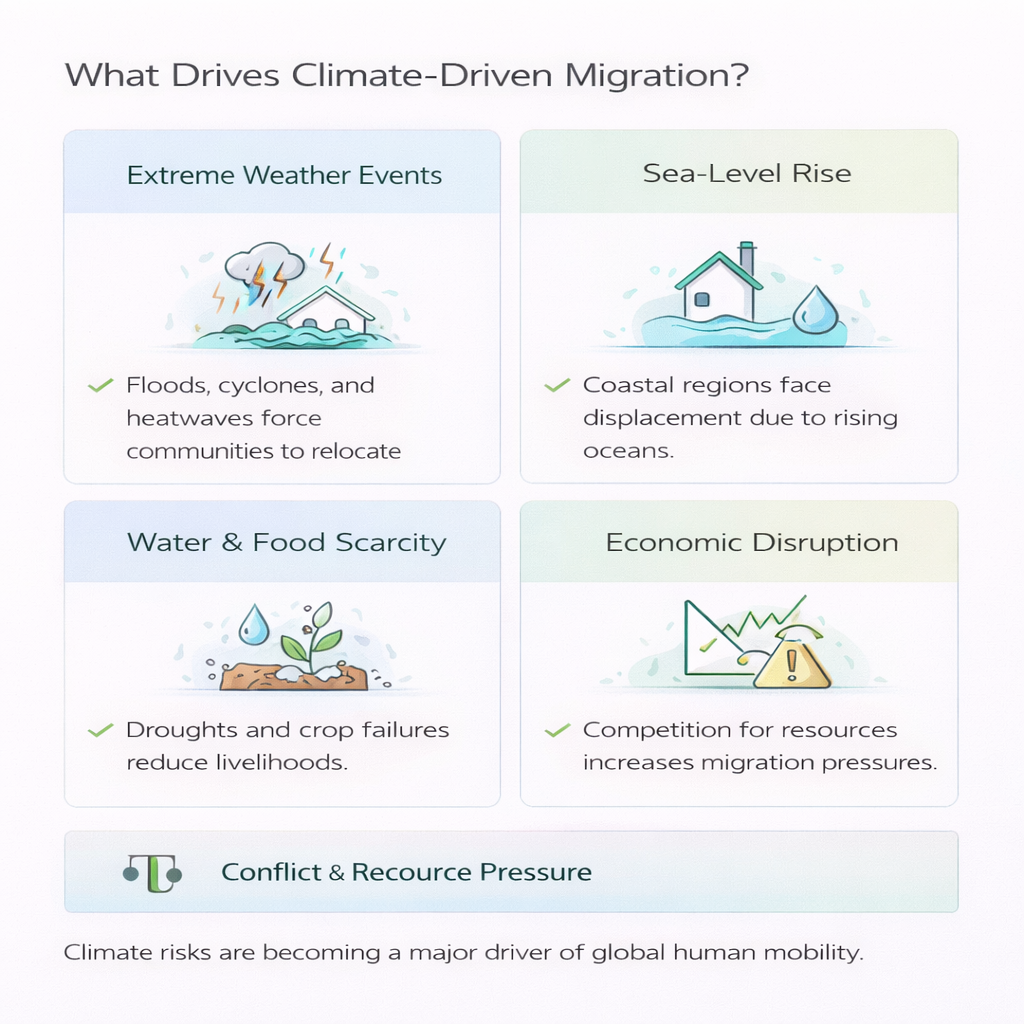
As the planet warms, it’s not just temperatures that are rising; people are moving. Across the globe, millions are being displaced by rising sea levels, crop failures, and extreme heat. This phenomenon, known as climate-driven migration, is no longer a projection; it’s already unfolding. By 2050, the World Bank estimates up to 216 million people could be displaced within their own countries.

Migration on such a scale poses risks for both origin and destination regions. Rural areas lose working-age populations and livelihoods, while cities struggle to absorb migrants into already stressed housing, healthcare, and infrastructure systems. Left unchecked, this can fuel inequality, instability, and social tensions.

But there’s a better way forward. Climate migration can be mitigated through sustainable development, especially by localising energy needs, diversifying livelihoods, and building climate-resilient infrastructure. Instead of being a crisis, it can become an opportunity to reshape economies, strengthen communities, and ensure inclusive growth.

From Risk to Resilience: The Role of Sustainable Development

  1. Localisation of Energy Needs: Decentralised renewable energy systems, microgrids, and community-based power solutions reduce dependency on fragile central infrastructure. By making clean energy affordable and accessible in vulnerable regions, communities are less likely to be uprooted.
  2. Resilient Livelihoods: Climate-smart agriculture, water-efficient practices, and green skills training enable people to thrive in their own regions. By creating new local income streams, migration pressures decline.
  3. Adaptive Urban Planning: For cities absorbing migrants, sustainable housing, green transport, and social protection systems can turn influx into inclusive urban growth, rather than unplanned sprawl.
  4. Policy and Governance: Strong climate leadership ensures migration is addressed in national adaptation plans, social policies, and financing strategies—making resilience systemic rather than reactive.

Building Climate Leadership with IIM Kashipur & evACAD

Addressing a challenge as complex as climate-driven migration requires more than ad-hoc fixes; it calls for leaders who understand the intersection of climate science, economics, energy systems, and policy innovation.

That’s where the PG Executive Program in Net Zero Strategy & Sustainability Leadership by IIM Kashipur and evACAD comes in. This program equips professionals to design, implement, and scale solutions that directly address the root causes of migration while driving sustainable growth.
Program Highlights:

  • Sustainable Energy & Localisation: Learn how renewable transitions and decentralised grids can stabilise vulnerable communities.
  • Resilient Livelihood Models: Explore strategies in climate-smart agriculture, circular economy, and climate finance.
  • Strategic Leadership Tools: Master ESG frameworks, carbon markets, and green finance for large-scale sustainability impact.
  • Experiential Learning: Work on real-world case studies, benefit from expert faculty, and take part in 2-day campus immersion at IIM Kashipur.
  • Alumni Advantage: Earn IIM Kashipur Executive Alumni status and access a strong network of sustainability leaders.

Final Word

Climate-driven migration is one of the defining challenges of our time. But it doesn’t have to mean loss and instability; it can be managed through sustainable development, localised energy systems, and strong leadership.

With the IIM Kashipur-evACAD program in Net Zero Strategy & Sustainability Leadership, professionals can step up to lead this transition, ensuring communities are not left behind, but instead empowered to thrive in a net-zero future.

evACAD logo with stylized orange checkmark integrated between letters.
Shape the businesses, policies, and technologies driving Net Zero & Sustainability. Get Started!
Know More
Talk to our advisor today and know more about our Sustainability and Net Zero Program
Four customer service agents wearing headsets working on laptops at a desk in a dimly lit office.
+918031404841
Graphic showing four diverse male portraits connected by orbiting colored dots around a central figure.
Take the Next Step with evACAD
Get Started!

FAQ

What is climate-driven migration, and how severe is the projected displacement?

Climate-driven migration refers to people relocating due to rising sea levels, extreme heat, and crop failures caused by climate change. The World Bank estimates up to 216 million people could be displaced within their own countries by 2050, making it one of the defining social consequences of the climate crisis.

How does decentralised renewable energy help reduce climate-driven migration?

Decentralised renewable energy systems like microgrids make clean power affordable and accessible in vulnerable communities. By stabilising local energy supply, they reduce the economic fragility that often pushes populations to migrate, directly supporting climate resilience and keeping communities rooted in their own regions.

What role does adaptive urban planning play in managing climate-driven migration?

Adaptive urban planning helps cities absorb incoming migrants sustainably through green transport, affordable housing, and social protection systems. Rather than creating unplanned sprawl, well-designed cities can transform migration pressure into inclusive urban growth, a core pillar of sustainable development strategies for climate-affected regions.

How does sustainable development help turn climate-driven migration into an opportunity?

Sustainable development approaches, including decentralised renewable energy, climate-smart agriculture, and green skills training, create resilient local livelihoods. When communities have stable income and reliable infrastructure, migration pressures decline, and regions can shift from crisis management to building long-term climate resilience and economic opportunity.

What skills does climate leadership require to address climate-driven migration effectively?

Effective climate leadership demands expertise across climate science, energy systems, green finance, and policy design. Programs like IIM Kashipur's PG Executive Program equip professionals with ESG frameworks, carbon market knowledge, and strategic tools needed to build a net-zero future while addressing the root causes of climate-driven migration.

Talk to Advisor over call
Blue upward arrow inside a white circle with a blue border.