You've analysed M.Tech in electric vehicles programs by considering their costs, browsing review sites, and possibly losing many sleepless nights worrying about whether or not you are on track with your decision. Two whole years of academic study, payments of significant tuition fees, and many other commitments lie ahead.
Here comes the explanation behind this phenomenon. According to Fortune Business Insights, the future scope for electric vehicles in India is anticipated to expand from 5.28 billion dollars in 2025 to 17.88 billion dollars in 2032 with a CAGR of 19%. (Fortune Business Insights, 2025). This will lead to several jobs that require unique and specialised skills in engineering that can only be fulfilled by foreign workers.
This blog post talks about what M.Tech in electric vehicles is all about, career prospects, salaries, and whether it makes financial sense.
Before analysing whether the degree is worth it, it would be wise to gain an understanding of what you will be committing to.
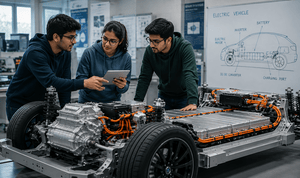
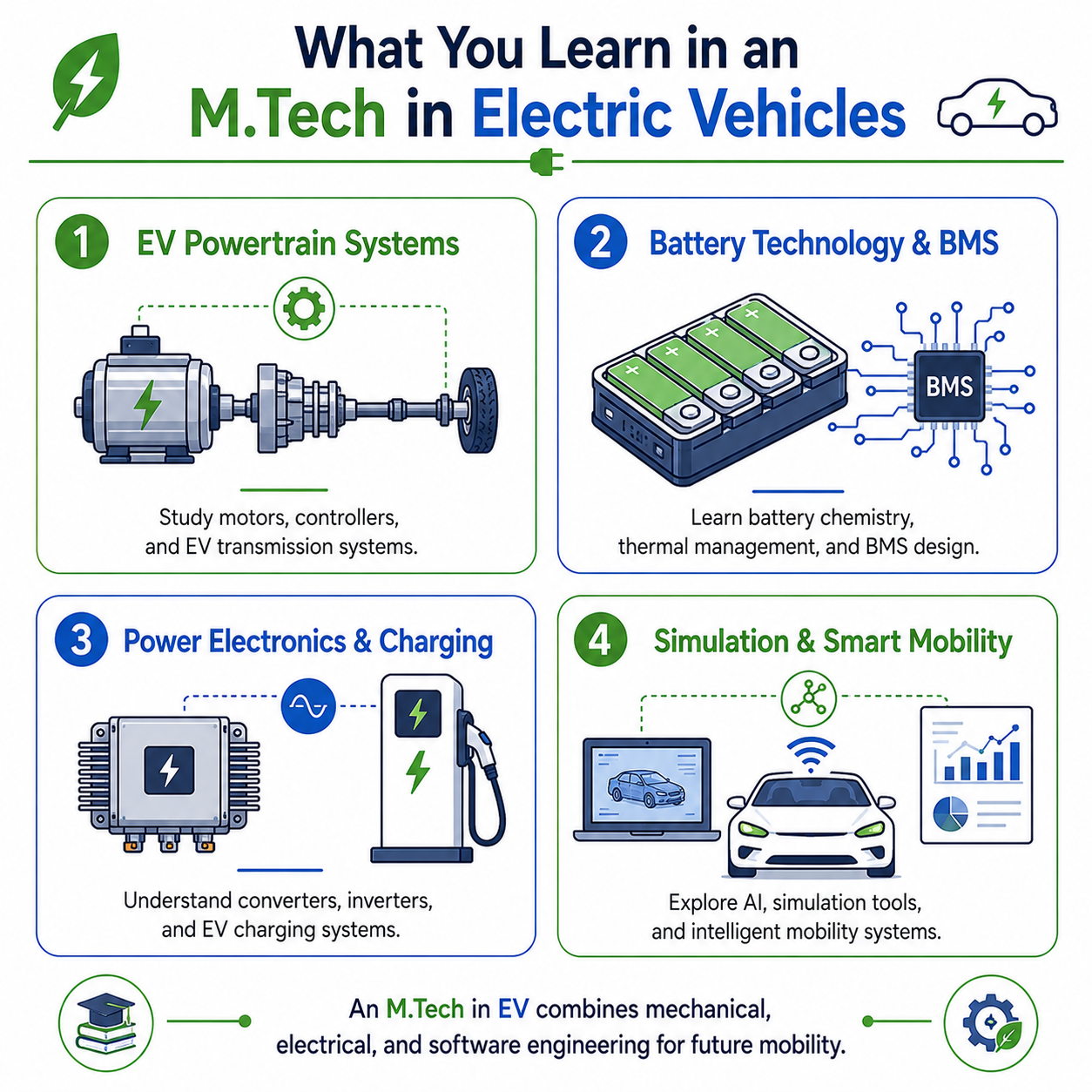
The M.Tech in electric vehicles program is an advanced engineering degree that covers all the technical aspects of electric vehicles, ranging from batteries, electric propulsion systems, motor drives, vehicle designs, and autonomous vehicle technologies. Contrary to the common M.Tech Mechanical/Electrical Engineering program, this program provides specialisation in areas where it counts.
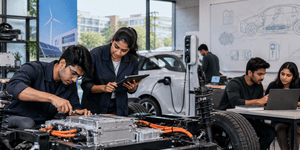
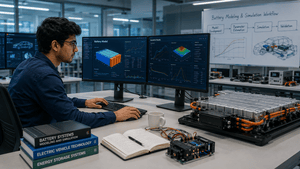
The duration for completion ranges from two years. Good programs always combine theory with practical experience in the form of laboratory work, project work, mentorship by industrial experts, and other methods. You will be introduced to simulations via MATLAB/Simulink models, battery simulation software, and real-time hardware components.
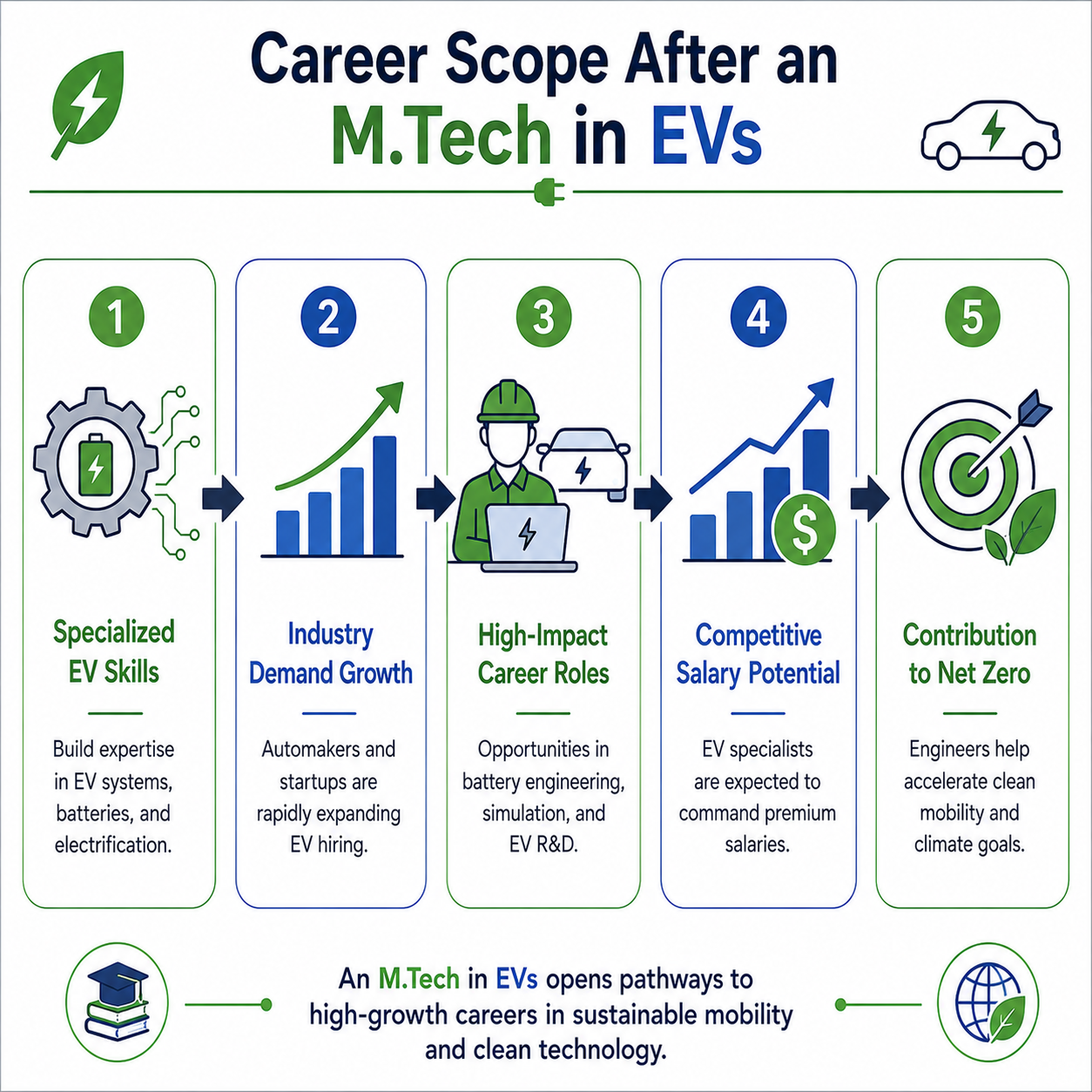
The job market for EV-specialised engineers is expanding faster than the talent pipeline can keep up.
The key advantage? Specialisation. In a pool full of general engineers, an M.Tech in EVs signals you've committed to the domain and brings ready-to-deploy skills.
However, not all M.Tech programs are made the same. The institution and the program’s structure have as much weight as the degree.
Some institutes offer M.Tech courses with EV specialisations on their own, or under existing courses of automobiles and electrical engineering. While choosing an institute, one should focus on curricula relevant to the industry, practical laboratory courses, and placement assistance from EV companies.
Curricula that follow NEP 2020 and India’s Automotive Mission Plan will have more value due to their policy-based relevance to the industry. Programs that are certified by the ASDC get more credibility due to compliance with SIAM, ACMA, and the Indian government standards.
An individual who cannot be absent from work to attend a regular campus program may want to consider some other options that exist.
evACAD, which is a knowledge-sharing vertical of the pManifold company, provides learning programs for professionals. For instance, the Blended M.Tech in EV Technology is a two-year hybrid course offered to professionals with more than one year of experience.
As per the DIYguru salary guide for the year 2026, new EV engineers in India will receive INR 3-8 LPA, with engineers in metros such as Bangalore and Pune being the highest paid among the lot. (DIYguru, February 2026). Engineers working in mid-range jobs, particularly in fields like BMS design, powertrain engineering, and EV software development, get salaries of INR 10-18 LPA. Engineers with INR 25 LPA or higher fall into the highest-paying bracket.
These numbers speak for themselves when compared to salaries for engineers working in general areas.
Professionals often consider the value that comes from pursuing an M.Tech degree in terms of its career impact rather than just the degree itself. A comparison between things like the time taken to get the degree, cost, salary, and career outcome can give insights.
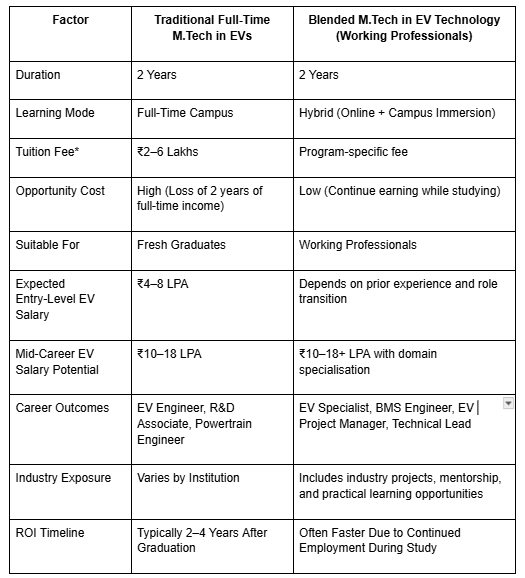
*Fees vary significantly by institution and program structure.
For most professionals, the main expense related to pursuing a graduate education is not the fee involved in the course but the salary forgone during full-time studies. This problem would be solved using the proposed model since the student would be able to work simultaneously.
Given that EV recruitment would be increasing in battery technology, power electronics, powertrain design, and automotive software, an engineer who has both industrial experience and specialised knowledge in EVs might have a more prosperous career path than the generalist.
For many professionals, the highest cost of a postgraduate degree is not tuition but the income sacrificed during full-time study. A blended M.Tech model can reduce this opportunity cost by allowing learners to continue working while upgrading their skills. As EV hiring expands across battery systems, power electronics, powertrain development, and vehicle software, professionals who combine industry experience with specialised EV credentials may see stronger long-term career growth than those relying solely on a general engineering background.
Here's the ultimate question that all of the above in this blog will come down to. It deserves an honest analysis.
When you are working in engineering and find yourself stuck in a generalist path, an M.Tech in electric vehicles gives you a concrete option to specialise. The industry is growing, the gap between demand and supply of talent is increasing, and employers are ready to pay top dollar for competent professionals.
However, your return on investment will depend on how hard you work on it. Choosing a well-structured program that includes practical aspects will prove to be much more beneficial than a purely theoretical one. If chosen correctly, the outcome will go beyond your diploma.
M.Tech in electric vehicle technology is not an ordinary postgraduate course. Considering that Fortune Business Insights says the global market will reach a CAGR growth of 19% from 2022 to 2032 and that there have been over 25 lakhs registrations of electric vehicles in India by the fiscal year of 2025-2026, the professional relevance of this course cannot be understated.
The issue is not whether or not this course will pay off, but whether you're ready to take the extra steps required to get yourself enrolled in the right program, which offers you all the opportunities and exposure that you need.
At evACAD, their courses on electric vehicles are tailored precisely towards that objective. So if you're still considering your options, why don't you give them a call and let them guide you?