Five years ago, e-mobility was only a buzzword used in conferences and in official documents. Now, it has become the primary motivation for the next-door neighbour buying an electric hatchback and the main reason why employers cannot find enough EV engineers to recruit. As reported by Precedence Research, the market for electric vehicles in India is expected to grow from $18.79 billion in 2025 to roughly $1,283 billion by 2035 at a CAGR of 52.56%. (Precedence Research, March 2026).
The future looks promising, but the reality is not without challenges. What do you even study first? The job description sounds strange, the sector is developing fast, and there seems to be a large difference between a regular engineering education and an EV-related skill set.
Here is your guide. Let’s discuss the competencies required, the courses that will help acquire them, job positions to aim for, and the EV career roadmap.
It's not only the sale of EVs that is increasing. New career profiles are being created that were not around a decade ago.
Policies by the government are speeding up the transition process. The FAME II scheme, the PLI policy for battery manufacturing, and the push for EV adoption in states like Delhi are making India one of the most exciting markets for EVs in the world. As revealed by the Persol India salaries forecast for 2026, engineers specialising in EV technology, embedded systems, and power electronics earn salaries between 30 percent and 50 percent higher than engineers specializing in generic engineering domains. (Persol India, March 2026).
It's not only the production line that needs these engineers. The growth will create openings for software developers, battery experts, powertrain designers, and charging infrastructure specialists.
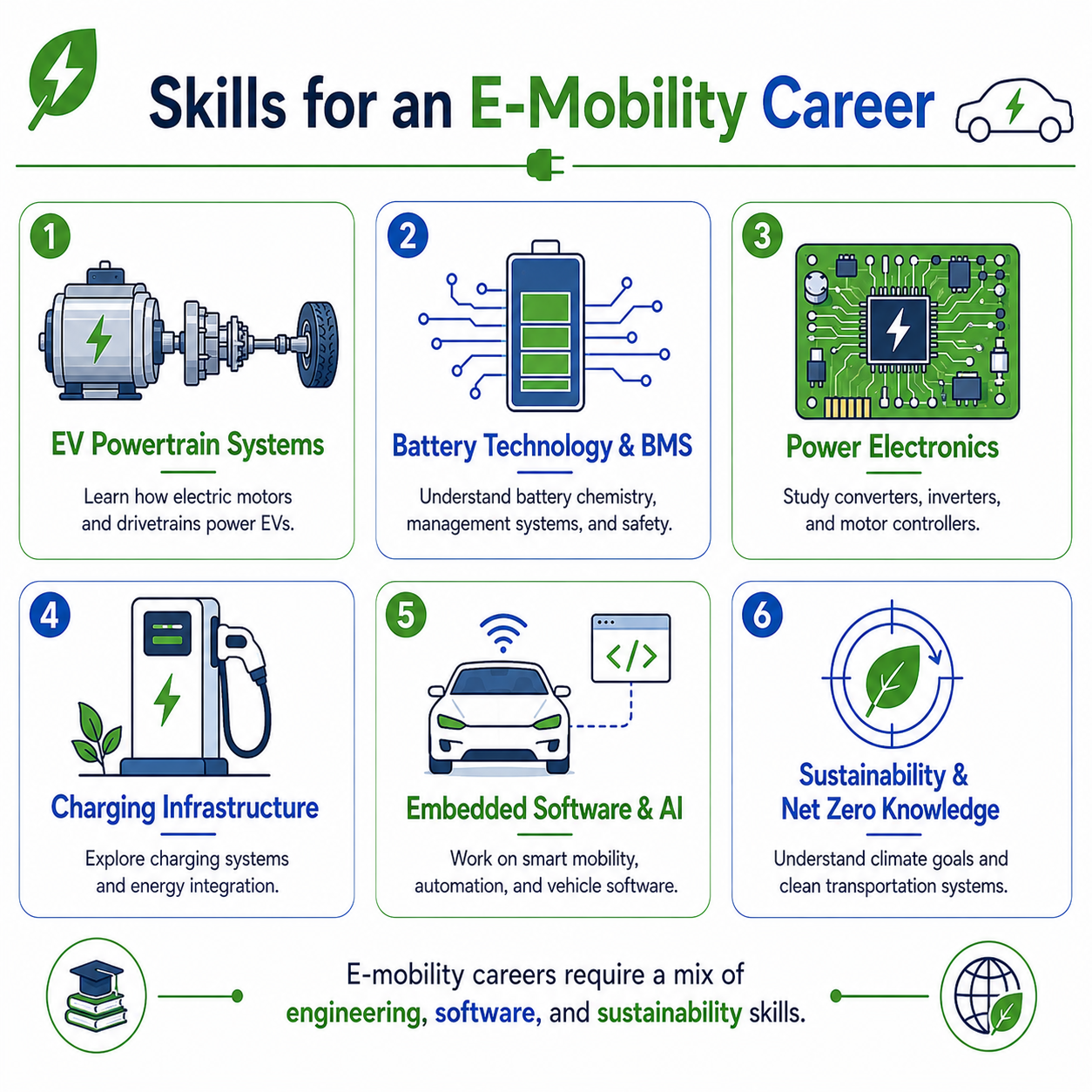
EV companies want specific, demonstrable competencies. Here's what consistently appears in EV career job listings:
Most professionals go deep in one or two areas first, then broaden. The key is choosing a specialisation that matches your background.
Choosing the correct course can be 50% of the job done. Wrong courses lead to wasted effort, while proper courses pave a direct path to jobs.
The situation regarding educational courses in the field of EVs in India has progressed much further. There are various types of courses, ranging from certificates and PG diplomas to even M. Tech programs.
Programs at evACAD carry ASDC certification. A credential that carries weight because the Automotive Skills Development Council was jointly established by SIAM, ACMA, FADA, and the Government of India through the Department of Heavy Industry and the National Skill Development Corporation (NSDC), making it the recognised awarding body for automotive skilling in India.
There are various courses offered under evACAD depending upon the career stage of a person. EvACAD offers a Certificate Program in EV Model-Based Engineering, which is a four-month-long introductory course. PGC in the eDrive and Battery Systems program is meant for mid-career individuals. There is also a two-year-long Blended M.Tech in EV Technology.
Once you've built the skills, knowing which roles to target saves you months of unfocused job searching.
These positions exist across OEMs, Tier-1 suppliers, startups, and consulting firms. The market is bigger than most people realise.
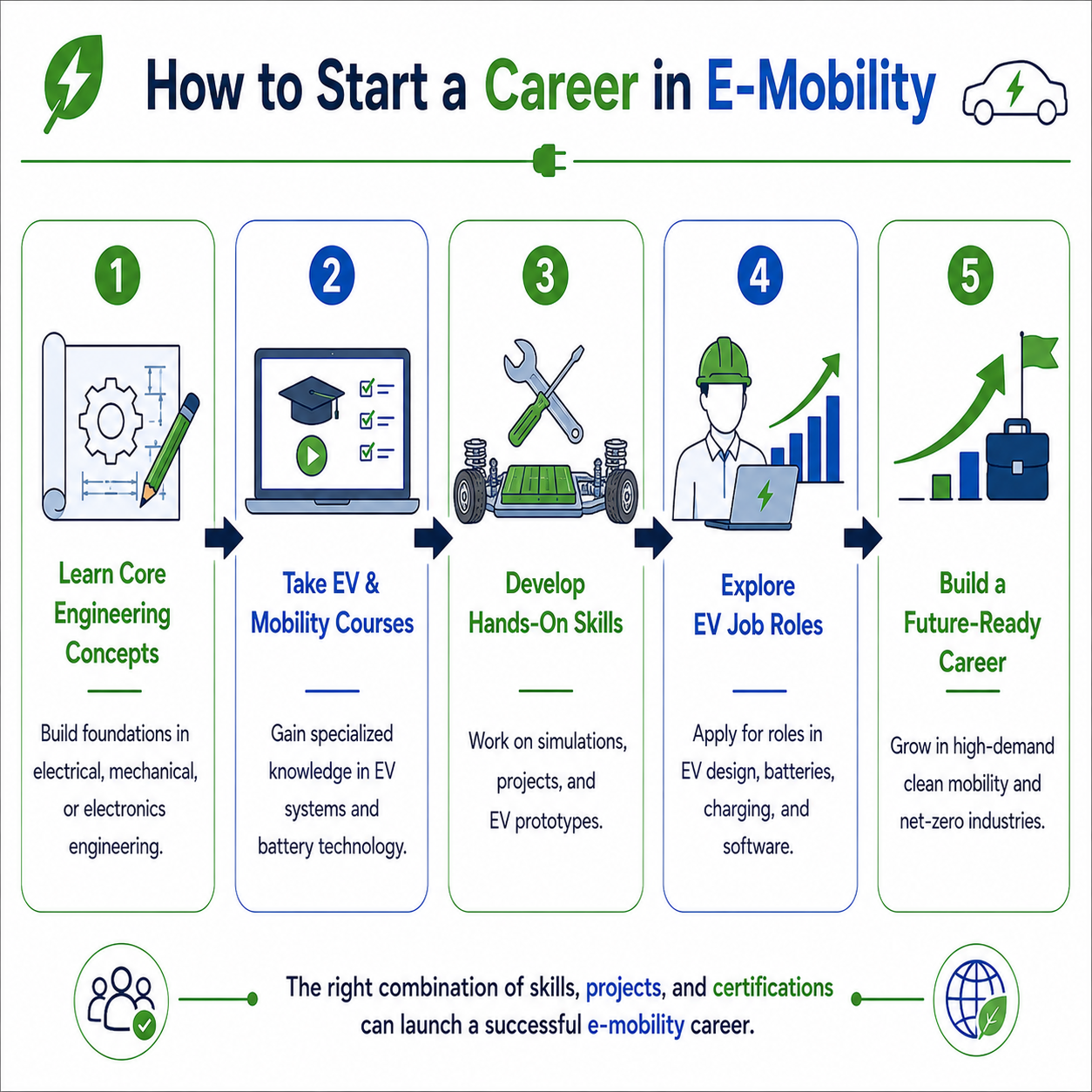
Always choose strategy over motivation. The following roadmap shows how we can go from our present state to the skills we gain, to the course that helps us develop those skills, and then to our desired role. Stick to the path that matches your present state.
Begin with your engineering knowledge foundation of mechanical, electrical, or electronic engineering and add the knowledge of the EV domain on top of it.
Step 1: Gain Awareness of Domain Knowledge. Begin your training on everything that you need to know about EVs, from battery packs, BMS systems, motor inverters, and sizing of the powertrain system. Lack of this awareness differentiates between regular engineers and candidates who are fit to work on EVs
Step 2: Select a domain area of expertise. Pick a specialisation that relates to your major. If you specialise in mechanical engineering, pick powertrain or vehicle integration. If you are an electrical/electronic engineer, select BMS system, power electronics, and embedded systems.
Step 3: Register for a course in EV. An EV Modelling and Model-based engineering certificate program (four-month duration) or a post-graduation certificate program in eDrive and battery systems will earn you credentials recognised by ASDC, which are sought out by the interviewers at OEMs and Tier-1s.
Step 4: Create an impressive portfolio. Put into practice your knowledge on MATLAB/Simulink modelling, battery management system algorithms, or powertrain size calculations. All the entry-level EV interviews involve testing your hands-on expertise.
Step 5: Hunt down your first job. Armed with knowledge, expertise, and credentials in hand, your next step would be to target positions like those of an EV design engineer, BMS engineer, or an EV product validation engineer at either OEMs, startups like Ather/Ola Electric, or Tier-1 firms like Bosch/Valeo.
You've got the engineering basics covered. What you lack is EV-specific expertise and certification, both of which can be acquired more quickly than you may think.
Step 1: Inventory your transferable skills. Your CAD experience applies to EVs Your embedded systems/PLC experience applies to EV software/control systems. Your ICE powertrain experience applies to EV powertrain integration. Figure out what skills of yours match those described in EV job postings before choosing what new skills to acquire.
Step 2: Address the domain gap through the development of suitable training programs. One such training program could be the PG Certificate program or the 2-year blended M.Tech program in Electric Vehicle (EV) technology by evACAD, which is specially formulated for working professionals who cannot afford to take any time off from their profession. The blended nature of this program ensures that learning takes place without jeopardising income.
Step 3: Get ASDC certified. It is a certification program which has been approved by SIAM, ACMA and the Government of India. Speaking about mid-career engineers looking for a career change, the ASDC certification program provides them with third-party validation regarding their EV expertise.
Step 4: Highlight your relevant experience during interviews. You are not re-entering school from scratch but merely shifting direction. Reframe your experience in a way that adds value to EV systems. A powertrain engineer could become an ideal candidate for a Powertrain Integration Engineer in Electric Vehicles. A controls engineer would be an ideal candidate for a BMS or Embedded Systems Engineer position.
Step 5: Focus on roles that pay off domain crossover. Roles such as an EV Product Development Engineer, Charging Infrastructure Engineer, and Power Electronics Engineer highly appreciate previous engineering expertise along with EV expertise gained through this course.
E-mobility is no longer just about the future. Jobs are being created, salaries are increasing, and those professionals who transition early will have the most leverage. The skills shortage is real, which makes this the perfect chance for you to act!
What makes people who simply ponder a change in their careers different from those who actually undergo one? The answer is quite simple: They have a plan and implement it. Choose your specialisation, equip yourself with the necessary knowledge and skills, and get into the right places.
Thanks to its unique training course that has been tailored to help you achieve this purpose, evACAD is at your service, be it when you’re just starting or have been in the industry for a while now.