
The evolving landscape of sustainable finance is reshaping global investment and corporate governance. As businesses increasingly face the twin pressures of climate change and stakeholder activism, two major strategies have emerged—ESG integration and impact investing. While both approaches aim to align profits with environmental protection and social responsibility,they differ significantly in intent, scope, and execution.
In the context of pressing global goals like the UN Sustainable Development Goals (SDGs) and the rise of renewable energy systems, understanding these strategies is crucial for businesses looking to achieve sustainable development and long-term value.
A Holistic Business Imperative ESG integration involves embedding Environmental, Social,and Governance (ESG) factors into investment analysis and corporate strategy.It aims to improve risk management and identify long-term opportunities by addressing material ESG issues. For companies, this means incorporating ESG into supply chains, HR policies, governance, and strategic planning.
This approach yields numerous benefits: reduced risk exposure, regulatory readiness, and cost savings through efficient resource use. It enhances brand value and investor confidence, which can lower capital costs. Furthermore, employees are more engaged when working for socially responsible firms, boosting productivity. ESG integration has evolved from a compliance exercise to a core strategic function that aligns internal operations for long-term financial and reputational gains.
Driving Intentional Change Impact investing is about making investments with the explicit intention of generating measurable social or environmental outcomes alongside financial returns. It differs from ESG integration by actively seeking out projects that deliver direct, positive change. Core principles include intentionality, measurability,financial return, and additionality.
Impact investments typically align withUN Sustainable Development Goals (SDGs) and focus on sectors like renewableenergy, microfinance, housing, and health. They fund innovation and addresssystemic challenges by supporting ventures that traditional finance mightoverlook. These investments can produce positive externalities such as jobcreation and community development, appealing especially to mission-driven oryounger investors who seek value alignment.
Key Distinctions
A Strategic Comparison While both ESG integration and impact investing fall under responsible investing, they differ fundamentally:

ESG is about enhancing corporate sustainability practices to avoid harm, while impact investing directly aims to solve social and environmental problems. Impact investing builds on ESG, addingthe requirement of intentional and measurable impact.
Choosing the Right Strategy The choice between ESG integration and impact investing dependson a company’s mission, risk appetite, industry, stakeholder expectations, and regulatory environment. ESG integration is becoming a baseline requirement for companies seeking to meet compliance and improve operations. It is well-suited to firms aiming to embed sustainability into their existing models.
Impact investing suits businesses whose core purpose is solving sustainability issues, such as renewable energy startups or affordable housing developers. Companies can also pursue both strategies simultaneously—embedding ESG in operations while investing in targeted impact initiatives.
Blended Strategies & Real-World Examples A blended approach offers strategic flexibility. For example:
These examples show that sustainability can drive innovation and profitability. Long-term value and competitive advantage increasingly stem from a company’s ability to integrate ethics into strategy.
As the world shifts toward green energy, there's a growing need for professionals who understand both ESG principles and impact investing frameworks. That’s where evACAD comes in:
Executive Program in Net Zero Strategy & Sustainable Leadership
Offered by IIM Kashipur and evACAD, this program equips mid- to senior-level professionals with tools to lead decarbonization, apply ESG metrics, and align operations with UN SDGs.
With a strong industry-academic collaboration, evACAD bridges skill gaps in advanced energy systems, climate finance, and environmental conservation—fueling India’s clean energy transformation.
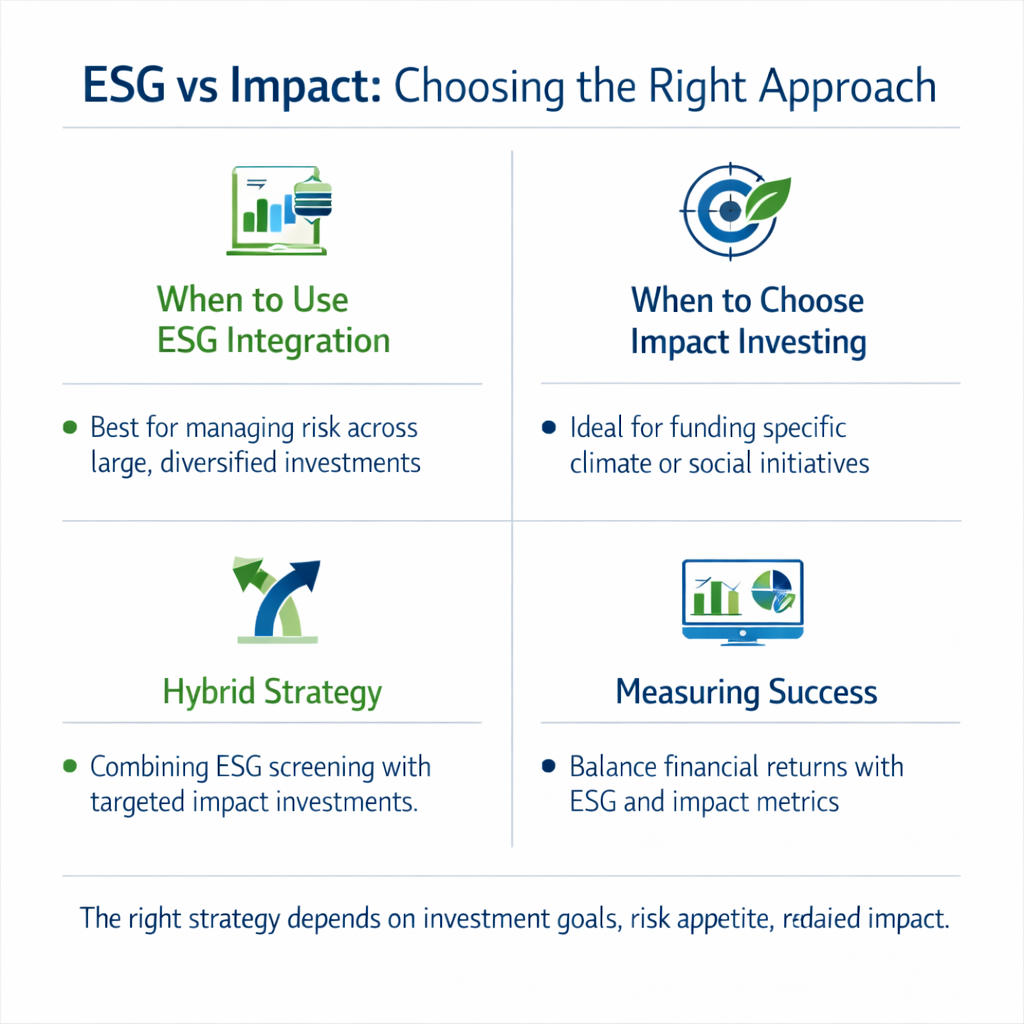
Both ESG and impact investing face real obstacles:
Yet, the tide is turning.
Governments are investing in carbon markets, solar initiatives like KUSUM Solar, and clean power companies such as ReNew Power and Adani Solar Power. Global institutions—from the International Atomic Energy Agency to Premier Energies—are aligning with environmental sustainability and net-zero agendas.
In a world increasingly shaped by ecological degradation, energy transition,and climate risk, companies can no longer afford to separate financial performance from environmental protection.
Whether through ESG integration, impact investing, or a blended model, the path forward lies in aligning profit with planet-positive outcomes.
And for organizations aiming to lead in this transformation, the key lies not just instrategy—but in education, innovation, and the cultivation of future-ready talent.


.webp)
.jpg)
.jpg)