
AI & Climate Risk Modeling: Transforming Bank Stress Tests

last updated
April 9, 2026

Climate change has emerged as one of the most pressing financial risks of the 21st century. From extreme weather events to rising sea levels and volatile regulatory shifts, climate-related disruptions are reshaping the global financial landscape. For banks and financial institutions managing billions in assets, this means reevaluating how they understand, measure, and mitigate risk.

Historically, banks have relied on stress testing, economic simulations designed to test portfolio resilience under hypothetical adverse conditions. But traditional models fall short when it comes to the complexity and unpredictability of climate risk. The need for AI in climate risk modeling for banks has never been greater.

Enter Artificial Intelligence (AI), a powerful enabler of AI-powered ESG risk analysis that is helping financial institutions transition from reactive to predictive risk management.

Why Banks Need Climate Risk Stress Testing

Financial institutions operate in an increasingly volatile global environment where climate-related disruptions can significantly impact assets, investments, and credit portfolios. Key reasons banks need climate stress testing include:
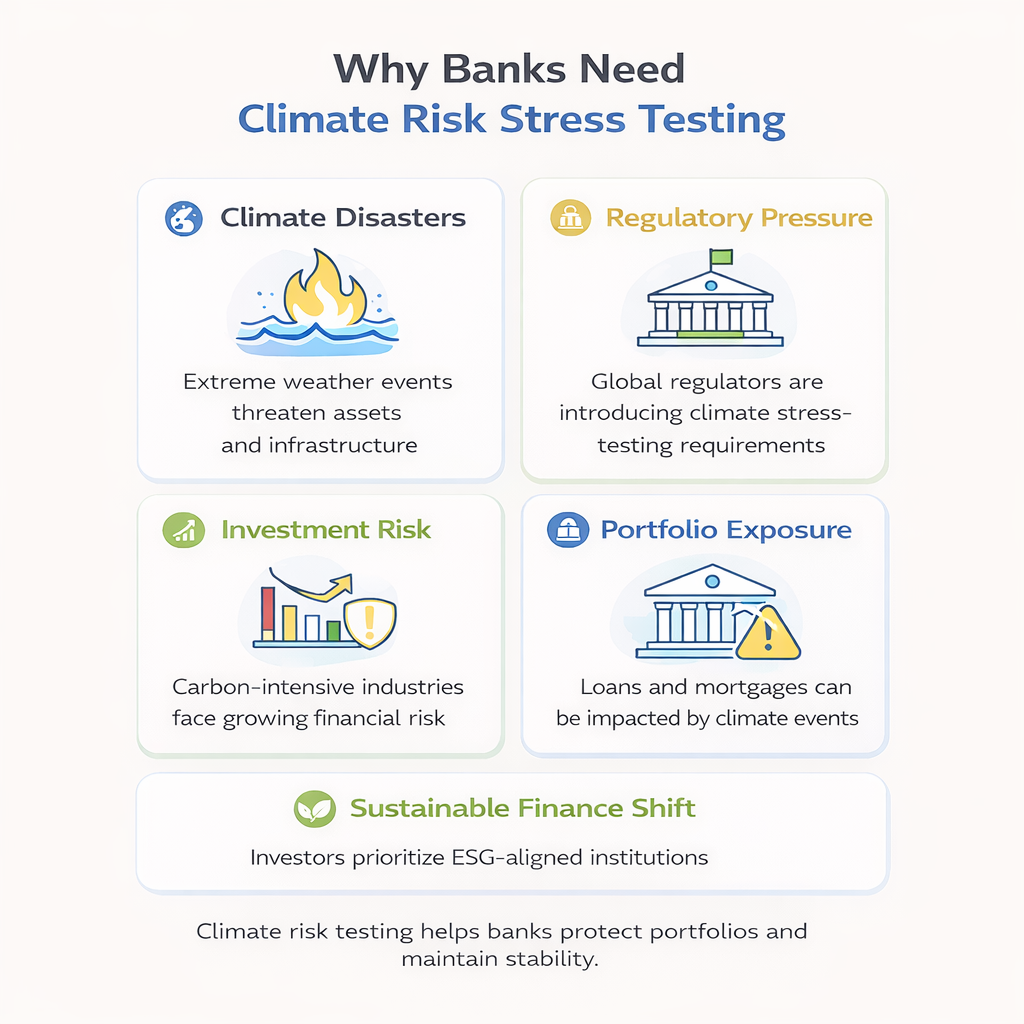
  • Governments and financial regulators worldwide are demanding climate risk disclosures. The European Central Bank (ECB) and the U.S. Federal Reserve have begun implementing climate stress testing frameworks.
  • Climate-related disasters, such as floods, wildfires, and droughts, can disrupt economies, leading to financial instability, lower GDP growth, and portfolio losses.
  • Institutional investors now prioritize sustainability metrics when evaluating companies and banks, making climate risk assessments a critical part of investment decision-making.
  • Assets in coastal regions, fossil fuel investments, and industries dependent on carbon-intensive processes face long-term risks due to climate regulations and changing consumer preferences.
  • Given these challenges, banks must adopt advanced, data-driven stress testing models, and AI is proving to be an essential tool in this transformation.

How AI Is Revolutionizing Climate Stress Testing

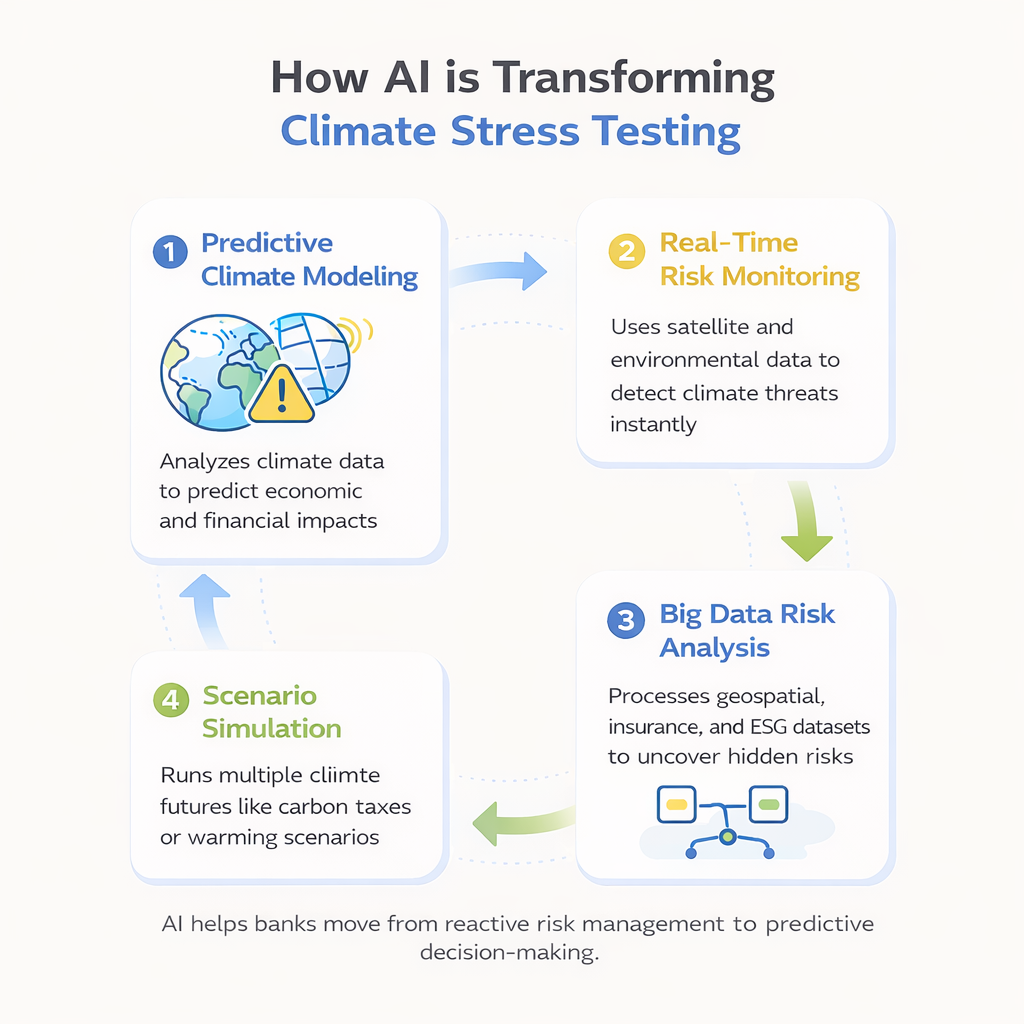
1. AI-Powered Predictive Modeling

AI leverages machine learning algorithms to analyze historical climate data and project future scenarios with higher accuracy than traditional models. Unlike standard economic simulations, AI can:

  • Identify patterns in climate disasters and their economic effects
  • Simulate thousands of potential climate-related risks across industries
  • Provide probabilistic forecasts for financial institutions, enabling proactive risk mitigation

For example, AI models can predict how an increase in global temperatures by 1.5°C vs. 2°C will affect agricultural productivity, housing markets, and insurance risks—helping banks adjust their lending strategies accordingly.

2. Real-Time Climate Risk Assessment

Traditional stress tests use historical data to assess risk, but climate change is dynamic and constantly evolving. AI-driven models, however, can integrate real-time climate data from satellite imagery, IoT sensors, and environmental monitoring tools.

Key benefits of real-time AI assessments:

  • Immediate identification of rising flood risks impacting mortgage loans
  • Faster response to wildfire zones affecting insured properties
  • Continuous adjustments in investment portfolios based on climate projections

Banks using AI-powered climate risk tools can modify lending decisions instantly rather than waiting for annual risk reports.

3. Big Data Processing & Automated Insights

AI excels at handling big data—processing millions of climate-related variables from sources like:

  • Geospatial climate mapping
  • Corporate sustainability reports
  • Historical insurance claims data
  • Energy consumption trends

By synthesizing vast datasets, AI uncovers deep insights into sector-specific vulnerabilities, helping banks understand which industries or geographic regions face the greatest climate risk exposure.

For instance:

AI can analyze energy transition risks, identifying industries likely to suffer from declining fossil fuel dependence.

It can assess coastal real estate exposure, predicting sea-level rise impacts on mortgage lending.

Banks can integrate AI findings into credit scoring algorithms, ensuring they account for climate vulnerabilities.

4. Scenario Analysis: Planning for Multiple Outcomes

AI-driven climate stress testing allows banks to model multiple climate scenarios based on changing policies and global commitments. Key scenarios banks can analyze include:

  • Assessing economic impacts if governments impose stricter carbon taxes and emissions regulations.
  • Identifying financial risks if governments fail to meet Paris Agreement targets, leading to severe climate disasters.
  • Modeling scenarios where industries transition rapidly toward renewables and banks adjust their lending portfolios accordingly.

With AI-powered simulations, banks no longer rely on static climate assumptions but instead run adaptive models that respond to evolving conditions in real time.

Leading AI Innovations in Climate Finance

Several financial institutions have already started integrating AI-driven climate risk modeling:

  • JPMorgan Chase utilizes machine learning to assess how hurricanes impact commercial real estate assets.
  • BlackRock applies AI-driven ESG models to analyze sustainability risks across its investment portfolio.
  • BNP Paribas leverages AI-powered climate analytics to refine insurance underwriting decisions.

Meanwhile, fintech firms are developing open-source AI models that help banks and asset managers incorporate climate risk into their financial strategies.
The Future of AI in Climate Risk Modelling

1. Regulatory Adoption Will Accelerate: As AI-powered risk assessment tools become more sophisticated, regulators will mandate AI-driven climate stress testing for major banks. Institutions that fail to comply may face penalties or investor distrust.

2. AI-Driven Investment Strategies: More banks will incorporate climate-aware AI models into investment decision-making. This could lead to a significant shift in capital allocation—favoring sustainable businesses over carbon-intensive industries.

3. Automated Climate Risk Alerts: AI platforms may soon offer automated alerts, warning banks of new climate risks before they materialize. Predictive systems could notify investors about changing policies, extreme weather events, or disruptions in global supply chains.

4. Blockchain + AI for Climate Finance: Future AI models may integrate with blockchain technology, creating transparent carbon credit tracking and ESG data validation, further improving financial risk assessments.

Learn Advanced Climate Risk and Sustainable Strategy with IIM Kashipur & evACAD

As financial institutions modernize, the need for experts in climate risk modeling, ESG analytics, and AI in sustainable banking is rapidly growing.

The PG Executive Program in Net Zero Strategy & Sustainability Leadership, offered by IIM Kashipur and evACAD, is uniquely positioned to equip mid- to senior-level professionals with:

  • Skills in advanced tools for environmental risk modeling
  • Mastery in green finance and ESG performance evaluation
  • Real-world insights into transition risk, carbon markets, and AI-powered climate stress testing

Ideal for professionals in finance, risk, ESG, policy, and strategy
Live weekend sessions | Real-world projects | IIM Executive Alumni Status

Conclusion

AI-driven climate risk modeling is transforming how banks conduct stress tests and prepare for financial volatility caused by climate change. By incorporating AI-powered predictive analytics, big data processing, and real-time scenario analysis, banks can enhance climate resilience, optimize lending decisions, and support sustainable finance initiatives.

For financial institutions, the future is clear—those that embrace AI will not only mitigate climate-related risks but also gain a competitive advantage in a rapidly shifting global market.

evACAD logo with stylized orange checkmark integrated between letters.
Shape the businesses, policies, and technologies driving Net Zero & Sustainability. Get Started!
Know More
Talk to our advisor today and know more about our Sustainability and Net Zero Program
Four customer service agents wearing headsets working on laptops at a desk in a dimly lit office.
+918031404841
Graphic showing four diverse male portraits connected by orbiting colored dots around a central figure.
Take the Next Step with evACAD
Get Started!

FAQ

Why are banks increasingly turning to AI climate risk modelling to assess financial exposure?

Traditional stress tests rely on static historical data, which falls short when dealing with the complexity of climate change. AI climate risk modelling allows banks to process vast datasets in real time, simulate thousands of potential outcomes, and generate probabilistic forecasts. This gives financial institutions a far more accurate picture of how climate-related disruptions could affect their lending portfolios and long-term asset valuations.

How does climate stress testing differ from conventional bank stress testing methods?

Conventional bank stress tests focus on short-term economic shocks over a limited timeframe. Climate stress testing, by contrast, models physical and transition risk scenarios across decades, accounting for policy shifts, carbon regulations, and extreme weather events. AI makes this process more dynamic by running scenario analysis across multiple potential futures simultaneously, rather than relying on a single static economic assumption.

What role does real-time climate data play in AI-driven risk assessments?

One of the biggest advantages of AI over traditional models is its ability to integrate real-time climate data from satellite imagery, IoT sensors, and environmental monitoring tools. This allows banks to immediately flag rising flood risks in mortgage portfolios, adjust lending decisions in wildfire-prone areas, and continuously recalibrate investment strategies based on the latest climate projections rather than waiting for annual risk reports.

How is AI-powered ESG risk analysis being used by major financial institutions today?

Leading institutions are already deploying AI-powered ESG risk analysis at scale. JPMorgan Chase uses machine learning to assess hurricane impacts on commercial real estate, BlackRock applies AI to evaluate sustainability risks across its global portfolio, and BNP Paribas leverages climate analytics to refine insurance underwriting. These examples show how AI climate risk modeling is moving from experimental to standard practice in global finance.

What career opportunities exist in sustainable finance and climate risk for professionals today?

Demand for professionals skilled in AI climate risk modeling, transition risk assessment, and scenario analysis is growing rapidly as regulators push banks toward mandatory climate disclosures. Programs like the PG Executive Program in Net Zero Strategy and Sustainability Leadership, offered by IIM Kashipur and evACAD, prepare mid-to-senior professionals with practical expertise in sustainable finance, ESG analytics, and AI-driven climate risk tools.

Talk to Advisor over call
Blue upward arrow inside a white circle with a blue border.