Green Hydrogen Project Development and Ecosystem

Learn how green hydrogen projects move from idea to bankable plant. Covers plant design, power-to-X and e-fuels, emerging uses, hydrogen valleys and clusters, project risk and bankability, and the role of small and medium enterprises (SMEs) and startups in a self-paced online format.
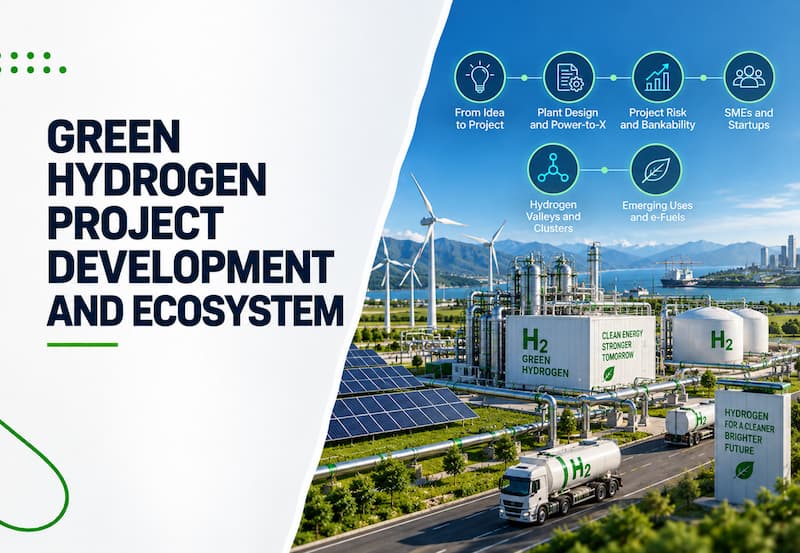
Home hero image

About the Program

Green Hydrogen Project Development and Ecosystem is a self-paced online programme from evACAD (pManifold EV Academy). It covers what it takes to design, finance and scale a green hydrogen project and how the wider ecosystem of clusters, suppliers and startups supports it.

Companies announce many hydrogen projects, but fewer reach financial close. The gap often lies in plant design, risk allocation and lender confidence. This programme helps developers, engineers and finance professionals to close that gap.

The programme consists of six modules. It moves from plant design and engineering to power-to-X systems, emerging applications, hydrogen valleys, project risk and bankability, and the role of SMEs and startups.

Skills You Will Gain
IIM online course certificate
Green hydrogen plant design basics
IIM online course certificate
Power-to-X systems and e-fuels
IIM online course certificate
Emerging hydrogen applications
IIM online course certificate
Hydrogen valley and cluster planning
IIM online course certificate
Project risk identification and allocation
IIM online course certificate
Bankability and lender requirements

Why Green Hydrogen Project Development and Ecosystem Matter Today:

India is building hydrogen hubs

In October 2025, the Ministry of New and Renewable Energy (MNRE) recognised Deendayal Port Authority (Gujarat), V.O. Chidambaranar Port Authority (Tamil Nadu) and Paradip Port Authority (Odisha) as Green Hydrogen Hubs under the National Green Hydrogen Mission. Hub projects need people who can plan shared infrastructure.

Public funding supports hubs

The mission set aside ₹400 crore for hubs and other projects in its first phase; up to 2025-26, developers who understand cluster design are better placed to use this support.

Large investment must become bankable

The government expects the mission to attract over ₹8 lakh crore in total investment by 2030. Lenders want every major risk named and assigned before they commit money, which makes bankability skills central.

Equipment rules affect project design

The Mission says that bidding rules for buying green hydrogen and its derivatives will require projects to use equipment approved by the Government of India against set quality and performance criteria. Design teams must plan around these rules.

Power-to-X links hydrogen to export markets

The Mission aims to make India a hub for producing, using and exporting green hydrogen and its derivatives. Power-to-X routes convert renewable power into tradable products, such as green ammonia and e-fuels.

Career growth

Professionals with project development, risk and ecosystem skills can work with developers, lenders, engineering, procurement and construction (EPC) firms, hub authorities, consultancies and hydrogen startups.

Program Curriculum

Course 01: Plant Design & Engineering
Course 02: Power-to-X Systems & e-Fuels
Course 03: Niche and Emerging Applications
Course 04: Hydrogen Valleys & Cluster Development
Course 05: Project Risks & Bankability
Course 06: SMEs & Startups Powering the Value Chain

Program Instructor

evACAD-workstation

Founder H2 Carbon Zero & Umagine

Green Hydrogen, Hydrogen Supply-Trade, Fuel Cell

evACAD-workstation

Mr. Rahul Bagadia
Chairman- pManifold

Sustainable Strategy, Net Zero Policy & Electric Mobility

Refund Policy

Click here to check the refund and cancellation policy.

Programme Curriculum:‍

Module 1 Plant Design & Engineering

Module 2 Power-to-X Systems & e-Fuels

Module 3 Niche and Emerging Applications

Module 4 Hydrogen Valleys & Cluster Development

Module 5 Project Risks & Bank ability

Module 6 SMEs & Startups Powering the Value Chain

Learning Outcomes:‍

Upon successful completion of the programme, learners will be able to:

  • Describe the main systems in a green hydrogen plant and how they connect.
  • Explain how Power-to-X systems turn renewable power into e-fuels and chemicals.
  • Identify niche and emerging uses of hydrogen and judge their readiness.
  • Outline how hydrogen valleys and clusters share infrastructure and demand.
  • Identify technical, market, policy and financial risks in a hydrogen project.
  • Explain what lenders look for before funding a hydrogen project.
  • Map where SMEs and startups can add value in the hydrogen value chain.

Career Opportunities:

After completing this programme, learners can pursue roles such as:

  • Green Hydrogen Project Developer
  • Project Manager (Hydrogen)
  • Plant Design Engineer
  • Power-to-X Engineer
  • Project Finance Analyst
  • Risk and Due Diligence Consultant
  • Cluster and Hub Development Manager
  • Startup Founder or Business Lead (Hydrogen)

Industry Applications:

The topics covered in this programme are used across:

  • Green Hydrogen and Green Ammonia Developers
  • Engineering, Procurement and Construction (EPC) Firms
  • Banks, Development Finance Institutions and Investors
  • Port Authorities and Industrial Parks
  • E-fuel and Chemical Producers
  • Energy and Infrastructure Consultancies
  • Hydrogen Equipment SMEs and Startups
  • State Industrial Development Agencies

Frequently Asked Questions

What makes a green hydrogen project bankable?
A project is bankable when lenders trust that it will earn enough to repay debt. That usually needs firm offtake agreements, reliable renewable power supply, proven equipment, clear permits and a fair split of risks between parties. Module 5 covers each of these in detail.
What is Power-to-X?
Power-to-X (PtX) means using renewable electricity to make hydrogen and then turning that hydrogen into other products, such as green ammonia, e-methanol or synthetic fuels. Module 2 explains these systems.
What is a hydrogen valley?
A hydrogen valley, or hydrogen hub, is a region where hydrogen production, storage, transport, and use are closely located and share infrastructure. India has recognised Deendayal, V.O. Chidambaranar and Paradip ports as Green Hydrogen Hubs. Module 4 covers how to plan such clusters.
Who should take the Green Hydrogen Project Development and Ecosystem programme?
It suits project developers, engineers, project finance professionals, consultants, startup founders and public sector officials who work on, fund or support green hydrogen projects.
Is this programme self-paced?
Yes. The programme is fully self-paced and online. There are no fixed live class timings, so you can study around your work schedule.
Blue upward arrow inside a white circle with a blue border.