
The EV Fleet Planning programme provides practical knowledge of electric vehicle fleet management, helping professionals plan, deploy, and optimize commercial EV fleets. Learn fleet electrification, route and depot planning, charging infrastructure planning, fleet scheduling, and Total Cost of Ownership (TCO) analysis to evaluate fleet performance and operational efficiency. Gain industry-ready skills to develop cost-effective, scalable, and sustainable fleet strategies for logistics, public transport, and commercial mobility applications.
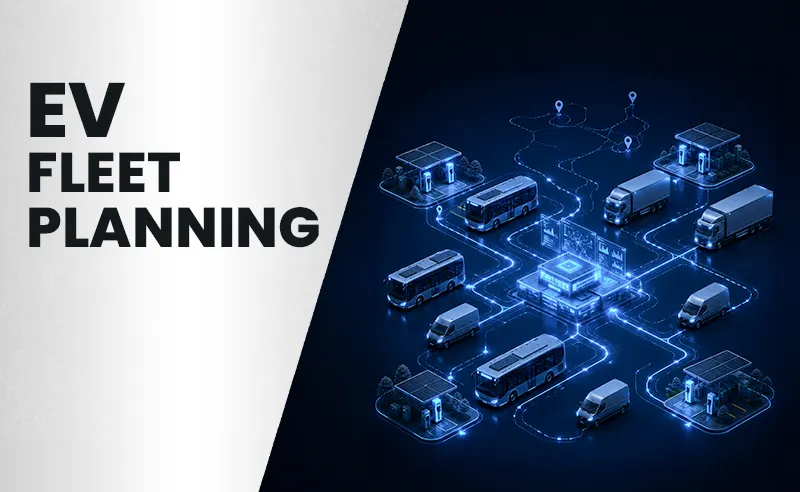
The EV Fleet Planning programme provides a comprehensive understanding of the technical, operational, and financial aspects of planning and deploying electric vehicle (EV) fleets across commercial mobility applications. Participants will gain practical knowledge of fleet modelling, route and depot planning, charging infrastructure sizing, vehicle scheduling, fleet analytics, and Total Cost of Ownership (TCO) analysis to support efficient fleet operations and long-term business success. The programme focuses on data-driven decision-making, helping learners evaluate fleet performance, optimize energy consumption, and develop cost-effective electrification strategies.
Through industry-relevant case studies and practical examples, learners will explore charging infrastructure planning, vehicle energy consumption modelling, fleet operations management, financial evaluation, and infrastructure investment planning. The course also covers fleet transition strategies, operational scheduling, risk assessment, and performance optimization to address real-world challenges associated with commercial EV deployment. Whether you are working in logistics, public transportation, corporate mobility, or fleet consulting, this programme equips you with the technical knowledge and analytical skills required to successfully plan, implement, and manage sustainable electric vehicle fleet management solutions while improving operational efficiency, reducing costs, and supporting the transition to clean mobility.

Learn the fundamentals of EV fleet planning and modelling by evaluating fleet requirements, vehicle selection, operational strategies, and energy consumption. Develop data-driven fleet deployment plans that improve efficiency, support fleet electrification, and enable cost-effective electric vehicle fleet management across commercial and public transport applications.
Understand how route and depot optimisation improves fleet performance by analysing travel patterns, vehicle utilisation, charging requirements, and depot locations. Learn strategies to reduce operating costs, minimise downtime, maximise vehicle productivity, and enhance the efficiency of commercial EV fleets.
Gain practical knowledge of EV charging infrastructure planning, including charger selection, infrastructure sizing, energy demand assessment, charging strategies, and network integration. Learn how to design scalable charging solutions that support reliable fleet operations while balancing operational efficiency and infrastructure investment.
Explore fleet scheduling and operations management techniques used to optimise vehicle allocation, route planning, dispatch, and daily fleet activities. Learn how operational scheduling, demand forecasting, and fleet analytics improve productivity, reduce idle time, and support efficient electric vehicle fleet operations.
Develop expertise in Total Cost of Ownership (TCO) analysis by evaluating capital expenditure, operating costs, maintenance, charging expenses, battery lifecycle, and vehicle utilisation. Learn how financial modelling and lifecycle cost analysis support informed investment decisions and successful fleet electrification projects.
Learn how to perform financial and business case evaluations for EV fleet projects by assessing return on investment (ROI), payback period, infrastructure costs, operating expenses, and long-term economic viability. Gain the skills required to justify electric vehicle fleet investments through data-driven financial decision-making.
The transition to electric vehicle (EV) fleets is transforming the future of commercial transportation, making EV fleet planning a critical capability for organizations aiming to improve efficiency, reduce costs, and achieve sustainability goals. Effective fleet planning involves evaluating vehicle requirements, designing charging infrastructure, optimizing route and depot planning, and analysing the Total Cost of Ownership (TCO) to ensure long-term operational and financial success. A well-planned fleet strategy helps businesses maximize vehicle utilization, minimize downtime, and improve energy efficiency while supporting the transition from conventional fuel-powered vehicles to electric mobility.
As governments and businesses accelerate fleet electrification, professionals must understand charging strategies, infrastructure sizing, fleet scheduling, energy demand, and operational planning. Data-driven fleet analytics enable organizations to make informed decisions that enhance productivity, reduce operating costs, and improve overall fleet performance. By integrating sustainable mobility practices and carbon reduction strategies, EV fleet planning also supports environmental goals and regulatory compliance. This programme equips learners with practical knowledge of electric vehicle fleet management, charging infrastructure planning, and financial evaluation, preparing them to successfully plan, deploy, and optimize commercial EV fleets across logistics, public transport, and corporate mobility applications.

Mr. Vikrant Vaidya
24+ years’ experience in global automotive design and product development on multiple EVs and Hybrid vehicle platforms, specialising in model-based design, calibration, testing, and system integration; a Six-Sigma Green Belt with 3 inventions in battery & hybrid electric vehicles. He earned his Master's degree in Energy Systems Engineering from the University of Michigan and his Bachelor's in Mechanical Engineering from Nagpur University.
The rapid growth of electric vehicle (EV) fleets has created strong demand for professionals with expertise in EV fleet planning, fleet electrification, and electric vehicle fleet management. Organizations across logistics, public transportation, commercial mobility, and corporate fleet operations are actively seeking professionals who can optimize fleet performance, charging infrastructure, and operational efficiency.
After completing this programme, learners can pursue careers as EV Fleet Managers, responsible for planning and managing electric vehicle operations, or as Fleet Planning Engineers, developing data-driven fleet deployment and optimization strategies. Opportunities also exist as Charging Infrastructure Planners, designing scalable charging networks for commercial EV fleets, and Fleet Operations Managers, overseeing scheduling, route optimization, and day-to-day fleet performance. Professionals with expertise in data analysis can build careers as Fleet Analytics Engineers, using operational data to improve vehicle utilization and reduce costs, while Sustainability Consultants help organizations achieve fleet electrification goals, reduce carbon emissions, and implement sustainable mobility strategies. These roles are increasingly in demand across automotive OEMs, fleet operators, logistics companies, government agencies, energy providers, and EV infrastructure organizations driving the transition to cleaner transportation.


