
Gain a comprehensive understanding of the EV battery supply chain and the principles of the circular economy that are transforming the future of electric mobility. Learn about battery value chains, critical minerals, battery manufacturing, life cycle assessment (LCA), battery recycling, second-life battery applications, and sustainable supply chain strategies through real-world industry case studies. Build practical knowledge of the complete battery lifecycle and develop the skills required for careers in battery supply chain management, battery recycling, sustainability, and the rapidly growing electric vehicle (EV) and energy storage industries.
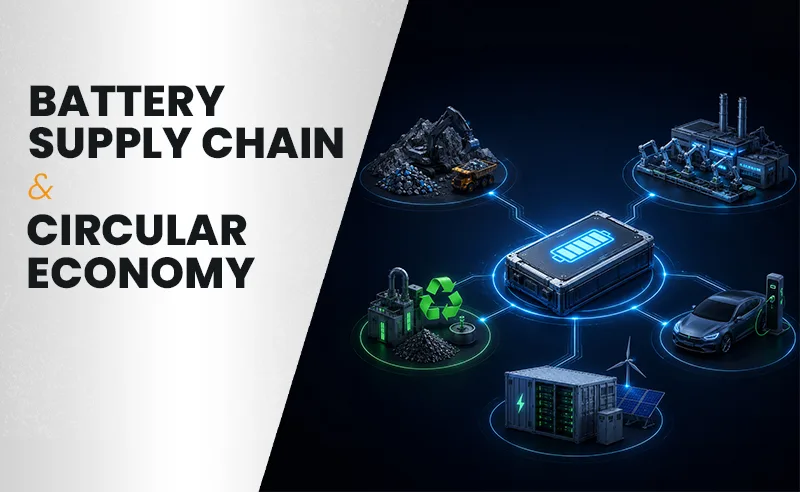
The Battery Supply Chain & Circular Economy programme is designed to provide a comprehensive understanding of the complete battery lifecycle, from critical mineral sourcing and battery manufacturing to logistics, recycling, and end-of-life management. As global demand for electric vehicles (EVs) and energy storage systems continues to grow, professionals need expertise in building sustainable, resilient, and transparent battery supply chains. This course explores the journey of a battery through raw material extraction, cell manufacturing, battery pack assembly, distribution, usage, life cycle assessment (LCA), and responsible recycling to support a circular economy.
Participants will gain practical knowledge of battery value chains, battery recycling technologies, second-life battery applications, critical mineral management, and emerging sustainability frameworks such as Battery Passport, ESG (Environmental, Social, and Governance), and Extended Producer Responsibility (EPR). Through real-world industry use cases and case studies, learners will understand how manufacturers, battery producers, recyclers, and policymakers collaborate to create sustainable battery ecosystems. Whether you are an engineer, supply chain professional, sustainability expert, or working in the EV industry, this programme equips you with the technical and strategic skills needed to drive innovation, resource efficiency, and net-zero initiatives across the global battery value chain.

Develop a comprehensive understanding of the battery value chain, from critical mineral sourcing and cell manufacturing to battery pack assembly, distribution, usage, and end-of-life management. Learn how supply chain decisions influence battery cost, sustainability, quality, and the global electric vehicle (EV) ecosystem.
Explore the global supply chains for lithium, cobalt, nickel, graphite, and other critical battery materials. Understand sourcing challenges, geopolitical risks, responsible mining practices, supply chain resilience, and strategies for securing sustainable raw materials for future battery manufacturing.
Learn how Life Cycle Assessment (LCA) evaluates the environmental impact of batteries across their entire lifecycle. Analyze carbon emissions, energy consumption, resource utilization, and recycling efficiency to support sustainable battery manufacturing and informed decision-making in the circular economy.
Understand the principles of the circular economy and how they transform battery production and resource management. Learn strategies for extending battery life, reducing waste, recovering valuable materials, and implementing sustainable business models that support net-zero and responsible manufacturing goals.
Gain practical knowledge of battery repurposing, second-life battery applications, and battery recycling technologies. Explore collection, disassembly, material recovery, and recycling processes that improve resource efficiency, reduce environmental impact, and strengthen sustainable battery supply chains.
Explore how sustainable mobility ecosystems integrate electric vehicles (EVs), renewable energy, battery recycling, smart infrastructure, and circular economy principles. Learn how governments, manufacturers, and technology providers collaborate to build resilient, low-carbon transportation systems that support long-term sustainability.
The rapid growth of electric vehicles (EVs) and energy storage systems has significantly increased the demand for lithium-ion batteries, making a resilient and sustainable battery supply chain more important than ever. Critical minerals such as lithium, cobalt, nickel, and graphite are essential for battery manufacturing, but challenges related to sourcing, geopolitical risks, and environmental impact have accelerated the need for a circular economy approach. Modern battery ecosystems now focus on battery recycling, second-life battery applications, critical mineral recovery, and responsible resource management to reduce waste and improve long-term sustainability.
Governments and industries worldwide are introducing initiatives such as the EU Battery Regulation, Battery Passport, Extended Producer Responsibility (EPR), and ESG (Environmental, Social, and Governance) frameworks to improve transparency, traceability, and environmental compliance across the battery value chain. Understanding the complete battery lifecycle—from raw material sourcing and cell manufacturing to reuse, recycling, and end-of-life management—is essential for professionals driving the future of electric mobility, battery technology, and net-zero initiatives. This course equips learners with practical knowledge of sustainable battery supply chains, circular economy principles, and emerging industry practices shaping the global EV ecosystem.

Mr. Vikrant Vaidya
24+ years’ experience in global automotive design and product development on multiple EVs and Hybrid vehicle platforms, specialising in model-based design, calibration, testing, and system integration; a Six-Sigma Green Belt with 3 inventions in battery & hybrid electric vehicles. He earned his Master's degree in Energy Systems Engineering from the University of Michigan and his Bachelor's in Mechanical Engineering from Nagpur University.
The rapid expansion of the electric vehicle (EV) industry and global sustainability initiatives has created strong demand for professionals with expertise in battery supply chains, circular economy, and battery lifecycle management. After completing this programme, learners will be equipped to pursue a wide range of high-growth roles across battery manufacturing, recycling, energy storage, consulting, and sustainable mobility industries.
Graduates can build careers as Battery Supply Chain Analysts, optimizing sourcing strategies and logistics for critical battery materials, or as Battery Recycling Engineers, developing innovative recycling processes and second-life battery applications. Opportunities also exist as Circular Economy Consultants, helping organizations implement sustainable resource management and waste reduction strategies, and as ESG Specialists, driving environmental, social, and governance initiatives across the battery value chain. Professionals interested in raw material security can pursue roles as Critical Minerals Analysts, while those focused on corporate sustainability can work as Sustainability Managers, supporting net-zero goals and responsible battery ecosystems. These career paths are increasingly sought after by EV manufacturers, battery producers, recycling companies, renewable energy firms, consulting organizations, and government agencies driving the transition toward a sustainable, circular economy.


