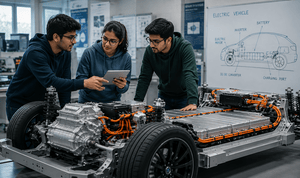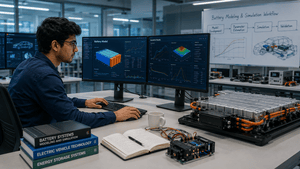
The most common query we get from learners in the first call is this - Will you teach us how to build an electric vehicle? The answer is that yes, our learners will learn how to disassemble and assemble an electric vehicle, part by part.
You have to learn what are the key electric vehicle parts and components, and how the vehicle specifications change due to electrification. It may be useful to study this full list of key electric vehicle parts and components if you are considering building an EV or learning about EV technology.
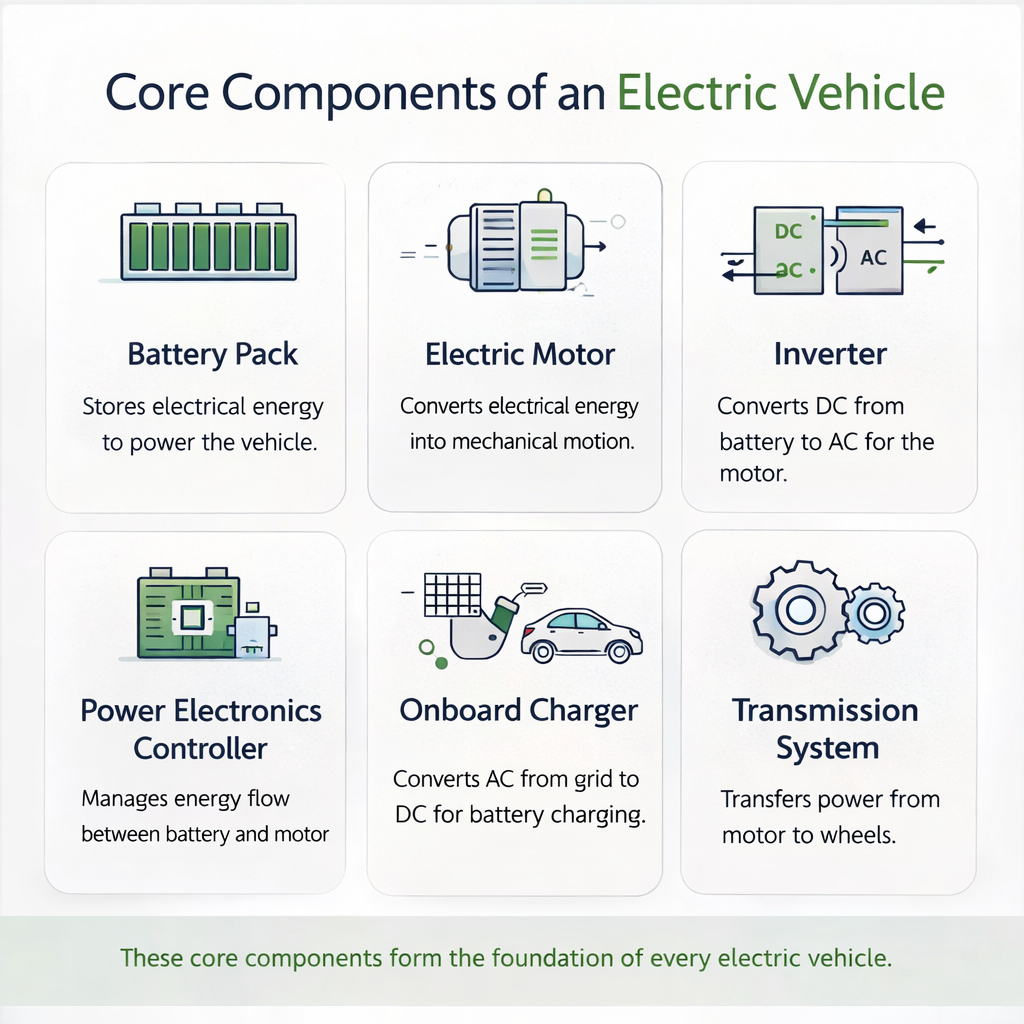
The electric drive unit is a combination of the electric motor, power electronics, and gearbox (if applicable). It is responsible for transmitting power from the motor to the wheels.
The electric motor is the heart of an electric vehicle. It converts electrical energy from the battery into mechanical energy to drive the wheels. There are different types of electric motors used in EVs, such as induction motors, permanent magnet motors, and more.
Power electronics components, including inverters and converters, are used to manage the flow of electricity between the battery and the electric motor. They convert the DC power from the battery into AC power for the motor and control its speed.
Many EVs use regenerative braking to recover energy during deceleration or braking. This system converts kinetic energy back into electrical energy and stores it in the battery, thus improving the mileage possible after a single full charge.
The battery pack stores electrical energy and provides power to the electric motor. Lithium-ion batteries are used in EVs these days, replacing the most commonly used lead acid battery packs. See our full list of battery technologies.
EVs have a charging port where external power sources can be connected to recharge the battery. There are various types of charging ports, including Level 1 (120V), Level 2 (240V), and DC fast charging.
The onboard charger is responsible for converting the AC power from the charging port into DC power that can be stored in the battery. Different EVs may have varying charging capacities.
EVs have a thermal management system to maintain the optimal temperature of the battery pack and other components. This system includes cooling and heating components, such as radiators and fans. This is a critical safety feature required in electric vehicles to avoid thermal runaway that can lead to battery pack explosions and fire.
The BMS monitors and manages individual battery cells within the battery pack. It ensures the cells are charged and discharged evenly, preventing overcharging and over-discharging.
EVs use high-voltage wiring to transmit power between the battery, motor, and power electronics. Safety measures are in place to isolate and protect this wiring.
The controller manages various functions of the EV, including power distribution, energy management, and safety systems.
These include systems such as power steering, air conditioning, and cabin heating, which are electrified in EVs to minimize the use of the main battery for non-propulsion purposes.
In addition to the high-voltage system, EVs have a low-voltage electrical system for lighting, infotainment, HVAC, and other accessories.
Like traditional ICE vehicles, EVs have suspension and chassis components, including tires, shock absorbers, steering systems, and brakes. These designs are largely carried over from ICE vehicles.
EVs are equipped with safety systems, including airbags, anti-lock braking system (ABS), traction control, and electronic stability control, to ensure safe driving.
Electric vehicles are more suitable for driver assist navigation features and partial autonomous vehicle systems that can handle driving functions at different SAE levels, up to ADAS.