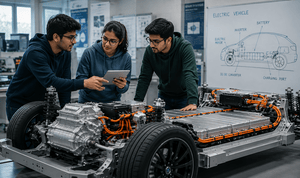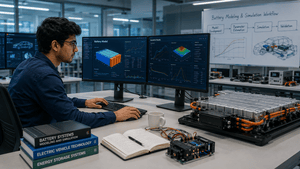
Five years ago, most mechanical engineers in India would probably have laughed if someone told them that batteries would become a big part of their work. At the time, electric mobility still felt like a niche space, far removed from the core of automotive engineering. Today, that has clearly changed. The same engineer may now be getting calls from several EV startups looking for talent. Electric mobility jobs in India have moved so fast from the margins to the mainstream that even people within the industry did not fully see it coming.
Indian production of battery electric vehicles is projected to reach 377,000 units in 2025, up from 130,000 in 2024, a near-threefold jump in a single year (IBEF, 2025). Scaling that output requires people. The ecosystem now spans roles that barely existed a decade ago.
For professionals weighing a career shift, the real question is not whether EV roles exist; it is which ones align with your current skills and how quickly you can close the gaps. The talent shortage is already underway, which means positioning yourself now carries a genuine advantage. Success in electric mobility career paths depends on your ability to understand all existing job possibilities.
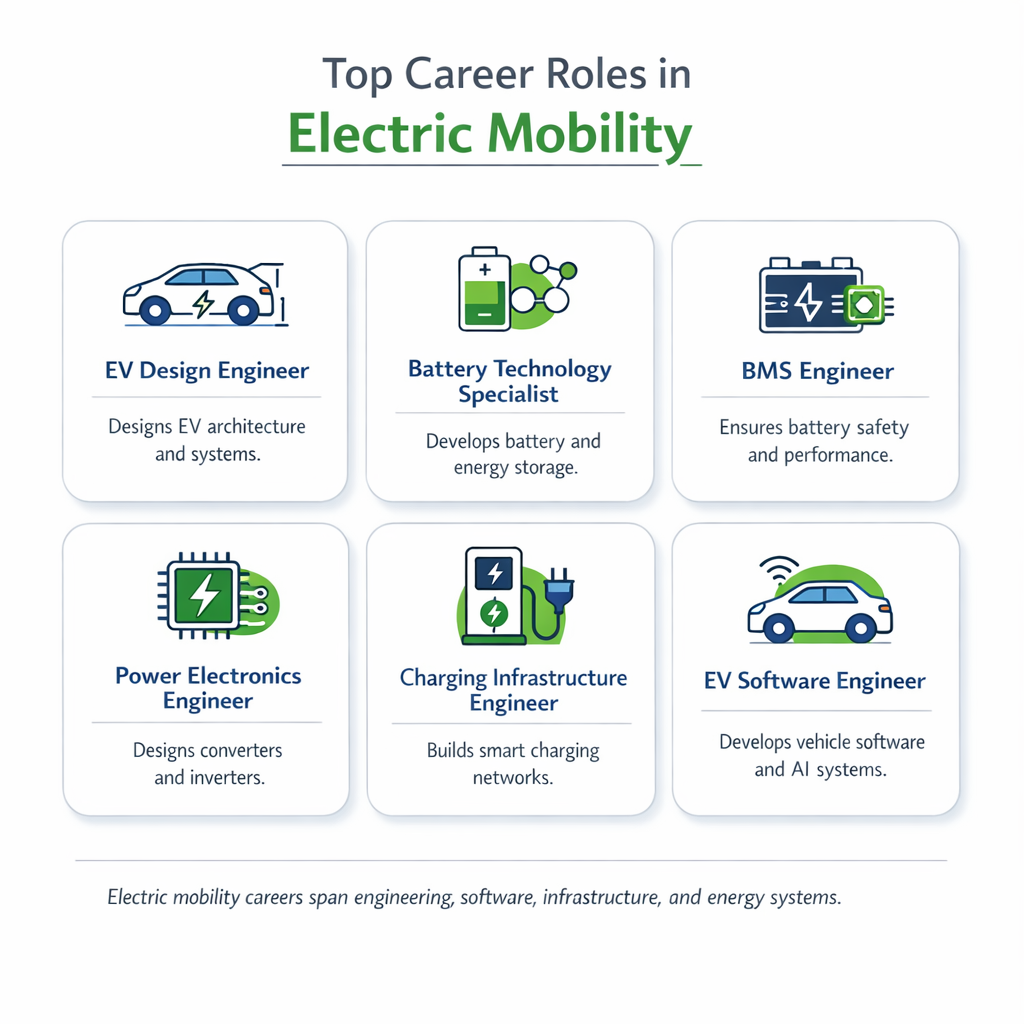
Many assume electric mobility roles are confined to R&D labs. The reality is considerably broader. Battery systems engineers are among the most in-demand hires at both OEMs and startups, with open roles consistently outpacing available candidates. Charging infrastructure planning has expanded alongside India’s projected need for 1.32 million public charging stations by 2030 (ITDP, 2025).
Fleet electrification consulting is a fast-growing niche as state transport undertakings accelerate e-bus transitions. EV policy advisory has emerged as a distinct function, with companies needing specialists to navigate FAME-II successor schemes and state-level EV policies.
Embedded software roles, particularly BMS firmware and regenerative braking systems, are especially scarce and command premium compensation. These are not peripheral functions; they sit at the intersection of electric vehicles, urban infrastructure, and grid management.
Embedded software developers create firmware solutions which control regenerative braking systems. The professional positions reward individuals who possess knowledge about how hardware and software elements interact with environmental factors.
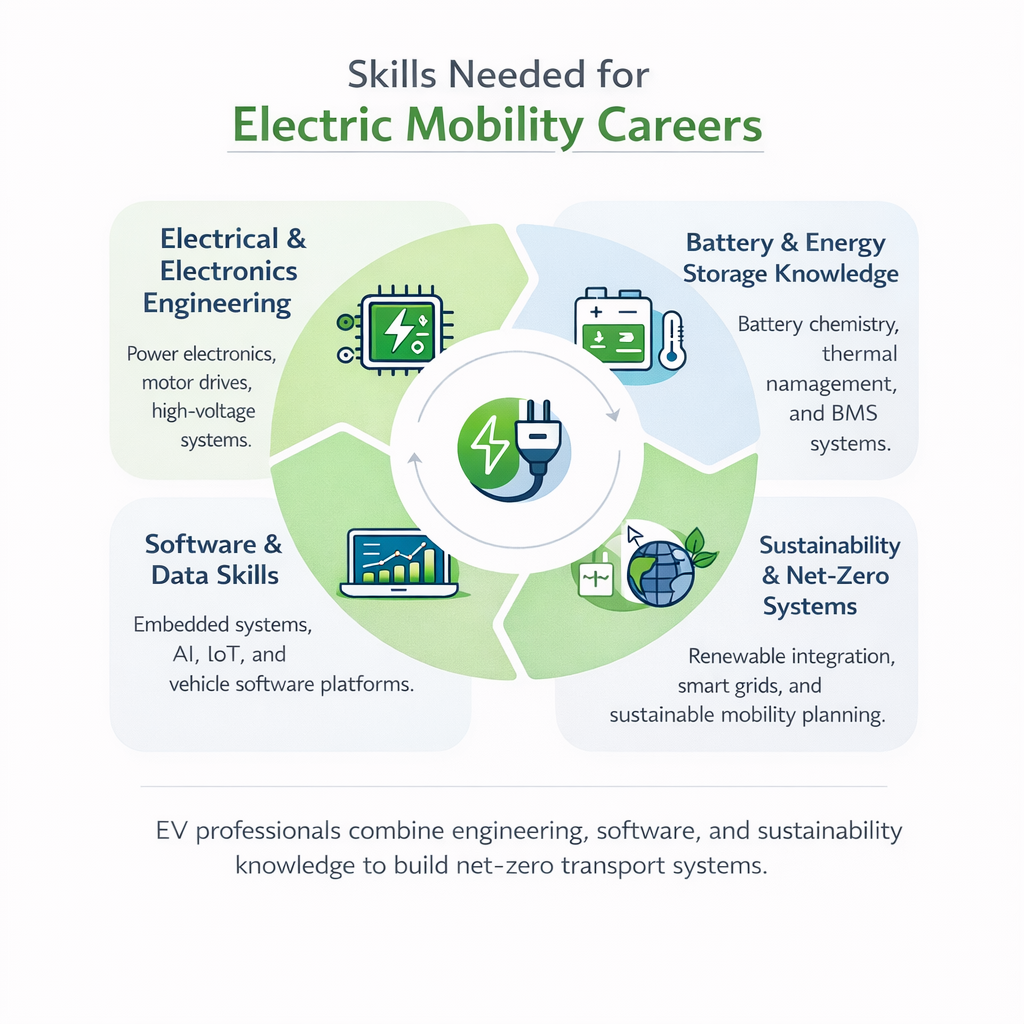
Job applicants who list their EV expertise on their resumes no longer gain any advantage during the hiring process. Recruiters now seek candidates who possess multiple skill sets. A mechanical engineer who possesses power electronics knowledge can enhance operational efficiency. A supply chain professional who can navigate lithium sourcing regulations and BRSR compliance stands out in a crowded pool.
EV and sustainability hiring increasingly rewards T-shaped professionals: deep expertise in one domain combined with working knowledge of adjacent areas such as lifecycle assessment and carbon accounting. Structured programmes from institutions like evACAD, in partnership with reputed NITs and IITs, deliver this breadth more efficiently than self-directed learning.
India’s 2070 net-zero commitment is not just a policy statement; it is a job-creation mechanism. Every decarbonisation target needs professionals to deliver on the ground. That is why career opportunities in electric mobility now extend well beyond vehicles into carbon credit management, green procurement, and ESG integration.
The PM E-DRIVE scheme allocates ₹10,900 crore to public transport electrification and charging infrastructure. That capital deployment creates demand for project managers, grid integration engineers, urban planners with EV fluency, and sustainability auditors.
Pune, Chennai, Bengaluru, and Delhi-NCR are the primary hubs for electric mobility jobs in India. Cities like Hyderabad and Coimbatore are showing early-stage activity in battery manufacturing and EV charging hardware, though at a smaller scale than the primary clusters.
The importance of timing is crucial. LinkedIn's 2025 Green Skills Report found that workers with green skills enjoy a hiring rate 46.6% higher than the overall workforce. The premium in India reaches 59.7%. The window to enter while demand outpaces supply remains open, but not indefinitely.
What makes this sector particularly compelling is how skills compound. Battery chemistry knowledge built today feeds directly into the design of energy storage systems tomorrow. Vehicle-to-grid protocol expertise now positions you for smart city roles that do not yet have formal job titles. The learning pathways at evACAD programs are structured with this compounding logic in mind, aligning learning sequences with where the industry is heading.
India’s electric mobility sector is being reshaped by converging forces: government policy, shifting investment patterns, and durable changes in consumer behaviour. The professionals who enter now with the right frameworks will have a hand in defining how this transition unfolds.
Being early helps, but being prepared matters more. Credentials built on systems thinking and regulatory fluency will outlast any first-mover advantage. The market rewards preparation.
For those who have been watching from the sidelines, the production numbers and hiring data have made the answer clear. The only question left is yours: what role will you play?