
The implementation of sustainability programs fails because organisations treat circular economy practices as secondary to their primary emission reduction goals. The decarbonisation plan receives CFO approval while the CSO identifies Scope 3 emission hotspots, but procurement continues to purchase virgin materials because nobody calculated the carbon delta. Organisations face difficulties in assessing their net-zero progress when they implement circular economy principles.
This is not about recycling bins or performative sustainability efforts. It requires a complete overhaul of material flow systems to eliminate emissions at their source.
A circular economy aligned with net zero goals requires strategic design changes that keep materials in use, eliminate waste, and reduce emissions from extraction, processing, and disposal.
Unlike energy transition strategies that focus primarily on power generation, circular economy approaches target material-based emissions. Steel recycling through electric arc furnaces avoids 1.5 tonnes of CO₂ per tonne compared to virgin production from blast furnaces, according to Worldsteel 2025 data (2). These changes create structural operational shifts rather than marginal improvements.
The International Sustainability Standards Board ISSB S2 climate disclosure requirements now mandate Scope 3 reporting, including full product life cycle emissions disclosure (5). Organisations that conduct Scope 3 accounting often find that purchased goods and services contribute between 50 percent and 80 percent of their total Scope 3 footprint (3). This is precisely where circular economy strategies operate most effectively.
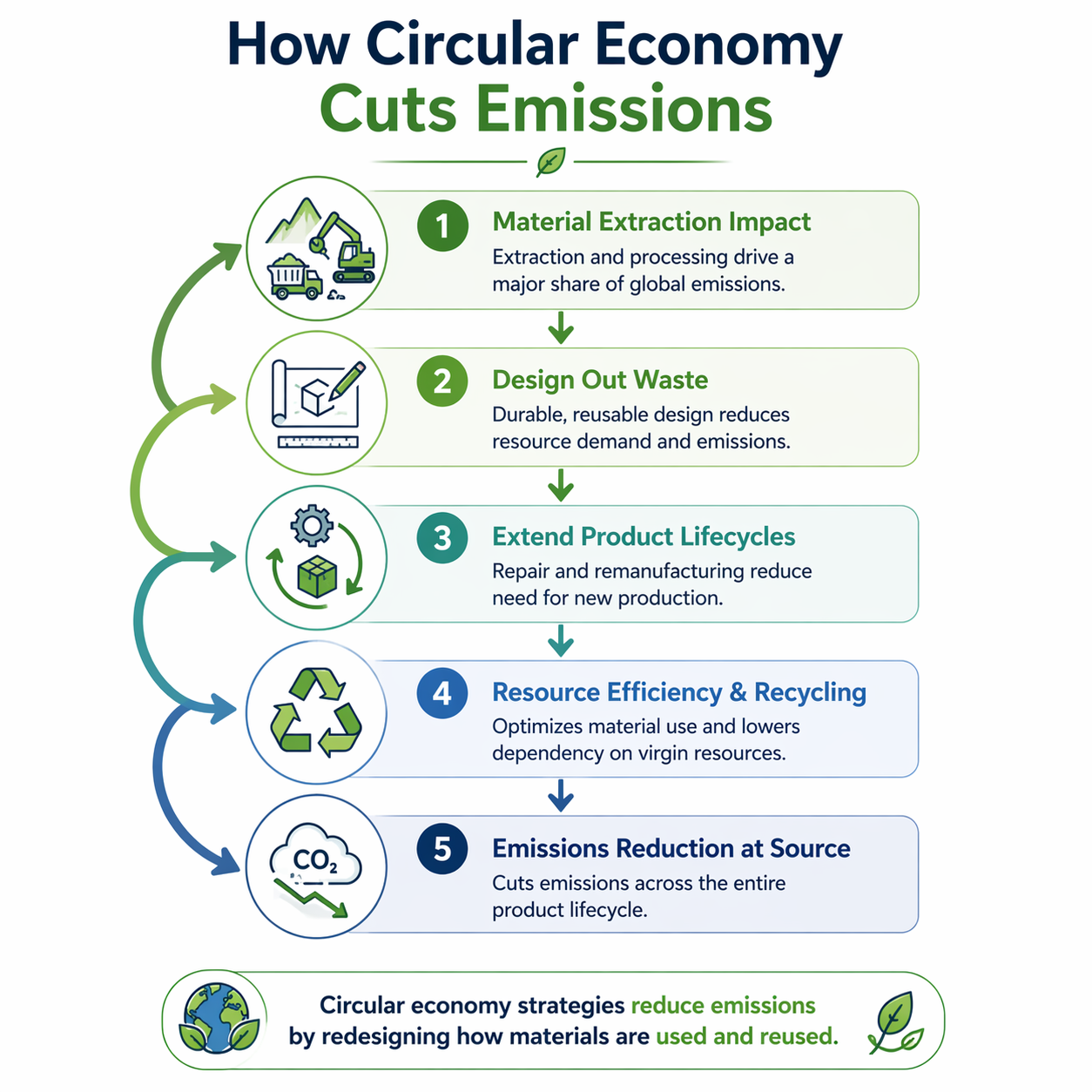
The European Commission Joint Research Centre published a report in October 2025 showing that European industries can reduce CO₂ emissions between 189 million tonnes and 231 million tonnes through improved resource management methods, including material reduction, reuse, and recovery (1). The steel sector alone has an annual reduction capacity between 64 million tonnes and 81 million tonnes, while plastics offer a reduction potential between 75 million tonnes and 84 million tonnes (1).
These reductions depend on design-for-disassembly protocols that enable component reuse, reverse logistics systems that capture end-of-life products, and material passports that track recovery cycle quality.
A construction company conducts a material flow analysis to obtain Science-Based Targets initiative SBTi validation (4). The head of procurement discovers that most purchased concrete contains no recycled content, even though recycled construction and demolition aggregates are locally available. The intervention includes:
The result is that new projects achieve lower embodied carbon emissions while maintaining structural performance standards. In established markets, recycled aggregates typically trade competitively with virgin materials.
Organisations invest heavily in renewable energy, yet overlook the fact that a product’s carbon profile is largely determined at the design stage. The CDP Supply Chain program now tracks the relationship between supplier engagement scores, material circularity, and renewable energy usage (6).
In practice, an electronics manufacturer may adopt design-for-environment protocols aligned with the Task Force on Climate-related Financial Disclosures TCFD scenario planning framework (7). The product development team receives carbon budgets for each new device. Beyond operational energy efficiency, the team evaluates:
The outcome is products that meet net zero pathway requirements under ISSB disclosure frameworks while generating value through standardized components and recovered materials (5).
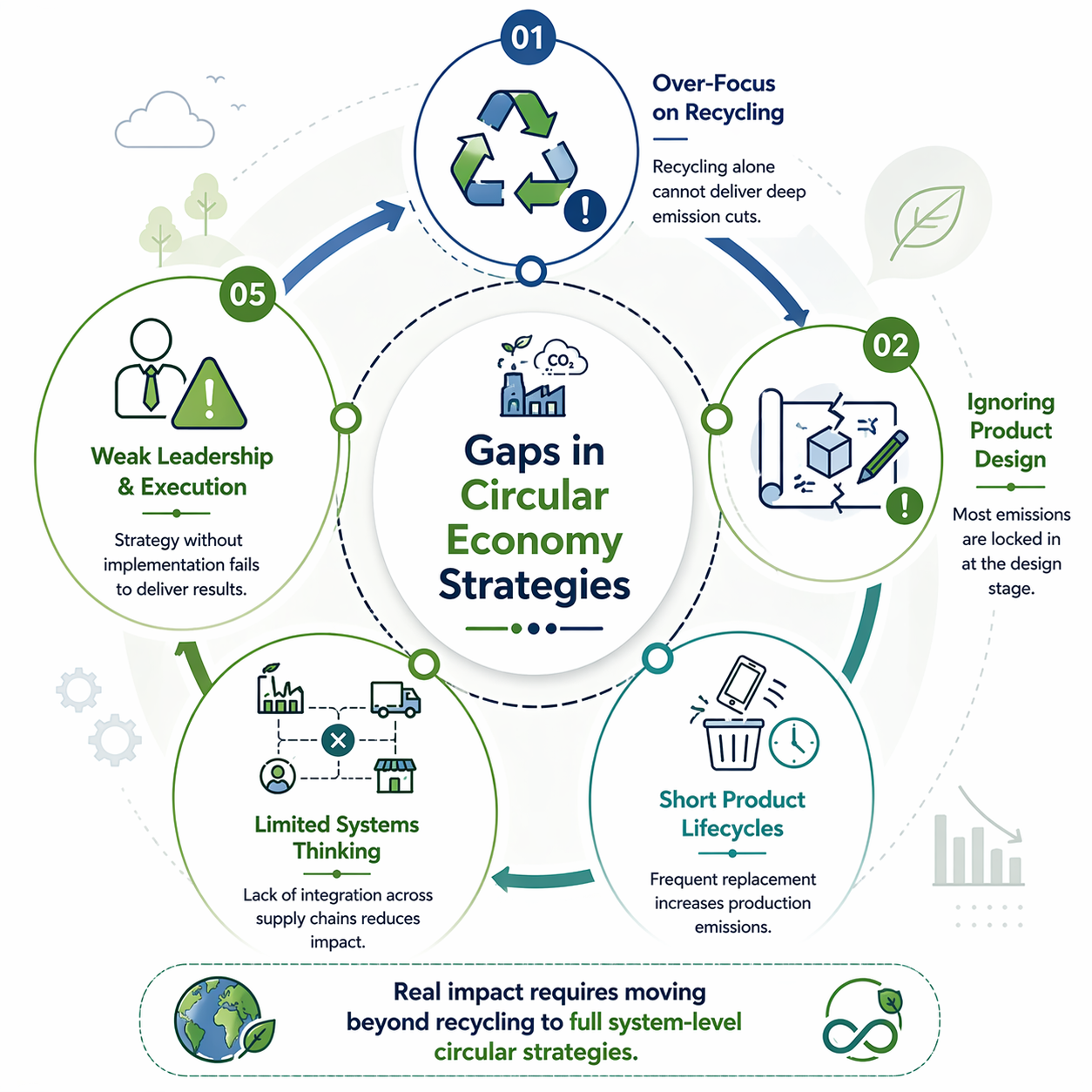
Organisations pursuing Paris-aligned net-zero trajectories through circular economy strategies must build foundational capabilities. This includes developing expertise in material flow accounting, creating product-as-a-service business models that assume full life cycle responsibility, and establishing reverse supply chains that recover residual product value.
The International Energy Agency identifies material efficiency as critical infrastructure for meeting climate goals (8). Yet many sustainability professionals still lack expertise in circular business model design, material substitution analysis, and reverse logistics integration.
The circular economy delivers measurable emission reductions through procurement specification changes, product design for future disassembly, and financial systems that account for avoided carbon emissions. Organisations that operationalize these principles gain a competitive advantage as climate regulations tighten.
Most sustainability and climate change programs focus on theory. Effective implementation requires material flow accounting skills, supplier engagement capabilities, and cross-functional coordination to achieve meaningful Scope 3 reductions.
Executives seeking to strengthen their implementation capacity should consider executive sustainable development courses tailored to organisational needs. These programs equip leaders with the practical tools required to translate circular economy principles into measurable net-zero outcomes.


.webp)
.jpg)
.jpg)