Future-Proof Your Career: 5 Essential Skills for Succeeding in the EV Industry

last updated
April 6, 2026

In the fast-changing world of mobility, the electric vehicle (EV) industry stands as one of the most exciting and transformative frontiers. No longer confined to research labs or concept showcases, EVs are dominating streets, showrooms, and policy discussions across the globe. But while electric vehicles promise a cleaner and more connected future, they also demand a completely different set of skills from the workforce.

If you’re preparing learners for tomorrow’s jobs, or planning to transition into the EV domain, or redesigning educational curricula, understanding which skills the EV industry values most is the first step toward making a meaningful impact. Let’s unpack what the EV ecosystem expects from its future professionals.

India's EV Growth: From Vision to Momentum

The global EV market has evolved from novelty to necessity. According to the International Energy Agency (IEA), electric car sales rose to 14 million units in 2023, accounting for nearly 18% of all car sales worldwide. The trend shows no signs of slowing, with manufacturers, governments, and startups investing heavily in this space.

Unlike traditional automotive roles, EV jobs sit at the intersection of electrical engineering, data analytics, sustainability, and software systems. As a result, the skillsets needed in this field are more interdisciplinary than ever, combining practical knowledge with digital fluency and a sustainability-first approach.

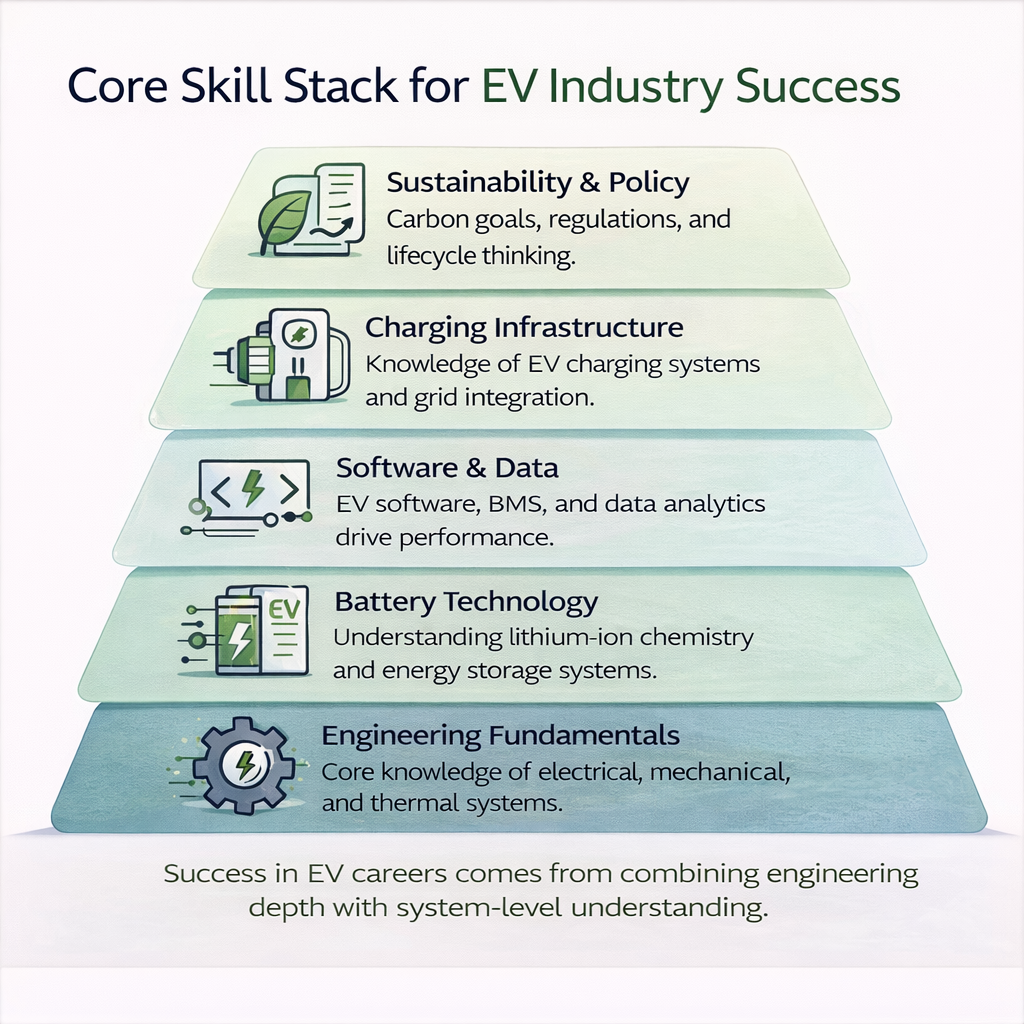
Top 5 Skills That Will Drive Your EV Career Forward

1. Battery Technology & Energy Systems Expertise

Understanding lithium-ion batteries, thermal management, battery management systems (BMS), and the chemistry of energy storage is foundational. Engineers who can test, design, and optimize battery packs are indispensable to the EV lifecycle.

Key Skills:

  • Lithium-ion and solid-state batteries
  • Cell-to-pack design and architecture
  • Battery testing, diagnostics, and thermal management
  • BMS design for safety, SoC/SoH estimation, and energy optimization
  • Basics of battery recycling and second-life use cases

Why it matters: Batteries are not just components—they define the vehicle's range, charging behavior, cost, and safety profile.

Relevant evACAD Programs:

2. Electric Drives & EV Powertrain Engineering

Working with electric motors, controllers, regenerative braking systems, and drivetrain configurations requires deep mechanical and electrical know-how. Professionals must master the shift from internal combustion to electric propulsion systems.

Key Skills:

  • PMSM, BLDC, and induction motor operation
  • Motor control strategies and inverter switching
  • Regenerative braking and energy recovery
  • EV drivetrain configuration and integration
  • Torque optimization and simulation tools like MATLAB/Simulink

Why it matters: Powertrain engineers build the systems that turn stored energy into movement - efficiency and performance start here.
3. Embedded Systems & Vehicle Software Integration

Modern EVs rely heavily on embedded systems for functionality, from monitoring vehicle health to delivering autonomous features. Skills in control systems, MATLAB/Simulink, CAN protocols, and automotive cybersecurity are in demand.

Key Skills:

  • Embedded C programming for ECUs
  • Control systems using MATLAB/Simulink
  • CAN, LIN, and FlexRay protocols
  • Functional safety (ISO 26262) and cybersecurity
  • Data logging, calibration, and OTA updates

Why it matters: As vehicles get smarter, software fluency is as critical as electrical expertise.

4. Charging Infrastructure & Power Electronics

As EV adoption grows, the need for robust charging infrastructure is paramount. Engineers and planners must understand power distribution, Electric Vehicle Supply Equipment (EVSE), AC/DC charging, and smart grid connectivity.

Key Skills:

  • DC-DC and AC-DC converters
  • Fast charging systems (CHAdeMO, CCS, Type 2)
  • EVSE (Electric Vehicle Supply Equipment) design
  • Onboard charger (OBC) and power factor correction
  • Vehicle-to-grid (V2G) communication and smart grid integration

Why it matters: A well-developed charging ecosystem ensures mass EV adoption and user satisfaction.

5. Sustainable Design & ESG Integration

The EV industry aims not just to eliminate emissions on the road but across the entire production and value chain. Skills in green manufacturing, LCA (Life Cycle Assessment), and environmental reporting are becoming highly relevant.

Key Skills:

  • Life Cycle Assessment (LCA) for EVs
  • Green manufacturing practices
  • ESG reporting frameworks and carbon tracking
  • Battery reuse and recycling
  • Materials selection for lightweight and eco-friendly vehicles

Why it matters: True sustainability means aligning EV production and performance with ESG goals throughout the entire value chain.
Career Trajectory in e-Mobility: Navigating a Fast-Evolving Job Landscape

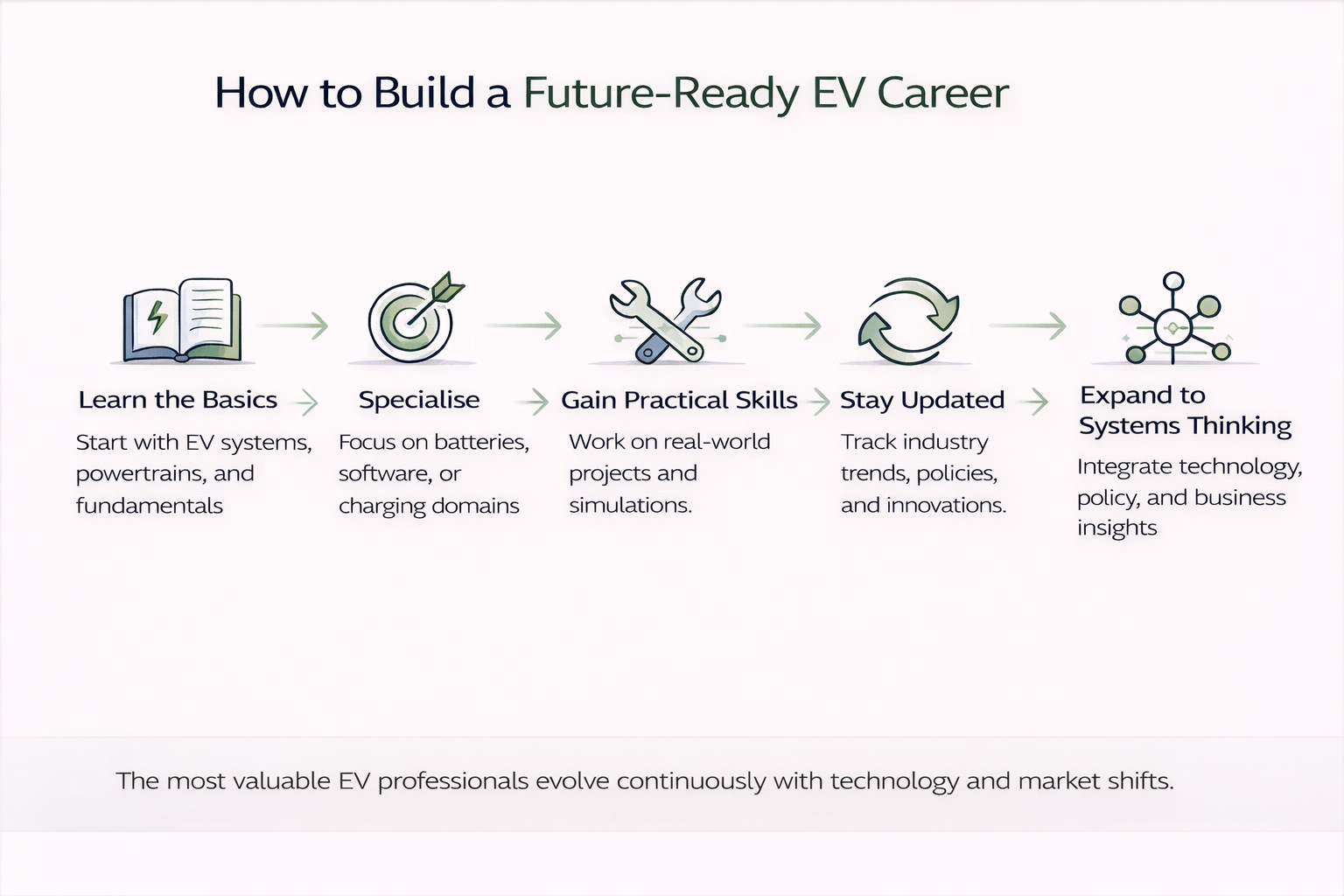
From EV product managers to thermal systems engineers and ESG analysts, the range of roles in this domain is expanding rapidly. Companies are hiring across disciplines, with special focus on people who bring cross-functional capabilities—those who can design, test, analyze, and optimize across technical and sustainability domains.

For educators and skill trainers, this shift signals the need to integrate EV-centric modules into existing engineering, IT, and science curricula. Hands-on labs, certification-based learning, and interdisciplinary teaching will define the future of EV education.

How evACAD Helps You Build EV Skills That Matter

At evACAD, we believe in outcome-oriented and skill-based education tailored to India’s rapidly growing EV industry. Our programs are:

  • Developed with input from top institutes like VNIT Nagpur, IIT Bhubaneswar, and industry leaders
  • Modular and flexible for working professionals and fresh graduates
  • Rich in simulation tools like MATLAB, Simulink, and control software
  • Focused on real-world EV product development and case studies

The electric vehicle revolution isn’t coming. It’s already here. From affordable EV cars in India to global investments in electric trucks, e-buses, and charging infrastructure, the industry is scaling faster than ever, and it needs a workforce ready to lead this transition.

Whether you're an engineering graduate, a mid-career professional, or someone with a passion for clean technology, the skills you build today will define your relevance tomorrow.

At evACAD, we don’t just teach theory—we build capability. Our programs are created with one goal: to bridge the gap between what the EV industry needs and what traditional education systems offer.

So if you’re serious about entering or growing in the EV sector—whether in electric drives, power electronics, embedded systems, or sustainable design—we’ve built the roadmap for you.

  • Industry-valued EV courses
  • Flexible, modular, and hands-on learning
  • Designed for Indian and global EV job markets

The future of mobility is electric. The future of jobs is evolving.

Make sure your skills are too. Learn with evACAD. Lead the charge.

evACAD logo with stylized orange checkmark integrated between letters.
Future-proof your career! Learn from the best in EV Design & Technology
Know More
Speak to our EV Career Guidance Expert
Four customer service agents wearing headsets working on laptops at a desk in a dimly lit office.
+918095336646
Graphic showing four diverse male portraits connected by orbiting colored dots around a central figure.
Take the Next Step with evACAD
Get Started!

FAQ

What are the most in-demand skills for building a successful EV career in India?

The top skills for an EV career include battery technology, EV powertrain engineering, embedded systems, charging infrastructure design, and sustainable manufacturing. The EV industry values professionals who combine electrical and mechanical expertise with software fluency, BMS design knowledge, and an understanding of ESG frameworks across the vehicle value chain.

Why is battery technology considered the most foundational skill in the EV industry?

Battery technology determines a vehicle's range, cost, safety, and charging behaviour, making it the single most critical area of expertise in the EV industry. Professionals skilled in lithium-ion chemistry, BMS design, thermal management, and cell-to-pack architecture are consistently among the highest-demand profiles across EV manufacturers, suppliers, and research organisations.

How does EV powertrain engineering differ from traditional automotive drivetrain design?

EV powertrain engineering replaces combustion engines with electric motors, inverters, and energy recovery systems, including regenerative braking. Engineers must master motor control strategies, torque optimisation, and simulation tools like MATLAB/Simulink. Unlike ICE-based roles, EV powertrain engineering demands a strong crossover between mechanical design and power electronics integration.

What role do embedded systems play in modern EVs, and why are these skills valuable for an EV career?

Embedded systems power every intelligent function in a modern EV, from battery monitoring and motor control to ADAS and OTA updates. Professionals with skills in embedded C, CAN protocols, ISO 26262 functional safety, and control systems using MATLAB/Simulink are highly sought after, making embedded systems expertise a strong accelerator for any EV career.

How does expertise in charging infrastructure and power electronics strengthen an engineer's position in the EV industry?

As EV adoption scales, charging infrastructure has become a distinct engineering domain requiring knowledge of DC-DC converters, fast charging standards, EVSE design, and V2G communication. Professionals with power electronics expertise who understand smart grid integration and onboard charger design are well-positioned to lead the EV industry's next phase of mass-market expansion.

Talk to Advisor over call
Blue upward arrow inside a white circle with a blue border.