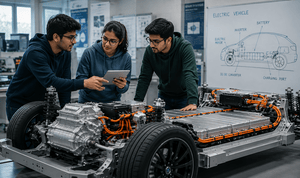
When someone shops for an electric vehicle today, they're rarely comparing just one number anymore. They're weighing battery efficiency against charging speed, checking how the car handles a hill climb, and, increasingly, asking where and how the battery itself was made. That shift, from a single "how fast does it go" question to a dozen interlocking ones, is what makes EV performance a genuinely different conversation than the one buyers used to have about petrol or diesel cars.
Here's how to actually make sense of it.
Every EV conversation eventually circles back to the battery, because the battery decides almost everything else about how the car behaves day to day.
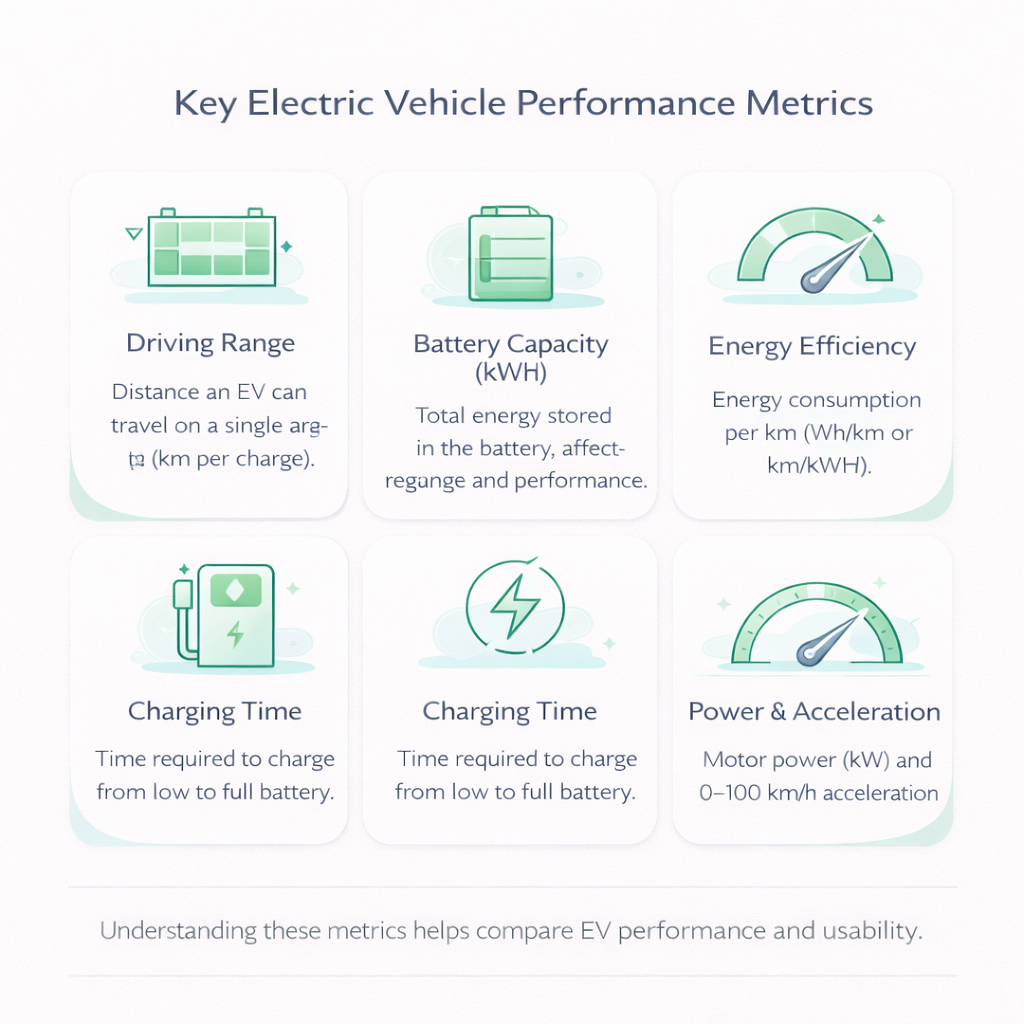
Driving range is the number most buyers fixate on first: how far the car goes on a single charge. In India, that figure usually comes from real-world test cycles run by the Automotive Research Association of India, which is one reason range claims here can differ from the WLTP or EPA numbers quoted for the same car sold abroad.
Energy consumption, usually expressed in kWh per 100 km, is the quieter number that matters just as much. A lower figure means the car is squeezing more distance out of the same battery, and it shows up directly in your electricity bill. The Bureau of Energy Efficiency has already drafted a similar star-rating system for electric two-wheelers, rating them on exactly this basis. It hasn't been extended to electric cars yet, but it signals where energy labelling for EVs in India is headed.
Charging speed is where the technology has moved fastest. Modern DC fast chargers can push a large share of a battery's capacity back in the time it takes to grab a coffee, though how much speed you actually get depends on your car's charging hardware just as much as the charger itself.
Battery lifespan is the number buyers ask about least and probably should ask about most. Most EVs sold in India today, across Tata, Mahindra, MG, and Hyundai, carry a battery warranty of around 8 years or 160,000 km, whichever comes first, guaranteeing the pack won't drop below a set capacity floor before then. A battery that degrades slowly protects your car's resale value for years after you've bought it.
Electric motors deliver full torque the instant you press the accelerator, which is why even modestly priced EVs can feel quicker off the line than petrol cars costing a lot more. But the more interesting performance story is happening elsewhere.
Gradeability, a vehicle's ability to climb a steep incline while loaded, matters far more to commercial EV fleets and hill-station operators than it does to the average city commuter. That's why it rarely comes up in consumer reviews but sits high on the spec sheet for anyone buying trucks or buses.
Regenerative braking turns the motor into a generator every time you lift off the accelerator or brake, feeding some of that energy back into the battery. It's a genuine range extender in stop-start city traffic, even though exactly how much range it adds varies with driving style and terrain.
Weight distribution benefits directly from where the battery physically sits. Mounting it low and flat along the floor of the car drops the centre of gravity and noticeably improves how planted the car feels through corners, which is one of the more underrated advantages of EV architecture over a conventional engine layout.
Modern EVs increasingly behave like computers on wheels, and that's changing what "performance" means to the person actually driving one.
Driver assistance systems, lane-keeping, automatic braking, and adaptive cruise control rely on sensors and software reading the road and intervening when needed. How reliable that software is has become as much a safety consideration as brakes or airbags used to be.
Ride comfort is engineered around the fact that EVs carry a heavy battery pack, so suspension tuning has to compensate for the extra weight while still keeping the cabin quiet. Acoustic glass and added insulation cut down cabin noise substantially, though "quieter" is a fairer description than "silent" since some wind and tyre noise still gets through at highway speed, regardless of the vehicle.
Infotainment systems have become the control centre for nearly everything: navigation, media, and increasingly, live updates on nearby charging stations. It's a genuine convenience, but how well it actually works, depending on how well the software is built. Not every touchscreen is equally responsive, and a laggy interface can undercut an otherwise well-built car.
Zero tailpipe emissions used to be the entire pitch for EVs. That's no longer enough for many buyers, who are asking harder questions about how the car was actually made.
The ICCT's Global Automaker Rating, now in its fourth edition, tracks exactly these factors: not just EV sales, but things like green steel sourcing in manufacturing and battery recycling commitments. Automakers running assembly lines on renewable electricity, or that have built closed-loop systems to recover rare metals from old battery packs, tend to score better on these sustainability assessments. Increasingly, that scoring shapes how buyers perceive a brand, not just how regulators do.
None of these factors means a spec sheet tells the whole story. Once you understand what each of these numbers measures and why it matters for the car's behaviour in your hands, you will be in a much better position to distinguish a genuinely good EV from one that merely looks good on paper.
Understanding what makes an EV perform well is one thing. Building the technical depth to design, engineer, or manage that performance is another, and that's exactly the gap evACAD's programs are built to close.
Explore evACAD's programs and find the one that matches where you are today.