
As global temperatures continue to rise, the world’s cities are heating up at an even faster pace. This phenomenon, known as the Urban Heat Island (UHI) effect, occurs when natural land cover is replaced by concrete, asphalt, and steel surfaces that trap heat during the day and release it slowly at night. The result? Cities that are several degrees warmer than their rural surroundings, particularly during heatwaves. As the frequency and intensity of these heat events surge, the implications for real estate markets, urban finance, and investor portfolios are becoming too significant to ignore.
What was once a niche environmental concern is now a core urban risk with direct consequences for housing demand, operating costs, asset valuation, and insurance premiums. For cities like Delhi, Phoenix, Paris, and Tokyo, UHI is not just a climate issue; it’s an economic liability. For real estate developers, financial institutions, and city planners, failing to account for this risk may result in stranded assets, increased maintenance costs, and reduced property resilience.
The science is straightforward. Surfaces like rooftops, roads, and parking lots absorb and retain more solar radiation than vegetation or open water. The absence of green cover and reflective materials means that dense urban cores become thermal traps, elevating temperatures by up to 7°C compared to surrounding areas.
But the impact goes beyond discomfort. Higher urban temperatures lead to increased energy demand for cooling, exacerbate air pollution and respiratory illnesses, reduce worker productivity, and even raise mortality rates. For cities already dealing with inequality and infrastructure stress, heat islands worsen urban vulnerability.
Studies show that lower-income neighborhoods often bear the brunt of UHIs, as they tend to have fewer trees, older buildings, and lower access to cooling infrastructure. This makes UHI a climate justice issue as well—one that intersects with health, housing, and income inequality.
For the real estate sector, rising urban temperatures translate into tangible financial risk. Buildings in heat-prone zones face higher energy costs, accelerated material wear and tear, and lower occupancy desirability. Air conditioning units work harder, maintenance intervals shorten, and tenant comfort declines. Over time, this erodes asset value and increases capital expenditure.
There is also a growing insurance premium associated with buildings in urban heat zones. With climate risk analytics becoming more sophisticated, insurers are pricing in heat-related claims, especially in regions prone to power outages, heatstroke incidents, and HVAC failures.
Furthermore, as sustainability-conscious tenants and investors begin to prioritize green buildings, real estate assets without heat-resilient features may suffer brown discounts—a valuation penalty akin to the concept of "stranded assets" in fossil fuel portfolios.
Financial institutions lending to urban development projects must now factor in climate-adjusted loan-to-value ratios. This means accounting for rising operational costs due to cooling demands, grid stress, and climate adaptation retrofits.
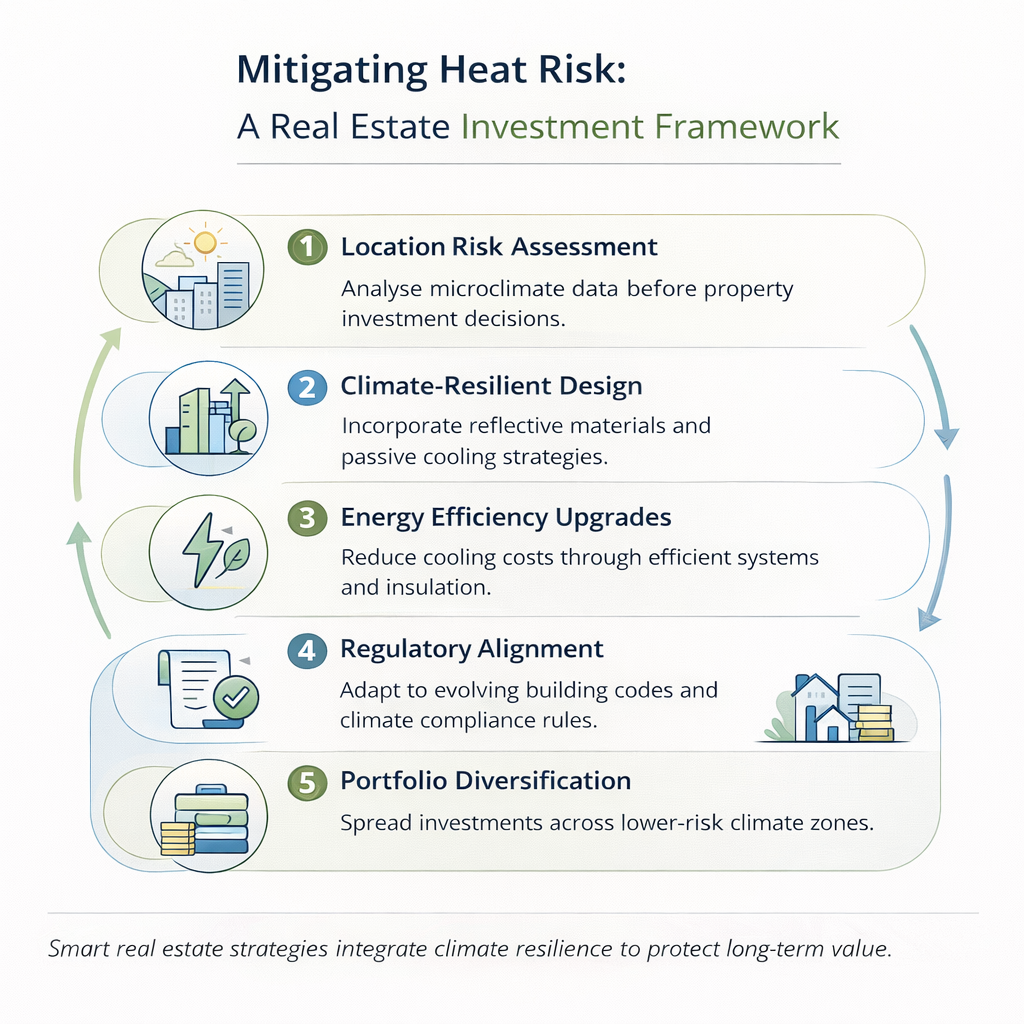
Lenders are also examining building certifications (like LEED or IGBC) for resilience factors—not just efficiency. Buildings with reflective roofs, passive cooling, and green façades are seen as future-proofed and hence more bankable.
Meanwhile, institutional investors managing REITs or urban infrastructure funds are recalibrating their climate exposure models. Some funds are even geo-tagging their portfolios to map urban heat zones and flag high-risk clusters. In global cities like Miami, Bangkok, and Mumbai, these analytics are informing both risk appetite and pricing models.
The good news is that solutions exist and they are increasingly viable. Green infrastructure, from urban forests and rooftop gardens to vertical greenery and cool pavements, can significantly reduce surface temperatures. Some cities, like Seoul and Medellín, have integrated such measures into their master plans with measurable success.
Zoning reforms that mandate minimum tree cover, permeable surfaces, and building orientation are also being introduced. In India, urban missions like AMRUT 2.0 and the Smart Cities Mission now include UHI mitigation in their toolkits.
For real estate developers and municipalities, investing in heat mitigation is no longer just CSR, it’s a cost avoidance strategy. The upfront cost of climate-smart design often pays for itself through lower utilities, improved public health, and higher asset resilience.
While the science of UHI is clear and the solutions are within reach, the bigger challenge lies in translating technical insights into financial models, urban planning decisions, and investment strategies. Today, organizations face three increasingly common barriers:
PG Executive Program in Net Zero Strategy & Sustainability Leadership, offered by IIM Kashipur in collaboration with evACAD, plays a transformative role in such a scenario.
The program is designed for mid- to senior-level professionals who want to bridge the gap between climate intelligence and organizational strategy. Its core strengths include:
For real estate developers, urban planners, financial analysts, or sustainability officers, this program is not just about learning—it’s about future-proofing your career while driving impact at scale.
Urban Heat Islands represent one of the most localized yet overlooked risks in the climate change playbook. Their impact is not theoretical; it’s measurable in degrees, dollars, and human lives. As cities expand and densify, the cost of ignoring UHI will grow exponentially.
For investors, planners, and policymakers, the path forward is clear: recognize heat as a financial risk, and design around it. In doing so, we don't just cool cities, we build value, resilience, and equity into the urban future.


.webp)
.jpg)
.jpg)