
In the face of rising temperatures, extreme weather events, and ecosystem disruption, the world has come to recognize that climate change carries a price. But what is that price, and who pays it?
For economists, the answer lies in a concept known as the Social Cost of Carbon (SCC). It represents the monetary value of the damage caused by emitting one additional tonne of carbon dioxide (CO₂) into the atmosphere. From floods in Bihar to wildfires in California, the SCC is a powerful tool to quantify the climate burden that today’s emissions impose on future generations.
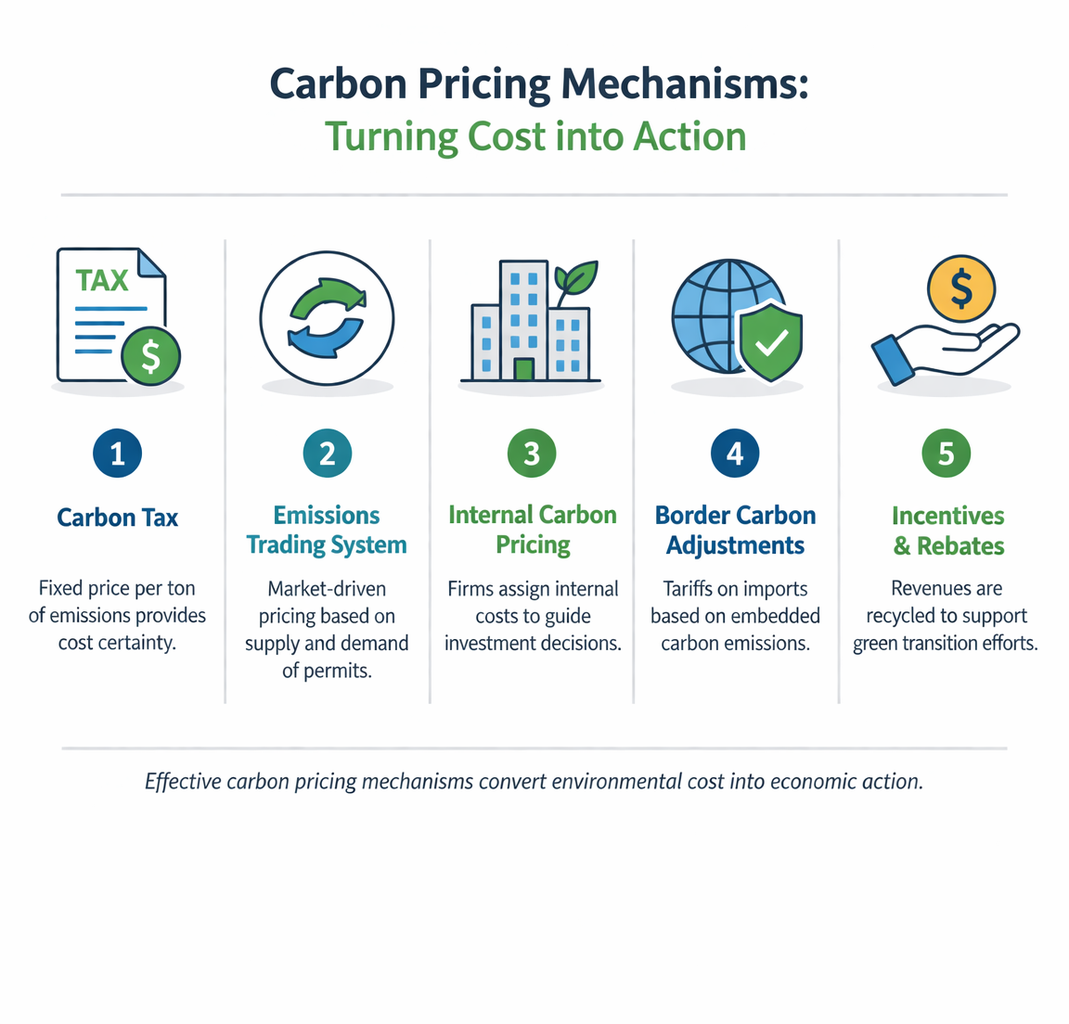
The idea of putting a price on carbon is more than an academic exercise. It is a policy compass. Whether governments are setting a carbon tax, designing cap-and-trade markets, or assessing the return on green infrastructure, the SCC provides a baseline for cost–benefit analysis.
Without pricing emissions, carbon-intensive industries operate in a distorted market, where polluters do not bear the cost of their environmental damage. This results in what economists call a “negative externality.” The SCC aims to internalize this cost, making pollution financially visible and policy-responsible.
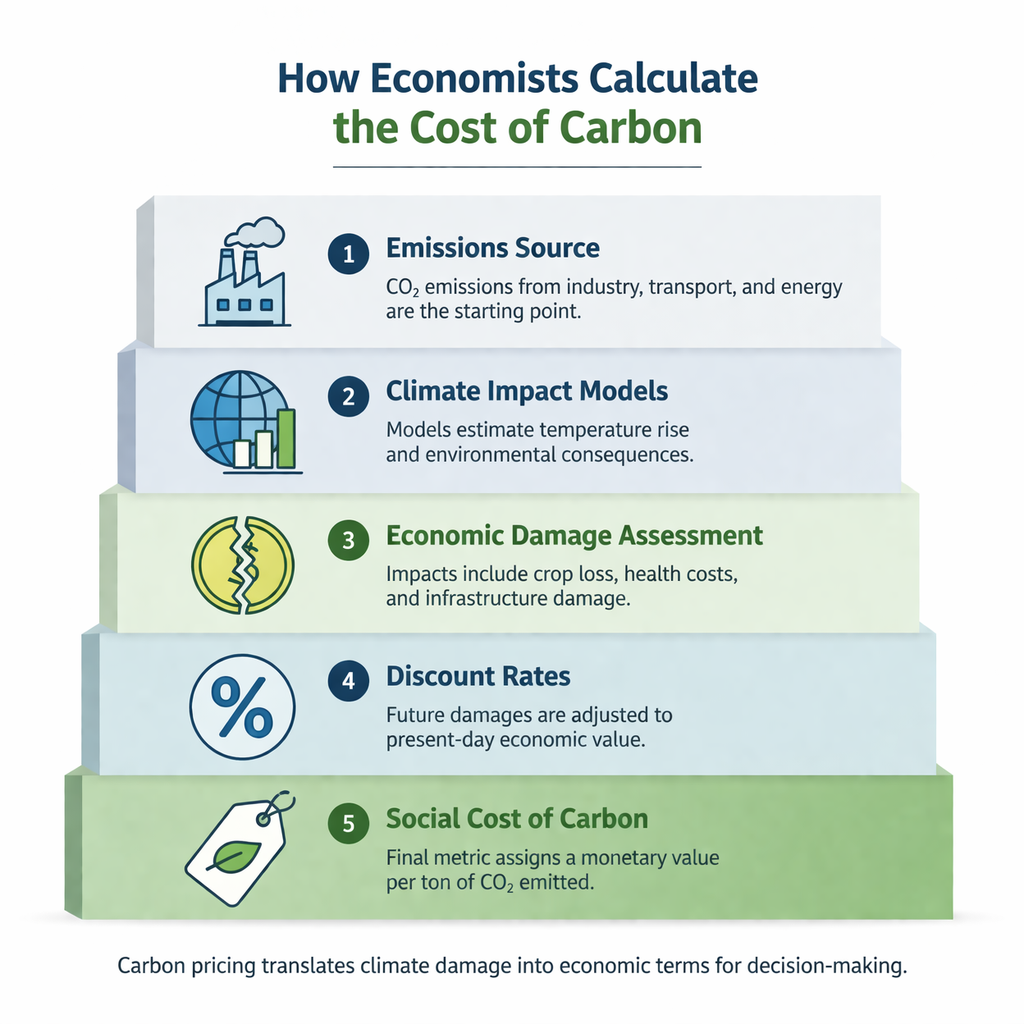
At the heart of carbon pricing are Integrated Assessment Models (IAMs)—mathematical models that combine climate science, economics, and energy systems to estimate the long-term impact of CO₂ emissions.
Three major IAMs have been widely used:
These models work by simulating how increased CO₂ levels affect global temperatures, how those temperatures impact agriculture, health, productivity, and disasters, and how much it would cost societies to adapt or recover. Economists then assign discount rates to bring future damages into today’s currency value.
For example, if emitting one tonne of CO₂ today leads to $100 worth of damages over the next century, and a 3% discount rate is applied, the SCC would reflect a lower present value, perhaps $50 or $60, depending on the model.
However, the assumptions involved, about climate sensitivity, economic growth, adaptation, and inequality, make SCC an inherently political and ethical calculation, not just a technical one.
In the UK, the government and industry often apply “shadow carbon pricing” in evaluating infrastructure and investment projects. While the UK Treasury does not publish a fixed price of £250 per tonne CO₂, industry examples—such as those cited by the UK Green Building Council—illustrate the use of values in that range for decision-making. Independent analyses, like the Grantham Research Institute’s modelling, project a net-zero-aligned shadow price starting at around £50/tCO₂ in 2020, rising to £160–300/tCO₂ by 2050.
In India, there is no officially adopted Social Cost of Carbon, but certain ministries, including Railways and Power, use internal shadow pricing to assess the long-term value of clean energy investments.
Why such variation? Because the SCC is sensitive to three main factors:
These choices reflect deeper philosophical questions: Whose future are we valuing, and how much?
While calculating SCC involves advanced climate economics, implementing it effectively requires leadership that understands both the numbers and the broader net-zero strategy. This is where programs like the PG Executive Program in Net Zero Strategy & Sustainability Leadership by IIM Kashipur in collaboration with evACAD become invaluable.
The program blends academic rigor with real-world application, preparing leaders to design policies and strategies that assist you to understand and improvise the national and corporate climate action plans. Participants explore climate finance, carbon markets, ESG frameworks, and deep-tech solutions—skills that directly influence how SCC values can be used to shape taxation, investment, and sustainability transitions.
By enabling decision-makers who can bridge the gap between economic modelling and practical implementation, IIM Kashipur and evACAD are equipping professionals to navigate one of the most critical questions of our time: How do we put a fair price on human & industrial activity that directly affects the future of our planet?
Despite its technical elegance, the SCC remains a contested figure—especially in emerging economies. Critics argue that:
Thus, while SCC is a critical decision-making tool, it should not become a substitute for climate justice, regulatory action, or climate resilience investments.
“The cost of carbon isn’t just about dollars—it’s about lives, livelihoods, and the legacy we leave behind.”
Putting a price on carbon is not just about market correction—it is about moral accountability. A transparent, robust, and context-sensitive SCC can help governments, companies, and communities make smarter, fairer climate decisions.
As India moves toward building its own carbon markets and sustainable finance frameworks, developing a homegrown Social Cost of Carbon, tailored to its economy and vulnerability profile, could be a pivotal next step.


.webp)
.jpg)
.jpg)