
The Economic Opportunities Driving Carbon Capture Adoption

last updated
April 3, 2026

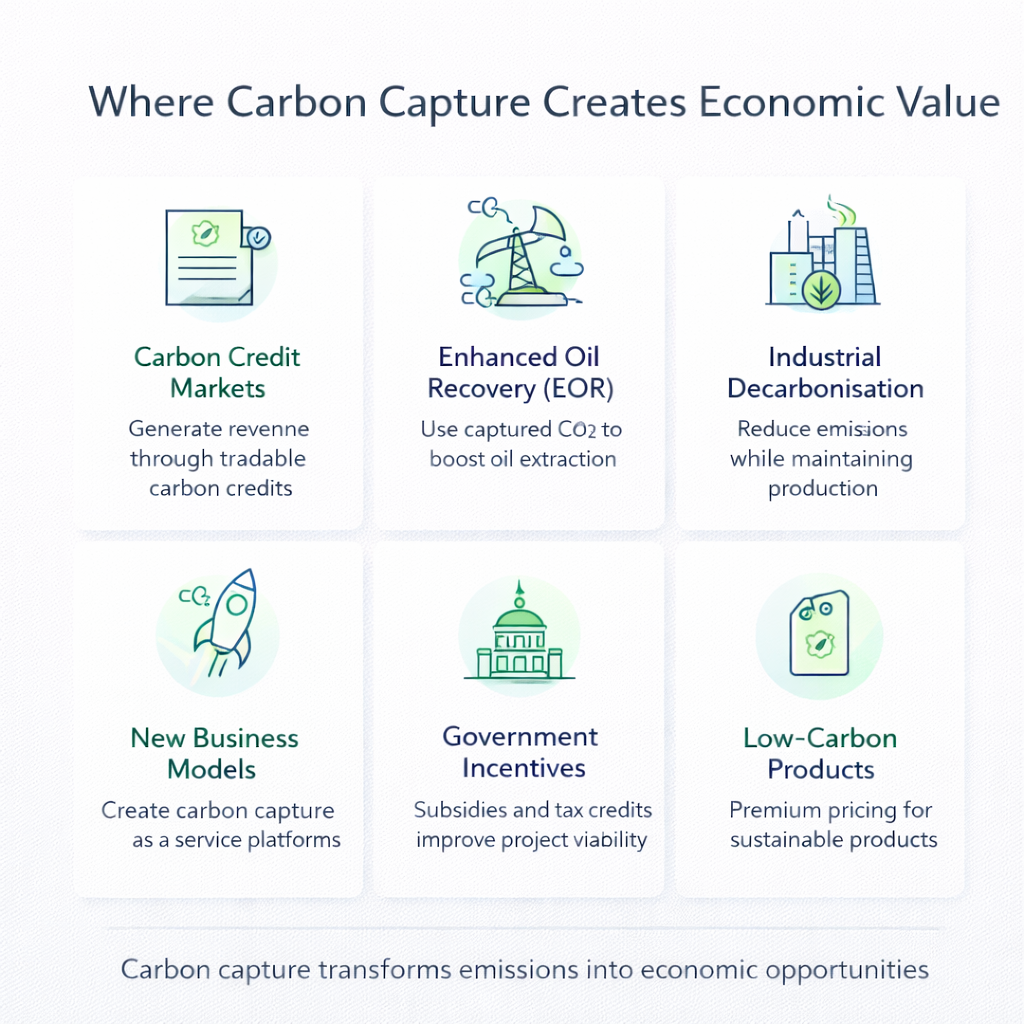
1. Growing Carbon Markets & Credit Incentives

Carbon capture becomes economically viable when industries can monetize stored CO₂ through carbon credits. Companies capturing and permanently storing CO₂ can sell credits to polluting firms looking to offset their emissions.

The global voluntary carbon market is projected to grow from $2 billion in 2022 to $100 billion by 2030, creating new revenue streams for carbon capture operators.

2. Industrial Utilization of Captured Carbon

Instead of simply storing CO₂, companies are now exploring how to recycle and repurpose captured emissions in ways that drive profitability. Some innovative uses include:

  • Building Materials: Injecting CO₂ into concrete during production to strengthen materials while trapping carbon permanently.
  • Consumer Goods: Utilizing carbon-based polymers in packaging and textiles.
  • Synthetic Fuels: Converting captured CO₂ into sustainable aviation fuel or methanol for transportation.

This shift toward a circular carbon economy could transform carbon capture into an essential component of manufacturing, rather than just a compliance cost.

3. Government Incentives & Tax Credits

Countries aiming to meet their climate commitments are launching financial incentives to accelerate carbon capture deployment. Notable programs include:

  • The U.S. Inflation Reduction Act (IRA) – Expanded tax credits provide up to $85per ton of captured CO₂, making carbon capture more profitable.
  • The EU Innovation Fund – Grants aimed at supporting carbon capture pilot projects across industries.
  • The UK’s Net Zero Strategy – Aims to fund carbon capture projects, particularly in industrial hubs like Teesside and Merseyside.

These initiatives reduce the economic risks associated with adoption and ensure businesses remain competitive while integrating sustainability practices.
Looking Ahead: The Road to Commercial Scale

As carbon capture technology moves from research labs to full-scale industrial adoption, the following trends will shape its future:

  • Advancements in AI-driven optimization, direct air capture methods, and modular CCS units will drive down costs.
  • As net-zero policies tighten,companies may have no choice but to integrate carbon capture solutions.
  • With companies like Microsoft,Amazon, and major oil players investing in carbon removal technology,commercial expansion is inevitable.

By 2030, global carbon capture capacity could exceed 1 gigaton per year, creating an economic landscape where sustainability and profitability go hand in hand.

evACAD: Building Skills for a Low-Carbon Economy

To capitalize on this transformation, organizations need talent trained in both carbon management and renewable energy technologies. That’s where evACAD steps in:

Executive Program in Net Zero Strategy & Sustainable Leadership

In partnership with IIM Kashipur,this program empowers professionals to lead net-zero initiatives,implement UN SDGs, and drive policy-aligned business transformation. If evACAD programs bridge academia and industry, empowering professionals to lead the charge in sustainable development, energy innovation, and environmental conservation.

Final Thoughts

Scaling carbon capture is not without its challenges, but the economic opportunities—from carbon credits to sustainable industrial applications—make it one of the most promising pathways to climate and commercial success.

With the right mix of government incentives, infrastructure investment, and skilled talent,CCS can transition from a niche solution to a mainstream pillar of the global green economy.

Carbon Capture as a Catalyst for Climate and Commerce

Carbon capture is rapidly evolving from a climate mitigation tool into a strategic economic lever. As carbon markets expand, industrial applications mature, and government incentives grow more robust, the financial case for carbon capture is becoming harder to ignore. What was once viewed as a costly compliance measure is now emerging as a driver of innovation, investment, and competitive advantage.

The road to commercial scale will require continued policy support, infrastructure development, and technological breakthroughs—but the momentum is building. For forward-looking businesses and governments, carbon capture offers not just a path to net zero, but a chance to lead in the emerging low-carbon economy.

evACAD logo with stylized orange checkmark integrated between letters.
Shape the businesses, policies, and technologies driving Net Zero & Sustainability. Get Started!
Know More
Talk to our advisor today and know more about our Sustainability and Net Zero Program
Four customer service agents wearing headsets working on laptops at a desk in a dimly lit office.
+918031404841
Graphic showing four diverse male portraits connected by orbiting colored dots around a central figure.
Take the Next Step with evACAD
Get Started!

FAQ

How do carbon credits make carbon capture adoption economically viable for industries?

Companies that permanently store CO2 can sell carbon credits to high-emitting firms seeking to offset emissions. With the voluntary carbon market projected to grow from $2 billion in 2022 to $100 billion by 2030, carbon credits create a direct revenue stream that improves the financial case for carbon capture adoption.

What is the circular carbon economy and how does it change carbon capture and storage economics?

The circular carbon economy repurposes captured CO2 into concrete, synthetic fuels, and packaging materials instead of simply storing it. This transforms carbon capture and storage from a compliance cost into a manufacturing input, unlocking new revenue streams and making carbon capture adoption commercially attractive across multiple industries.

How does the US Inflation Reduction Act support carbon capture adoption?

The US Inflation Reduction Act provides tax credits of up to $85 per ton of captured CO2, significantly improving the profitability of carbon capture and storage projects. This makes carbon capture adoption financially viable for a wider range of industries, reducing investment risk and accelerating deployment at commercial scale.

What industrial applications are emerging within the circular carbon economy?

Captured CO2 is being used to strengthen concrete, produce synthetic aviation fuels, and create carbon-based packaging polymers. These applications embed carbon capture and storage into core manufacturing processes, driving carbon capture adoption beyond niche compliance use toward mainstream industrial integration in the low-carbon economy.

What is the projected scale of carbon capture and storage capacity by 2030?

Global carbon capture and storage capacity could exceed 1 gigaton per year by 2030, driven by tightening low-carbon economy policies, expanding voluntary carbon market demand, and rising corporate investment from companies like Microsoft and Amazon accelerating large-scale carbon capture adoption globally.

Talk to Advisor over call
Blue upward arrow inside a white circle with a blue border.