
Shipping in the Tempest: Climate Change’s Impact on Maritime Transport and Trade Routes

last updated
April 3, 2026

Global trade has long sailed on the stability of ocean routes. With 80% of world trade carried by sea, the maritime sector is the backbone of the global economy, connecting continents, fueling supply chains, and shaping geopolitics.

But that backbone is now under strain. As climate change intensifies, the world’s shipping lanes, ports, and maritime infrastructure face mounting physical, operational, and financial risks. The age of “seaborne certainty” is giving way to a new era of climate volatility on water.

From sea-level rise threatening port infrastructure to warming waters disrupting cargo efficiency, the shipping industry is navigating a multidimensional crisis. And it’s not just the environment at stake; it’s the cost of trade, insurance, logistics planning, and even global food and fuel security. For investors, insurers, and national governments, the climate-proofing of maritime systems is becoming a strategic priority.

The Physical Impacts of a Warming Ocean

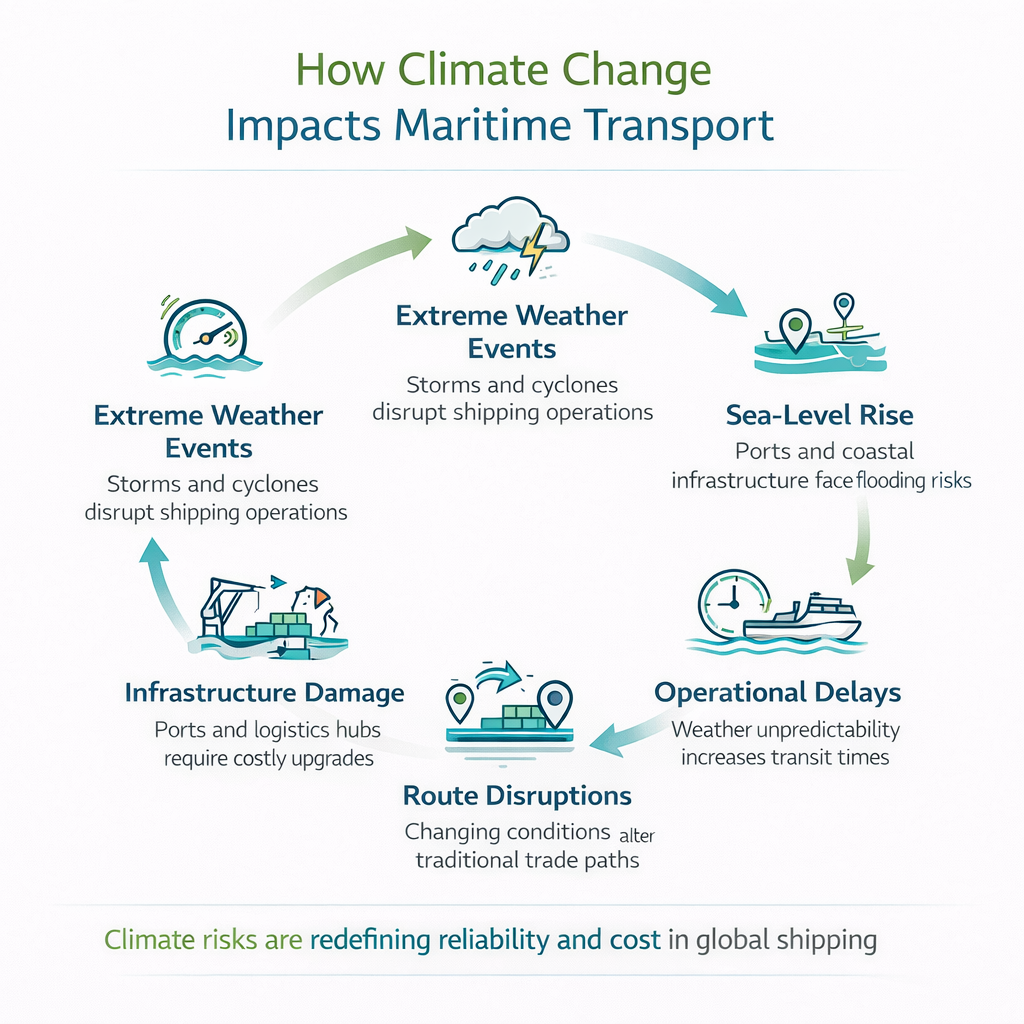
The most visible threat is rising sea levels. Ports in low-lying cities, Mumbai, Rotterdam, Miami, and Shanghai, are at risk of flooding, storm surge, and saltwater intrusion. Since these ports are critical nodes in global supply chains, disruption here reverberates across continents.

Then comes extreme weather. More intense hurricanes and typhoons are damaging ships, delaying cargo, and raising insurance premiums. Shifting ocean currents and increased precipitation are affecting navigability and port accessibility. Heatwaves and rising seawater temperatures reduce engine efficiency, making certain shipping routes less fuel-efficient and more polluting.

Even changes in wind patterns and Arctic ice melt are shifting trade dynamics. The Northern Sea Route across the melting Arctic promises shorter transit times between Europe and Asia, but brings new hazards, insurance uncertainties, and geopolitical tensions.

Ports and Infrastructure at Risk

Unlike ships, ports are fixed assets; they cannot reroute. Their vulnerability to climate risk is therefore particularly acute.

A 2022 report by the International Association of Ports and Harbors (IAPH) found that nearly two-thirds of ports had experienced climate-related disruptions in the past five years.

Key challenges include:

  • Flooding of terminals and access roads
  •  Increased maintenance costs from corrosion due to higher sea levels
  • Disruption of port-linked infrastructure, like railways and pipelines
  • Congestion due to weather-induced closures or capacity limits

For exporters and importers, these risks increase logistics uncertainty and costs. For port authorities and governments, they demand billions in adaptation investments—from seawalls and drainage systems to digital climate monitoring infrastructure.
Cost Transmission and Insurance Implications

As climate volatility hits shipping schedules and infrastructure, costs per container are rising. Freight rates are no longer shaped only by fuel prices or demand cycles, but also by climate delays, rerouting, and insurance surcharges.

Marine insurers are rebuilding their risk models to factor in climate disruptions. Routes prone to cyclones (Bay of Bengal, Gulf of Mexico) are facing higher premiums, while vessels operating in polar waters face strict environmental compliance and liability regimes.

Adding to this, the International Maritime Organization (IMO) is enforcing stricter decarbonization standards. Ships are now rated on their carbon intensity, with direct consequences for port access and compliance status. For fleet owners and logistics managers, this means strategic redesign of routes and investments in low-emission technologies.

Trade Route Realignment: Winners and Losers

Climate change is reshaping the geography of trade:

  • Suez Canal: Increased sedimentation and heat stress affect transit speed.
  • Panama Canal: Droughts reduce freshwater availability, limiting vessel draft and traffic.
  • Arctic routes: Faster but environmentally risky and geopolitically contested.
  • Inland rivers (Rhine, Ganges): Facing both droughts and floods, making navigation unreliable.

These dynamics may alter global trade flows—creating winners and losers. For instance, India has a strategic interest in climate-proofing major ports under the Sagarmala Programme, while exploring green hydrogen shipping corridors.

Building Resilience at Sea

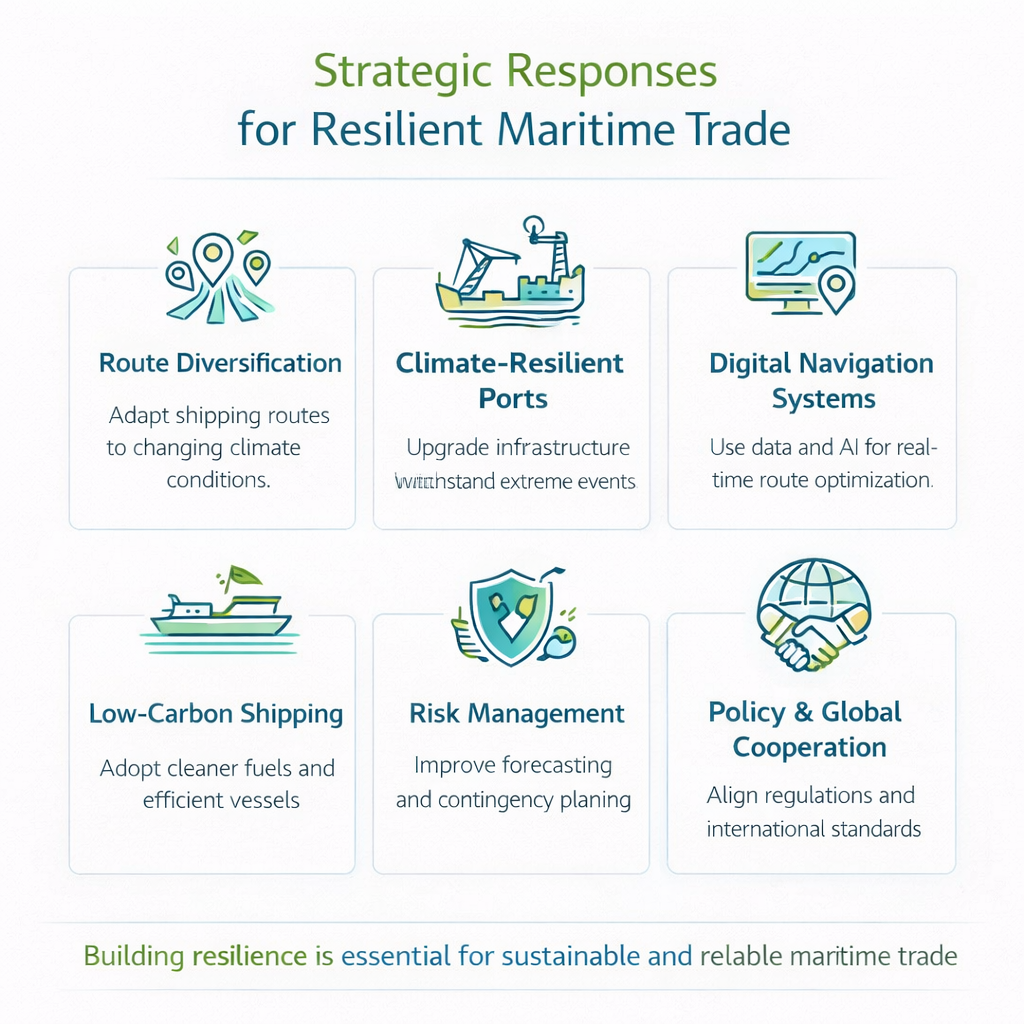
The shipping industry is fighting back with both adaptation and innovation. Leading ports are investing in:

  • Climate-resilient infrastructure – elevated terminals, early warning systems, advanced dredging
  • Green port technologies – shore power, electrified cargo handling, rainwater harvesting
  • Digital twins & satellite data – predictive logistics and weather-smart routing
  • Public–private finance models – unlocking funds for adaptation in vulnerable regions

Meanwhile, shipping companies are decarbonizing fleets through biofuels, green ammonia, wind-assisted propulsion, and retrofitting. Maritime finance is evolving, too, with sustainability-linked loans tied to emission metrics.

The shipping industry has always been a symbol of global connectedness. But today, that very connectedness makes it vulnerable to the climate crisis.
Navigating Climate Risk with Strategy

The maritime climate crisis is not just an engineering challenge; it’s a leadership challenge. Global trade now demands decision-makers who can translate climate risk into resilient strategies, combining insights from science, finance, and policy.

Our PG Executive Program in Net Zero Strategy & Sustainability Leadership by IIM Kashipur, in collaboration with evACAD provide you with the right knowledge to tackle such issues in this industry.

Why it matters for maritime & trade professionals:

  • Learn to integrate climate analytics with financial risk models for shipping and logistics.
  • Gain expertise in ESG, green finance, hydrogen, and carbon markets, tools shaping maritime decarbonization.
  • Work on real-world case studies covering port resilience, shipping emissions, and trade route redesign.
  • Earn the prestige of IIM Kashipur Executive Alumni status and join a high-impact leadership network.
  • Position yourself at the frontline of climate-smart global trade leadership.

Final Word

Sea routes are no longer neutral; they are strategic climate corridors. Their viability depends on foresight, sustainability leadership, and global cooperation.

In a century of stormier seas, success won’t come to those waiting for calm waters; it will come to those who adapt their sails. And the time to climate-proof maritime trade is now.

evACAD logo with stylized orange checkmark integrated between letters.
Shape the businesses, policies, and technologies driving Net Zero & Sustainability. Get Started!
Know More
Talk to our advisor today and know more about our Sustainability and Net Zero Program
Four customer service agents wearing headsets working on laptops at a desk in a dimly lit office.
+918031404844
Graphic showing four diverse male portraits connected by orbiting colored dots around a central figure.
Take the Next Step with evACAD
Get Started!

FAQ

How is climate change directly threatening port infrastructure and maritime transport globally?

Rising sea levels, storm surges, and saltwater intrusion are placing port infrastructure in cities like Mumbai, Rotterdam, and Shanghai at serious flood risk. Since these ports are critical nodes in maritime transport, climate-related closures and congestion cascade across global supply chains, raising logistics costs and demanding billions in adaptation investment from port authorities and governments.

How is climate volatility affecting marine insurance and freight costs in global trade routes?

Climate disruptions are driving up freight rates beyond traditional fuel and demand factors. Marine insurance models are being rebuilt to account for cyclone-prone corridors such as the Bay of Bengal and Gulf of Mexico, resulting in higher premiums. Maritime transport operators face mounting surcharges for rerouting and weather delays, making climate risk a core financial variable in global trade routes planning.

What is the IMO decarbonization agenda, and how does it affect shipping operations?

The IMO decarbonization framework requires ships to meet carbon intensity ratings, with direct consequences for port access and regulatory compliance. Fleet owners and logistics managers must redesign routes and invest in low-emission technologies, including biofuels, green ammonia, and wind-assisted propulsion. Failure to comply with IMO decarbonization standards increasingly affects a vessel's commercial viability and marine insurance eligibility.

How are Arctic shipping routes changing global trade route,s and what risks do they introduce?

Melting Arctic ice is opening Arctic shipping routes that offer shorter transit times between Europe and Asia, presenting a potential shift in global trade routes. However, these corridors introduce new hazard,s including unpredictable ice conditions, limited search-and-rescue infrastructure, rising marine insurance costs, and unresolved geopolitical tensions, making Arctic shipping routes commercially promising but operationally and strategically complex.

What strategies are leading ports and shipping companies adopting to build climate-resilient shipping capacity?

Leading ports are investing in elevated terminals, early warning systems, and digital twin technology for weather-smart routing to build climate-resilient shipping operations. Shipping companies are pursuing IMO decarbonization goals through fleet retrofitting and green fuels. Public-private finance models and sustainability-linked loans tied to emission metrics are also emerging as key tools to fund maritime transport adaptation across vulnerable regions.

Talk to Advisor over call
Blue upward arrow inside a white circle with a blue border.