
With the rapidly evolving corporate decarbonization and the demand for clean energy, storage has become a strategic resource for organizations. The growing range of Energy Storage technologies available to companies dramatically changes how organizations manage power reliability, integrate renewable energy sources, and optimize energy costs. More importantly, the choice between grid-scale and behind-the-meter (BTM) storage is often complex and context-dependent.
Corporate energy administrators should consider relooking former procurement practices and consider how diverse storage designs affect long-term competitive positioning. The difference between the two is going to be fundamental for effective decision-making for companies on the road to sustainable transformation.
This article aims to help evaluate the operational, financial, and strategic parameters that differentiate grid-scale storage from behind-the-meter systems.
Grid-scale storage systems are large energy storage systems linked to the power transmission and distribution systems. They stabilise the grid by absorbing excess electricity during low-demand periods and discharging it during high-demand periods. The IEA predicts that the volume of stored electricity globally for grid-scale storage systems will increase considerably as more renewable energy sources and reliable grids are required.
These systems are increasingly crucial for encouraging the integration of renewable energy sources, particularly for addressing the power generation bursts and shortfalls caused by wind and solar. Grid-scale storage systems mitigate the extremes of generation across regions. Through their integration into the grid, large corporate electricity consumers benefit indirectly by reducing generation and transmission curtailments, lowering total system costs, and enhancing transmission grid reliability.
Grid-scale storage systems also provide essential ancillary services of frequency regulation and voltage control, stability, and reserve capacity, which are required by all modern power systems. They are often crucial to the everyday operations of companies that rely heavily on continuous operations, including data centres and high-energy-use manufacturing processes, even if they do not own the storage facilities.
Nevertheless, grid-scale storage is, in most instances, a product of utility firms or independent power producers. Consequently, corporate end-users rarely get to design and tailor the system to their specifications. They only get to participate in various market mechanisms, such as improved power quality, differential pricing during peak periods, demand response, and lower tariff rates.
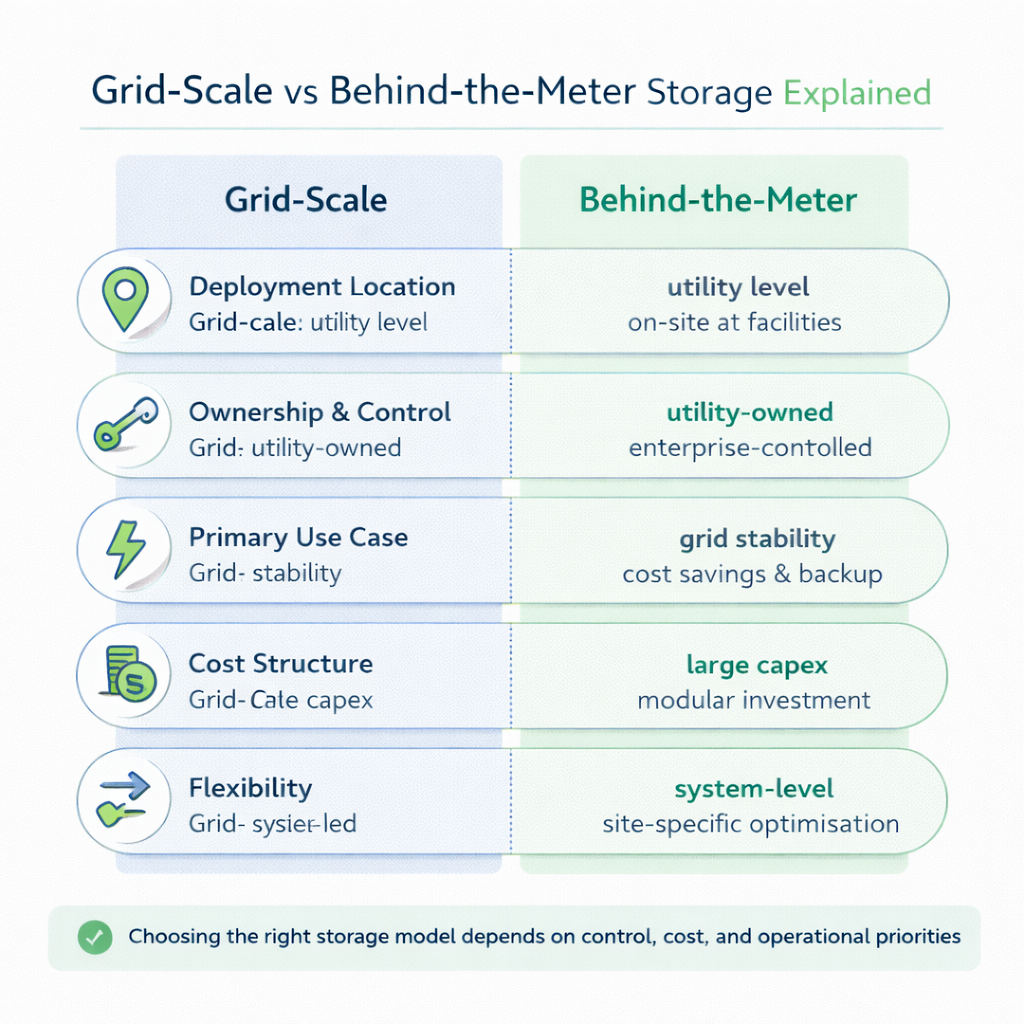
From the consumer's standpoint, behind-the-meter storage systems are storage capacity installed at the consumer's end. Such systems allow businesses to store electricity for later use during peak tariff periods, power outages, or periods of renewable energy supply variability. BTM systems have been adopted to mitigate costs, but mainly to enhance operational resilience.
For instance, a commercial facility equipped with solar panels can also pair them with BTM batteries to use the stored energy when it is most needed. This reduces reliance on the grid while protecting the facility from costs associated with peak energy demand conflicts. The U.S. Department of Energy notes that adoption of behind-the-meter batteries is increasing as a result of declining costs for enabling technologies and firms' desire to decarbonize their operations.
For BTM storage systems, the first significant benefit is that it provides control over energy use on-site and increases energy independence. The second significant benefit is that it gives a measure of resilience during outages or when the grid supply is unstable. The third is enabling the firm to achieve some of its sustainability goals by maximizing the consumption of renewables for its operations.
For corporate energy managers, behind-the-meter systems present ways to manage and even mitigate demand charge costs. Many commercial power providers charge significant amounts when customers reach a specific peak demand level. BTM batteries help flatten these demand peaks and save significant operational costs over time.
Specific financial considerations, operational simplicity, and sustainability policies primarily drive the decision between grid-scale and BTM storage. While grid-scale storage contributes to system-level resilience and renewable energy provision, it is not explicitly designed for the operational needs of particular facilities. On the other hand, behind-the-meter storage provides facility-level optimization, but usually comes at the cost of capital and operational resources.
For companies in sectors such as pharmaceutical manufacturing, financial services, and semiconductors that are highly focussed on reliability, BTM systems are often preferred for the guaranteed local backup they provide. Hybrid strategies that optimize on-site autonomy and grid-scale benefits are more common in distributed facility networks.
Behind-the-meter is likely to provide faster payback in the presence of time-of-day tariffs, net metering, well-developed energy market participation, and other flexible market structures. Conversely, in regions with rapid growth in renewable energy sources and increased system unpredictability, grid-scale energy storage is more relevant.
Professionals studying the impacts of regulatory environments on businesses in the renewable energy sector are gaining insight into grid adaptability, tariff design, and the design of ancillary services, which are increasingly becoming crucial for the next generation of energy practitioners.
New lithium-ion batteries, flow batteries, and hybrid inverter designs are improving cost mitigation and simplification of corporate storage technology. According to the National Renewable Energy Laboratory, new battery chemistry and longer cycle lifetimes are already enhancing the economics of grid-scale and behind-the-meter technologies.
Automation and artificial intelligence are streamlining dispatch models and forecasts. Predicting peak demand with greater accuracy and integrating back-of-the-meter systems with distributed solar and electric vehicle fleets has become the new standard.
Going forward, future investments in energy storage systems require a design strategy that accounts for lifecycle costs, system degradation, and end-of-life management. The shift towards circularity in the battery supply chain and corporate battery systems as part of corporate strategy for energy supply is increasingly emphasized in corporate sustainability and sustainability leadership programs.
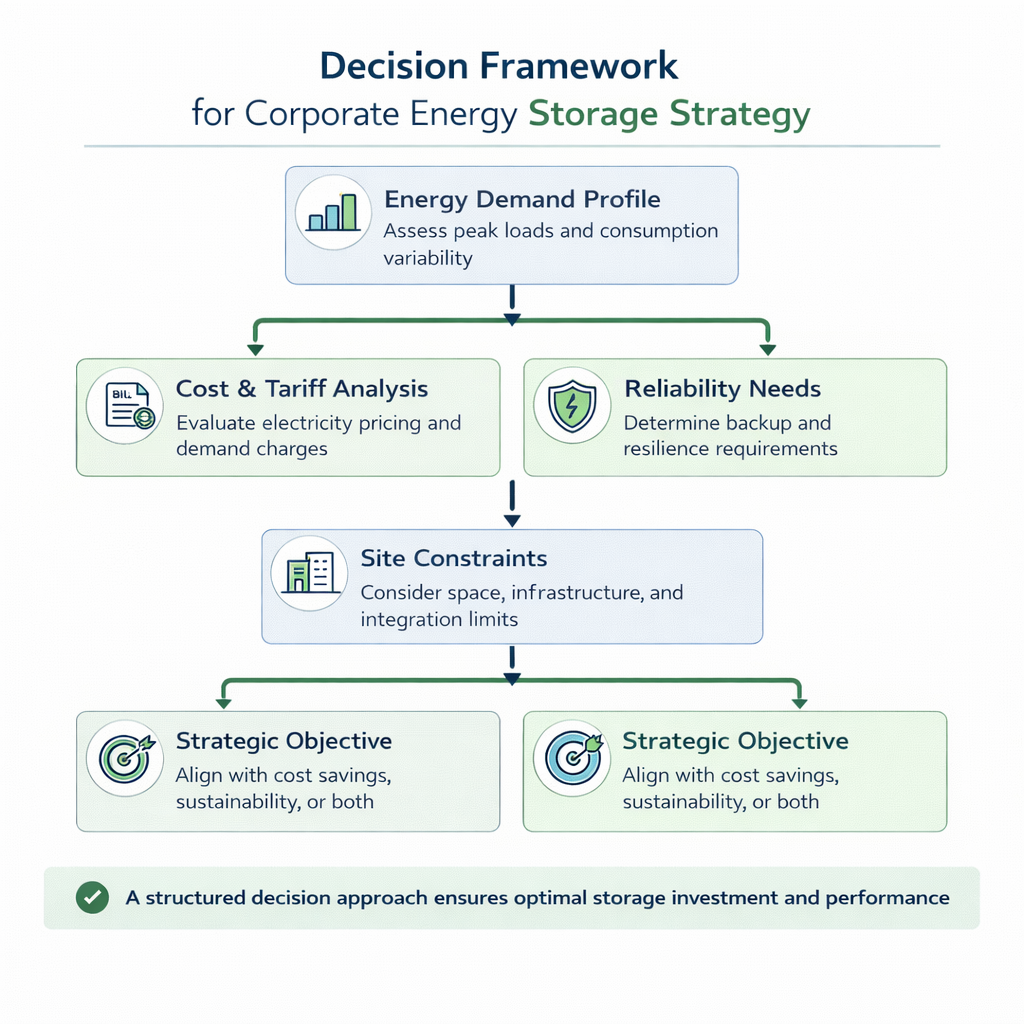
Understanding the impacts of demand peaks, outages, and renewable generation profiles is the first important step in load analysis for corporate energy managers. Cost savings are tied to geographical energy prices, so analyzing tariff structures is also an important step.
Second, companies need to determine the level of resilience required. If facilities have substantial downtime costs, it may be necessary to include behind-the-meter storage to ensure business continuity. Considering sustainability goals, it is essential to consider the level of support for renewables from the storage system and long-term decarbonisation pathways as well.
Policy is another crucial factor organisations need to consider. Storage economics are strongly influenced by incentives, market reforms, and efforts in grid modernisation which corporate leaders must account for.
Both behind-the-meter and grid-scale storage have significant potential for corporate energy transformation. Each organisation must determine the appropriate strategy to adopt based on its operational requirements, energy cost parameters, and sustainability objectives. Companies that harness the right combination of storage systems will be better equipped to provide reliability, achieve cost savings, and lead in climate action as the transition to clean energy becomes central in this decade.
If your team is looking to deepen its understanding of energy strategy, decarbonisation pathways, and cutting-edge storage technology, consider evACAD's specialised programs and courses designed to orient future corporate energy leaders.


.webp)
.jpg)
.jpg)